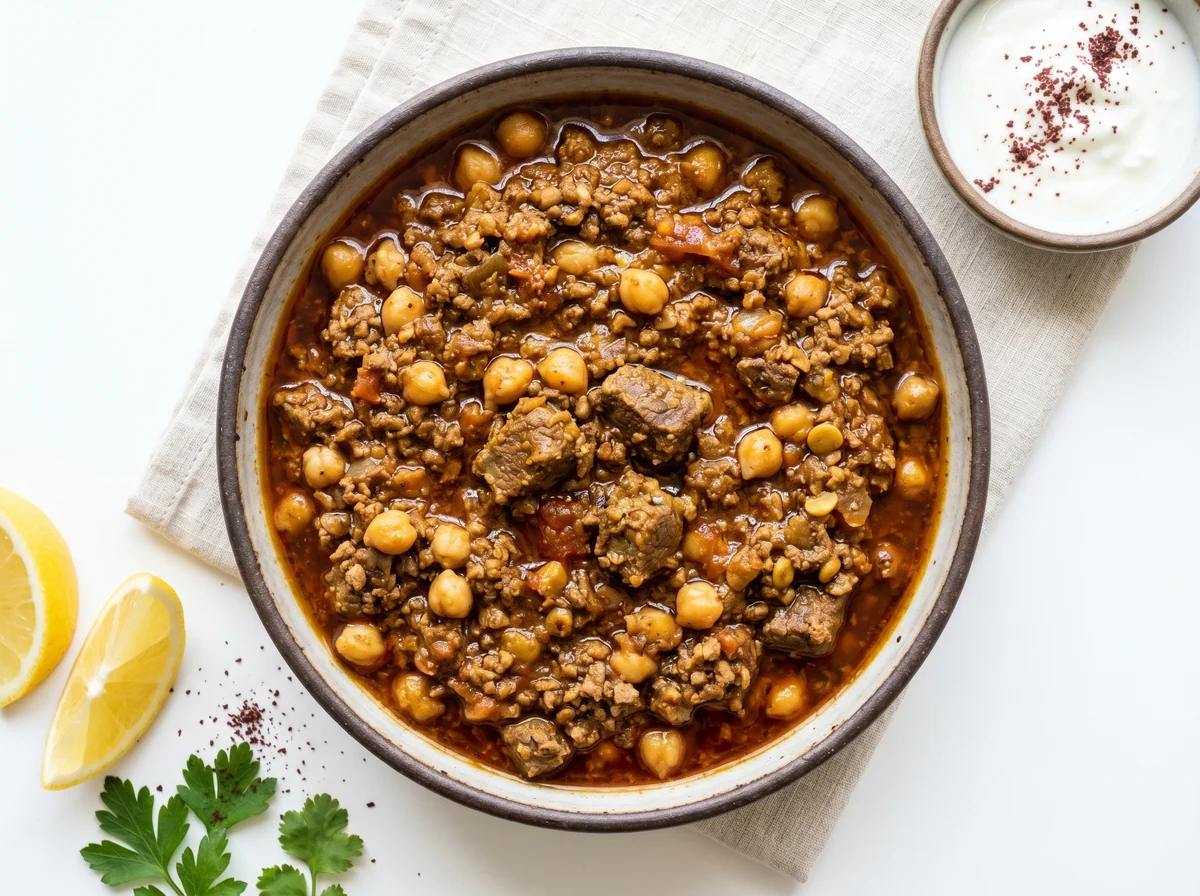
A treasured Iraqi heritage dish — very finely ground meat and chickpeas slow-cooked in a spiced tomato sauce into a thick, smooth stew. Famous as the Ashura dish, served over rice, low glycemic load, and free from common allergens.
Qeema (also called geema, pronounced gima) is a famous Iraqi heritage dish built on very finely ground meat and chickpeas slow-cooked in a spiced tomato sauce until they become a thick, smooth stew. Qeema is deeply associated with Ashura and the commemoration of the martyrdom of Imam Hussein at Karbala, when it is cooked in enormous pots (at processions and husainiyas) and distributed as votive offerings and charity to the people — a deeply rooted tradition in Iraq and parts of the Gulf. It is also cooked for celebrations and at home.
What distinguishes it is the very finely ground meat (ground twice) and its thick, smooth, homogeneous texture. It is served over white rice. The rich flavor of chickpeas, meat, and spices and its association with Ashura and generosity have made it a deeply cherished Iraqi dish — a symbol of heritage, celebration, and charity.
Preparation Steps
Cook the chickpeas
Cook the soaked chickpeas in water until completely tender (mash some of them for a thicker texture). Chickpeas are an essential ingredient in qeema (they give it body and nutritional value), so cook them through until soft. Set aside.
Prepare the finely ground meat
Fry the grated onion in ghee until soft, then add the very finely ground meat and stir, breaking it up constantly. Qeema is distinguished by its very finely ground meat (ground twice or passed through a mincer) so the texture becomes smooth and homogeneous rather than chunky.
Add the spices and tomato
Add the tomato paste, Iraqi baharat (Gulf spice blend), cinnamon, salt, and pepper, and stir until the paste starts to fry and deepen slightly in color. Frying the tomato paste deepens its flavor and color, and the Iraqi baharat (Gulf spice blend) (with cinnamon) gives qeema its distinctive warm fragrance.
Slow simmer
Add the cooked chickpeas and water, then leave the qeema to cook slowly over low heat until thickened and the meat, chickpeas, and sauce meld together into a cohesive stew (about one hour), stirring periodically. Long, slow cooking creates a smooth, thick, homogeneous texture — the secret to great qeema.
Adjust the consistency
The qeema should become a thick, smooth stew (not watery and not dry), deep reddish-brown from the tomato. Mash some of the chickpeas for an even smoother texture, and add hot water if it gets too thick. Taste and adjust salt and spices.
Serve
Serve the qeema hot over white rice (or Iraqi spiced rice) or with bread. This is a famous Iraqi heritage dish particularly associated with Ashura and the commemoration of Karbala (cooked in large quantities and distributed as votive offerings and charity). It is also cooked for celebrations and at home. Its smooth, thick texture and the rich flavor of chickpeas, meat, and spices are a delight — a symbol of authentic Iraqi cuisine, its generosity, and its traditions.
Blood Sugar Impact
The glycemic index (GI) measures how quickly a food raises blood sugar, while the glycemic load (GL) measures how much a full serving raises it. Together they give the complete picture.
Glycemic Index
GI
26Low
Low0–55Medium56–69High70+
A low value (≤55) means a gradual rise in blood sugar — the most suitable range for diabetes and insulin resistance.
Glycemic Load
GL
5Low
Low0–10Medium11–19High20+
Glycemic load reflects the impact of the full serving. To lower it: take half a serving, or pair the recipe with a source of protein and fiber.
Nutritional Information
Per ServingMakes 6 servings · one serving is about 165 g of raw ingredients
Calories395 kcal20%of Daily Value*
Protein21 g42%of Daily Value*
Carbohydrates25 g9%of Daily Value*
Fat24 g31%of Daily Value*
Fiber7 g25%of Daily Value*
Sodium77 mg3%of Daily Value*
Potassium718 mg15%of Daily Value*
Phosphorus267 mg21%of Daily Value*
* Percent Daily Values are based on a 2,000-calorie diet per FDA food-label reference values — your daily needs may be higher or lower. Values are derived from the recipe's ingredients via the USDA database.
Troubleshooting
The most common problems when preparing Iraqi Qeema (Spiced Meat and Chickpea Stew), and how to fix them:
The meat is chunky, not smooth
Not ground finely enough. Qeema's signature is very finely ground meat — use meat that has been minced twice (or passed through), and break it up constantly during frying. Long, slow cooking also smooths the texture.
Thin and watery
Too much water or it has not reduced. Cook the qeema slowly until thickened (the excess evaporates), or mash some of the chickpeas (this thickens it). Qeema is a thick stew, not a soup — let it reduce.
Dry or burning on the bottom
Heat too high or not enough liquid. Cook on low heat with regular stirring (it will stick and scorch on high heat), and add hot water if it dries out before the stew is done. Low heat and stirring prevent burning.
Bland flavor
Not enough spices or the tomato paste was not fried. Fry the tomato paste (it deepens the flavor), and add enough Iraqi baharat (Gulf spice blend) and cinnamon, and adjust the salt. Frying the paste and the spices are the foundation of qeema's flavor.
The chickpeas are still firm
Not soaked long enough or not cooked through. Soak the chickpeas overnight (or use canned) and cook until completely tender before adding them. Firm chickpeas will not soften in the sauce in a short time.
Storage and Make-Ahead
Refrigerator (4°C)
Qeema keeps in an airtight container in the refrigerator for 3 to 4 days and its flavor improves (like all stews). Reheat on low heat with a splash of water (it thickens when refrigerated). Practical for weekday meals over rice.
Freezer
Freeze for two to three months in an airtight container (it freezes excellently). Thaw and reheat with a little water. Very practical (large batches are cooked during Ashura and frozen in portions).
Advance preparation
An ideal dish to prepare in advance (it improves the next day and the slow cooking already takes time). Prepare it a day before the occasion and reheat. Cook a large batch and freeze portions for future meals or occasions.
Food safety
Cook the meat and chickpeas until fully done, cool the qeema quickly, do not leave it at room temperature for more than two hours, and reheat thoroughly (especially when distributing large quantities at occasions).
Tested Ingredient Substitutions
Original Ingredient
Tested Substitute
Ratio
Flavor Difference
Lamb/beef
Lean ground meat
same amount
Lean meat reduces saturated fat while preserving protein and flavor; qeema is traditionally made with lamb or beef
Ghee
Vegetable oil or less ghee
as desired
Reduces saturated fat; ghee is a traditional flavor, but a small amount or oil is a lighter substitute
Serving over white rice
Brown rice, bread, or a smaller portion
as desired
The stew itself is low glycemic load; white rice raises it — brown rice or a moderate portion is healthier
How Much Does It Make? Scaling Guide
Number of servings
Meat
Chickpeas
Tomato paste
3 (small)
250 g
1/2 cup
1.5 spoons
6 (base)
500 g
1 cup
3 tbsp
12 (occasion)
1 kg
2 cups
6 tbsp
EEINA Nutrition Tip
Qeema is a relatively balanced dish: the meat is protein, and the chickpeas are plant protein and fiber (lowering the glycemic index and keeping you full), while the glycemic load is low. The slow cooking does not require much frying. The challenges are saturated fat (meat and ghee), sodium (tomato paste and salt), and that it is served over white rice (which raises the load). For a better version: use lean meat, increase the chickpeas (fiber and protein), reduce the ghee, adjust the salt, and serve with moderate rice or brown rice. The stew itself is healthy and balanced — watch the rice quantity and fat.
Add This Recipe to Your Plan
The EEINA app saves your favorite recipes, calculates them from their real ingredients, and shows your daily numbers toward your goal. Try it free now.
An Iraqi dish of very finely ground meat and chickpeas slow-cooked in a spiced tomato sauce into a thick, smooth stew, served over rice. Particularly associated with Ashura (cooked in large quantities and distributed as votive offerings and charity), it is also cooked for celebrations and at home. Its smooth texture and rich flavor of chickpeas, meat, and spices are distinctive.
Why is qeema associated with Ashura?
During Ashura and the Karbala commemoration, qeema is cooked in enormous pots at processions and husainiyas and distributed as votive offerings and charity to the people — a deeply rooted tradition in Iraq and parts of the Gulf, observed to mark the occasion and feed others. It has become a symbol of the occasion, generosity, and charity — people gather to cook and distribute it — though it is also cooked outside Ashura.
What gives qeema its distinctive texture?
The meat is very finely ground (minced twice or passed through), so no chunks of meat appear — instead the texture is smooth and homogeneous. The cooked chickpeas (some mashed) also thicken it, and the long, slow cooking produces a thick, smooth stew. This smooth, thick texture distinguishes it from ordinary ground meat stews.
Is qeema healthy?
Relatively balanced: meat provides protein, and chickpeas provide protein and fiber (lowering the glycemic index and keeping you full), with a low glycemic load. The challenges are saturated fat, sodium, and serving over white rice. Use lean meat, increase the chickpeas, reduce the ghee and salt, and serve with moderate or brown rice. The stew itself is healthy — watch the rice and fat.
Sources: University of Sydney · Gulf GSO · Our methodology · Updated on