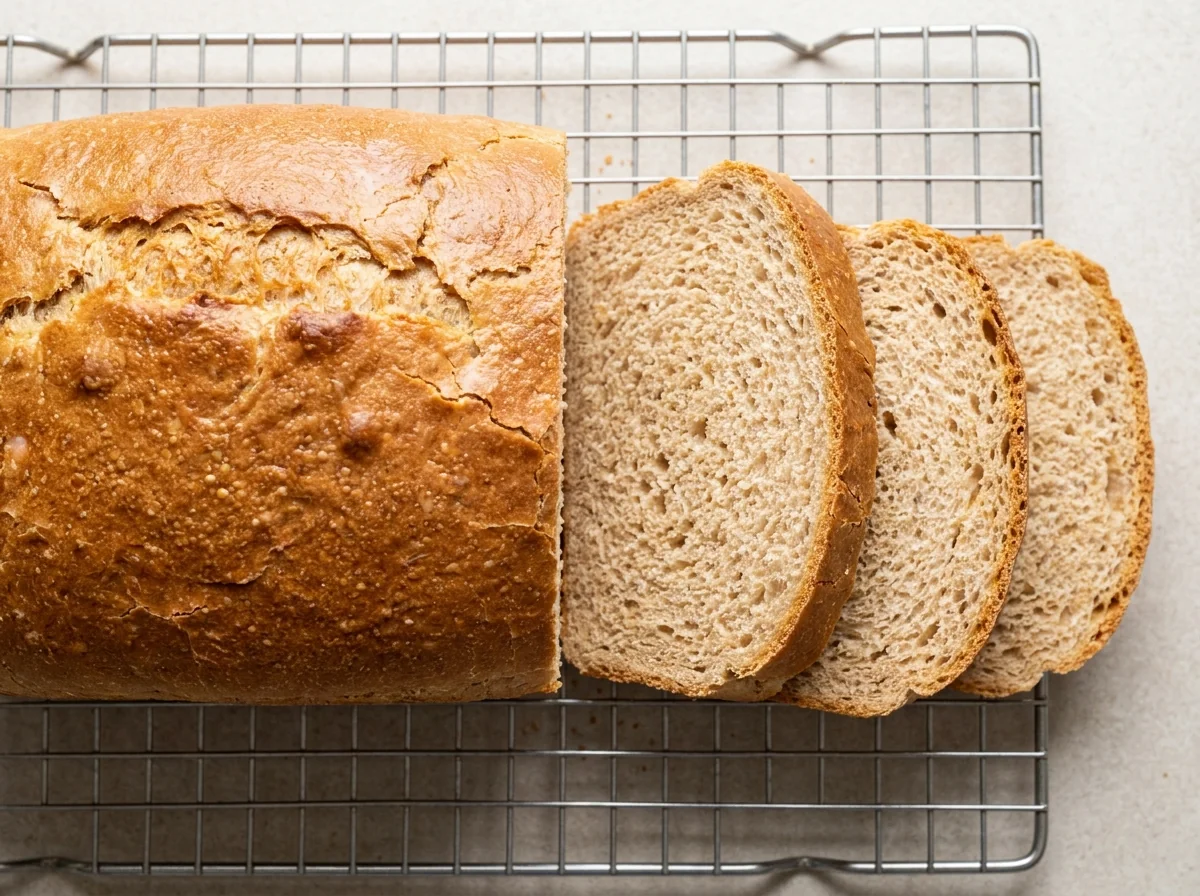
Homemade toast bread is the weekend project that frees the house from the shelf of industrial bread.
A brown pan loaf with seven ingredients you know every one of, with no improvers or preservatives, that the house breakfasts on for a whole week.
Preparation Steps
Knead the toast dough long
Mix both flours, the yeast, sugar, and salt, add the warm milk and water and knead for five minutes, then add the softened butter and knead ten more minutes until it becomes a supple dough that stretches into a thin membrane without tearing. This is the famous windowpane test that guarantees cottony slices.
First rise
Cover it in a greased bowl for an hour and a quarter until it doubles, as whole wheat in the dough asks for a little more patience than pure white.
Shape the loaf-pan cylinder
Gently knock out its air and flatten it into a rectangle the width of the loaf pan, roll it into a tight cylinder and seal its ends, then settle it into the greased pan seam-side down.
Second rise to the rim of the pan
Cover it for forty minutes until its dome rises a finger above the rim of the pan. This risen dome is the classic toast shape to come.
Brush and bake
Brush the top with milk and bake in an oven preheated to 190 degrees for thirty-five minutes until deeply golden and it sounds hollow when you tap its base. The bread-doneness gauge that never lies.
Cool it fully before the first slice. The hardest vow
Take it out of the pan right away onto a rack and let it cool for a full hour however its scent tempts you. Slicing it hot mashes its crumb into dough, while cooled it slices into even toast slices worthy of the toaster.
Blood Sugar Impact
The glycemic index (GI) measures how quickly a food raises blood sugar, while the glycemic load (GL) measures how much a full serving raises it. Together they give the complete picture.
Glycemic Index
GI
63Medium
Low0–55Medium56–69High70+
A low value (≤55) means a gradual rise in blood sugar — the most suitable range for diabetes and insulin resistance.
Glycemic Load
GL
23High
Low0–10Medium11–19High20+
Glycemic load reflects the impact of the full serving. To lower it: take half a serving, or pair the recipe with a source of protein and fiber.
Nutritional Information
Per ServingMakes 10 servings · one serving is about 90 g of raw ingredients
Calories236 kcal12%of Daily Value*
Protein8 g16%of Daily Value*
Carbohydrates40 g15%of Daily Value*
Fat5 g6%of Daily Value*
Fiber4 g14%of Daily Value*
Sodium322 mg14%of Daily Value*
Potassium171 mg4%of Daily Value*
Phosphorus151 mg12%of Daily Value*
* Percent Daily Values are based on a 2,000-calorie diet per FDA food-label reference values — your daily needs may be higher or lower. Values are derived from the recipe's ingredients via the USDA database.
Troubleshooting
The most common problems when preparing Homemade Whole Wheat Toast Bread, and how to fix them:
The slices came out crumbly
Under-kneaded so the gluten did not build, or cut hot. The windowpane test before the rise, and full cooling before the knife.
The dome sank in the oven
A second rise that went past its limit. A finger above the rim, no more, as an over-risen dough collapses at the first heat.
The crumb is dense and heavy
Whole wheat dominant with not enough water, or a rushed rise. Half white lifts it and patience finishes it, and a slightly softer dough is whole wheat's friend.
The crust came out thick and hard
A dry oven. A small dish of water in its base for the first ten minutes thins the crust, and the milk brush softens it.
Storage and Make-Ahead
At room temperature
Wrapped in cloth then a bag, three days. With no preservatives, this is its honest shelf life.
In the freezer
Slices from its baking day, two months. A slice from freezer straight to the toaster: the clever system of home-toast households.
Do not refrigerate
The fridge speeds bread's staling. Room temperature or freezing, no third option.
Tested Ingredient Substitutions
Original Ingredient
Tested Substitute
Ratio
Flavor Difference
Half whole wheat and half white
All whole wheat
1:1
Pure brown and denser. Add two spoons of water
The milk
All water
1:1
It works, and the milk softens and browns the crust
The butter
Olive oil
35 ml
A plant-based loaf with nearly the same softness
The loaf pan
Shaping it as a free loaf on a tray
~
It loses its pan shape but keeps its slices
How Much Does It Make? Scaling Guide
Ingredient
1 loaf (~10 slices)
half a loaf
2 loaves
Flour
500 g
250 g
1 kg
Milk and water
320 ml
160 ml
640 ml
Butter
40 g
20 g
80 g
EEINA Nutrition Tip
No knife before full cooling however the noses crave it. The hot loaf's steam is what finishes cooking its crumb from within after the oven, and cutting it early releases that steam so the crumb sinks into a sticky dough that cannot be sliced.
Add This Recipe to Your Plan
The EEINA app saves your favorite recipes, calculates them from their real ingredients, and shows your daily numbers toward your goal. Try it free now.
Seven ingredients you can all read versus a list of improvers, emulsifiers, and preservatives, and the whole wheat in half its flour is real fiber, not a caramel color faking the brown.
Only three days. Is that not short?
That is honest bread's lifespan with no preservatives, and the answer is the freezing system: it is sliced on its baking day and frozen, and every morning a fresh slice from the toaster.
Do I need an electric mixer?
Hands suffice with a quarter hour of patient kneading, and the mixer cuts it to ten minutes: what matters is reaching the windowpane test, not the tool.
How do I make it every Friday's project?
A doubled batch with two loaves: one for the week and another sliced for the freezer. Two Friday hours spare you a month of the store's shelf.