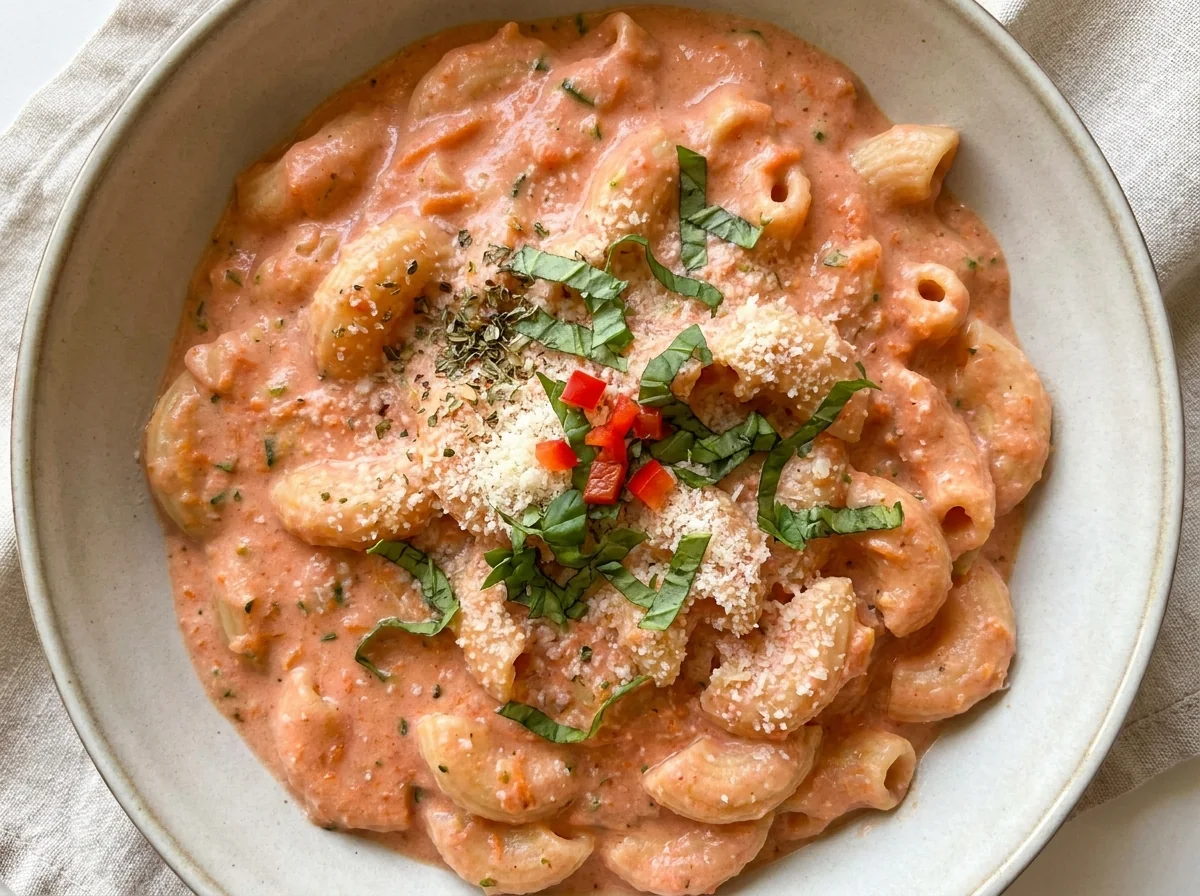
The hidden-veggie pink sauce is the most famous secret weapon of mothers. Four vegetables dissolve into a soft pink sauce that gives away not a single carrot.
It is not a trick but a progression: the tongue grows used to the flavor hidden, then accepts it in the open. Concealment is a bridge, not a homeland.
Preparation Steps
Cook the four vegetables in the sauce
Soften the onion and garlic in the oil, then the grated carrot, zucchini, and pepper for five minutes, then the paste and tomato, and simmer for fifteen minutes until all the vegetables dissolve into the red.
Blend smooth: the moment of full concealment
Blend the sauce with a hand blender until completely smooth, giving nothing away. Four vegetables vanished into one red: what the small eye does not see, the small tongue does not refuse.
The cream tints and softens
The light cream goes in and turns the red into a soft pink. The pink color itself is half the persuasion: "pink pasta" gets requested by name.
The fun-shaped pasta
The bowties or spirals, one minute short, are tossed in the pink with cooking water to loosen it. The fun shape is the third partner in the persuasion.
Parmesan, basil, and strategic silence
Serve it with its cheese, the vegetables the kitchen's secret until further notice: then revealed gradually as the tongue grows used to them. Concealment is a stage, not a philosophy.
Blood Sugar Impact
The glycemic index (GI) measures how quickly a food raises blood sugar, while the glycemic load (GL) measures how much a full serving raises it. Together they give the complete picture.
Glycemic Index
GI
46Low
Low0–55Medium56–69High70+
A low value (≤55) means a gradual rise in blood sugar — the most suitable range for diabetes and insulin resistance.
Glycemic Load
GL
34High
Low0–10Medium11–19High20+
Glycemic load reflects the impact of the full serving. To lower it: take half a serving, or pair the recipe with a source of protein and fiber.
Nutritional Information
Per ServingMakes 4 servings · one serving is about 350 g of raw ingredients
Calories488 kcal24%of Daily Value*
Protein15 g30%of Daily Value*
Carbohydrates81 g29%of Daily Value*
Fat12 g15%of Daily Value*
Fiber6 g21%of Daily Value*
Sodium153 mg7%of Daily Value*
* Percent Daily Values are based on a 2,000-calorie diet per FDA food-label reference values — your daily needs may be higher or lower. Values are derived from the recipe's ingredients via the USDA database.
Troubleshooting
The most common problems when preparing Hidden-Veggie Pink Sauce Pasta, and how to fix them:
The pieces were discovered and rejected
Under-blended. A full minute with the hand blender and complete smoothness. The small eye is a professional investigator.
The sauce came out a telltale orange
The carrot overpowered the tomato. Get the balance right, for the tomato is always the master of the color.
The cream separated
It went in over a boil. Low heat when it goes in. The cream's eternal lesson.
Rejected despite everything
It happens. Repeat after a few days with no battle: the eight-attempts rule governs all children, and the battle at the table is one the mother always loses.
Storage and Make-Ahead
Immediately
With its pink and its cheese.
The sauce alone
In the refrigerator four days or frozen two months in portions. The strategic pink reserve.
Tomorrow's lunchbox
It works as a room-temperature school lunchbox. Pink pasta is eaten in all its states.
Tested Ingredient Substitutions
Original Ingredient
Tested Substitute
Ratio
Flavor Difference
The recipe's vegetables
Squash or small beetroot (adds to the pink!)
~
Anything that dissolves is a candidate
Cream
Cream cheese or Greek yogurt off the heat
~
The pink by three methods
Adding protein
Our shredded chicken or small meatballs
~
A complete meal
White pasta
Whole wheat after acceptance is established
~
The second step in its own time
How Much Does It Make? Scaling Guide
Ingredient
4 servings
2 servings
8 servings
Pasta
350 g
175 g
700 g
Hidden vegetables
500 g
250 g
1 kg
Cream
100 ml
50 ml
200 ml
EEINA Nutrition Tip
Blend the sauce until completely smooth, then reveal gradually. A single carrot piece surviving the blender betrays the whole project to a child's examining eye: complete smoothness is the condition of the first stage; but the ultimate goal is declared: after weeks of acceptance, start leaving small visible pieces and name the vegetables. Permanent concealment raises a child ignorant of vegetables, while gradualness raises one who eats them.
Add This Recipe to Your Plan
The EEINA app saves your favorite recipes, calculates them from their real ingredients, and shows your daily numbers toward your goal. Try it free now.
Permanent concealment, yes. That is why for us it is a bridge stage that ends with declared, gradual reveal: the aim is a child who eats vegetables knowingly, not ignorantly deceived, and the bridge is valid as long as it is temporary.
How many vegetables does a child actually eat in a serving?
~125 g of dissolved vegetables per serving (~480 full calories). More than many adults eat willingly: the pink works in silence.
How does it differ from our Napolitana?
Napolitana is openly red with declared ingredients, while the pink is blended with hidden vegetables and cream. The tactical mother owns both.
Does it work for adults who refuse vegetables?
Adults are longer-lived children in this respect. The same sauce works on spouses with home-documented efficiency.