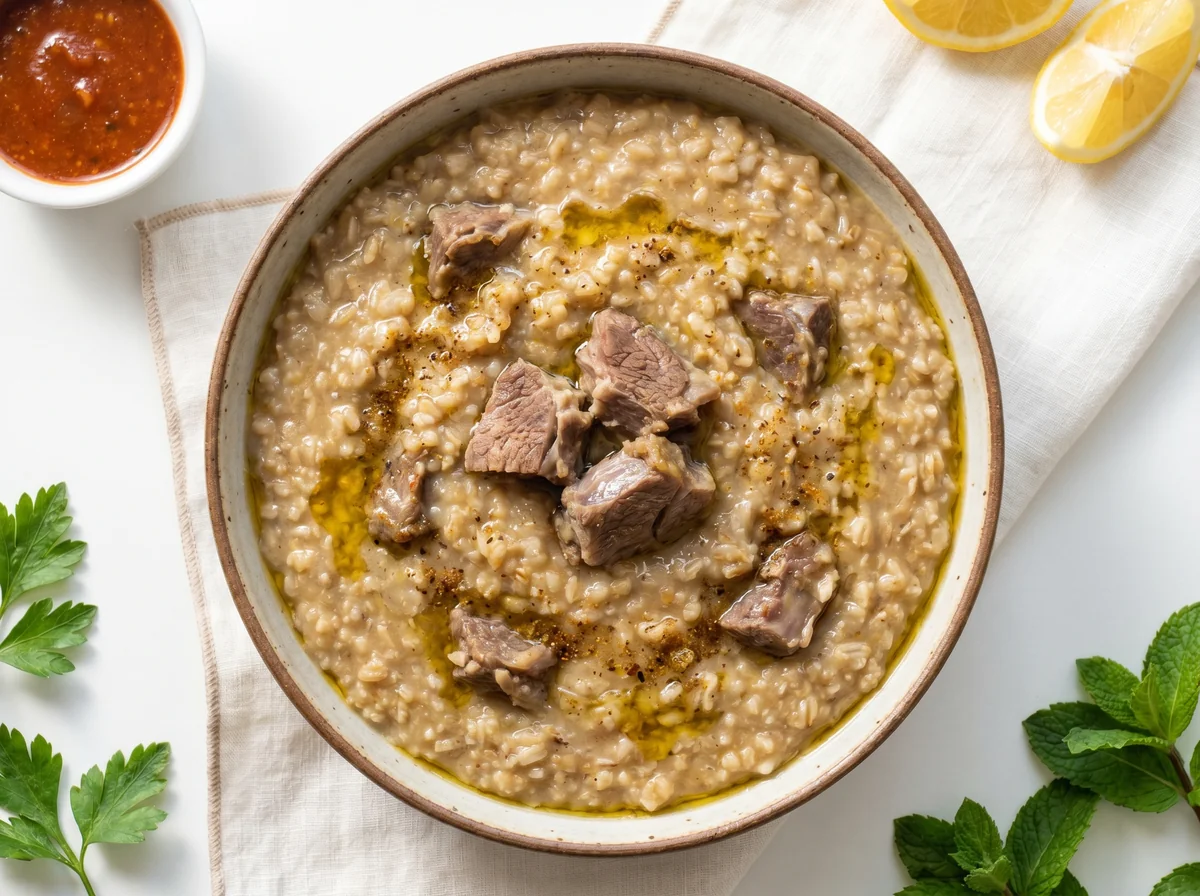
An ancient Gulf Ramadan dish — whole wheat grains cooked with lamb over a long, gentle heat then pounded until they become a smooth, cohesive paste. Eeina's version uses lean meat and a modest measure of ghee, preserving the silkiness and richness of Hareesh.
Hareesh is an ancient Gulf dish, present on Ramadan and wedding tables from the UAE to Saudi Arabia. Its secret lies in cooking whole wheat grain with meat over a long, gentle heat and then pounding the two together until they become a smooth, cohesive paste.
It differs from Jareesh (cracked-wheat porridge) in that the grain is pounded completely smooth, giving a silkier texture. Eeina's version uses lean meat and a modest measure of ghee, so the Hareesh keeps all its silkiness and richness but with a lighter profile, while the whole wheat grain adds fibre and a low glycemic index.
Preparation Steps
Soak the wheat
Rinse the wheat grain and soak it in water for at least an hour (or overnight). Soaking softens the grain, shortens the cooking time, and helps achieve the smooth final texture.
Cook the lamb and wheat together
In a large heavy pot, combine the lamb, the drained wheat grain, the cinnamon, the cardamom, and a pinch of salt, then cover with the hot water. Bring to the boil, then lower the heat and cover the pot, skimming off any foam that rises first for a cleaner broth.
Long slow cook
Leave the pot on the lowest possible heat for one and a half to two hours, stirring every twenty minutes or so and adding hot water whenever it dries out, until the wheat is fully cooked and the meat has fallen apart. The long, slow cook is the secret of Hareesh.
Pound the mixture
Once the wheat is tender and the meat has broken down, pound the mixture with a wooden masher or a potato ricer (or gently with an electric hand mixer) until it becomes a smooth, cohesive, even paste with no visible grain. This pounding is what defines Hareesh.
Adjust the consistency
Return the Hareesh to a low heat for a few minutes, stirring, and adjust the salt and texture: if it is too thick, add hot water; if too thin, leave it to thicken. Hareesh is served smooth and cohesive — not liquid and not dry.
Serve
Pour the Hareesh into a bowl, make a well in the centre and pour in the melted ghee, then dust cinnamon over the top. Serve hot — it is sometimes finished with a light sprinkling of sugar to taste in the Gulf tradition.
Blood Sugar Impact
The glycemic index (GI) measures how quickly a food raises blood sugar, while the glycemic load (GL) measures how much a full serving raises it. Together they give the complete picture.
Glycemic Index
GI
45Low
Low0–55Medium56–69High70+
A low value (≤55) means a gradual rise in blood sugar — the most suitable range for diabetes and insulin resistance.
Glycemic Load
GL
11Medium
Low0–10Medium11–19High20+
Glycemic load reflects the impact of the full serving. To lower it: take half a serving, or pair the recipe with a source of protein and fiber.
Nutritional Information
Per ServingMakes 5 servings · one serving is about 410 g of raw ingredients
Calories328 kcal16%of Daily Value*
Protein20 g40%of Daily Value*
Carbohydrates29 g11%of Daily Value*
Fat15 g19%of Daily Value*
Fiber5 g18%of Daily Value*
Sodium348 mg15%of Daily Value*
Potassium425 mg9%of Daily Value*
Phosphorus345 mg28%of Daily Value*
* Percent Daily Values are based on a 2,000-calorie diet per FDA food-label reference values — your daily needs may be higher or lower. Values are derived from the recipe's ingredients via the USDA database.
Troubleshooting
The most common problems when preparing Hareesh (Gulf Wheat and Lamb Porridge), and how to fix them:
The wheat did not cook through or stayed hard
It was not soaked or the cooking time was too short. Soak the grain for at least an hour and cook it slowly for one and a half to two hours, adding hot water as needed.
The Hareesh is lumpy with visible grain
It was not pounded enough. Pound it with a wooden masher or hand mixer until it becomes a smooth, even paste with no visible pieces.
The Hareesh is dry and heavy
The water dried out. Add hot water gradually while pounding and heating until it softens to the desired smooth consistency.
It stuck to the bottom and scorched
The heat was too high or it was stirred too infrequently. Cook it on the lowest possible heat, stir every twenty minutes, and use a heavy-bottomed pot.
Bland flavour
Too little salt or spice. Cinnamon and cardamom cooked in from the start deepen the flavour, and a final dusting of cinnamon and the ghee at serving complete the Gulf taste.
Storage and Make-Ahead
Refrigerator (4°C)
Three days in a sealed container. It thickens after chilling, so reheat it with a little hot water and stir.
Freezer (-18°C)
One month. Thaw in the refrigerator and reheat with hot water and stirring until smooth again.
Advance preparation
Soak the wheat and make the Hareesh well ahead of breaking the fast — it needs a long cook. Pound it, store it, then reheat at serving time.
Reheating
Over low heat with a little hot water and stirring until hot. Do not leave cooked food outside the refrigerator for more than two hours [2].
Tested Ingredient Substitutions
Original Ingredient
Tested Substitute
Ratio
Flavor Difference
Lamb
Skinless chicken
Same weight
The lighter chicken Hareesh — it cooks faster, so shorten the time slightly
Whole wheat grain
Jareesh (cracked wheat)
Same weight
Slightly coarser texture; needs more pounding to reach the smoothness of Hareesh
ghee
Olive oil
Half the quantity
A healthier unsaturated fat; lighter flavour than traditional ghee
Sugar topping at serving
Omit or use a pinch of cinnamon only
—
Hareesh is delicious savoury; omitting the sugar is better for those monitoring their blood sugar
Hand pounding
Electric hand mixer, gently
Same mixture
Faster and smoother — do not over-beat or it becomes gluey
How Much Does It Make? Scaling Guide
Servings
Wheat
Lamb
Water
Pot
2 (single × 2)
80 g
160 g
2.5 cups
Small pot
5 (standard)
200 g
400 g
6 cups
Large heavy pot
8 (family)
320 g
650 g
10 cups
Large pot
12 (feast)
500 g
1 kg
15 cups
Feast pot
EEINA Nutrition Tip
Whole wheat grain is one of the best starches: rich in fibre and low in glycemic index, so Hareesh is gentler on blood sugar than white-rice dishes. Choose lean meat and limit yourself to one tablespoon of ghee, and serve it without sugar or with the minimum for those watching their blood sugar.
Add This Recipe to Your Plan
The EEINA app saves your favorite recipes, calculates them from their real ingredients, and shows your daily numbers toward your goal. Try it free now.
What is the difference between Hareesh and Jareesh (cracked-wheat porridge)?
Both are made from wheat grain and meat, but Hareesh is pounded completely until it becomes a smooth, cohesive paste, while Jareesh (cracked-wheat porridge) keeps the grain cracked and visible, giving a coarser texture. Hareesh is smoother and Jareesh is coarser.
Why does Hareesh need such a long cook?
Whole wheat grain is hard and needs a long time over low heat to cook through and fully soften, with the meat breaking down alongside it. This slow cook is essential to reaching the smooth, even texture.
Is Hareesh suitable for diabetics?
Yes — whole wheat grain is rich in fibre and low in glycemic index, making it one of the best starches for blood sugar. Serve it without sugar or with the minimum, and choose lean meat.
Can I make it with chicken?
Yes — chicken Hareesh is popular and lower in fat. Use skinless chicken, which cooks faster than lamb so reduce the time slightly. The method is the same.
How do I achieve a smooth, cohesive texture?
Soak the wheat first, cook it long and slow until completely tender, then pound it well with a wooden masher or hand mixer until it becomes an even paste, adjusting the consistency with hot water.
Sources: USDA · University of Sydney · Gulf GSO · Our methodology · Updated on