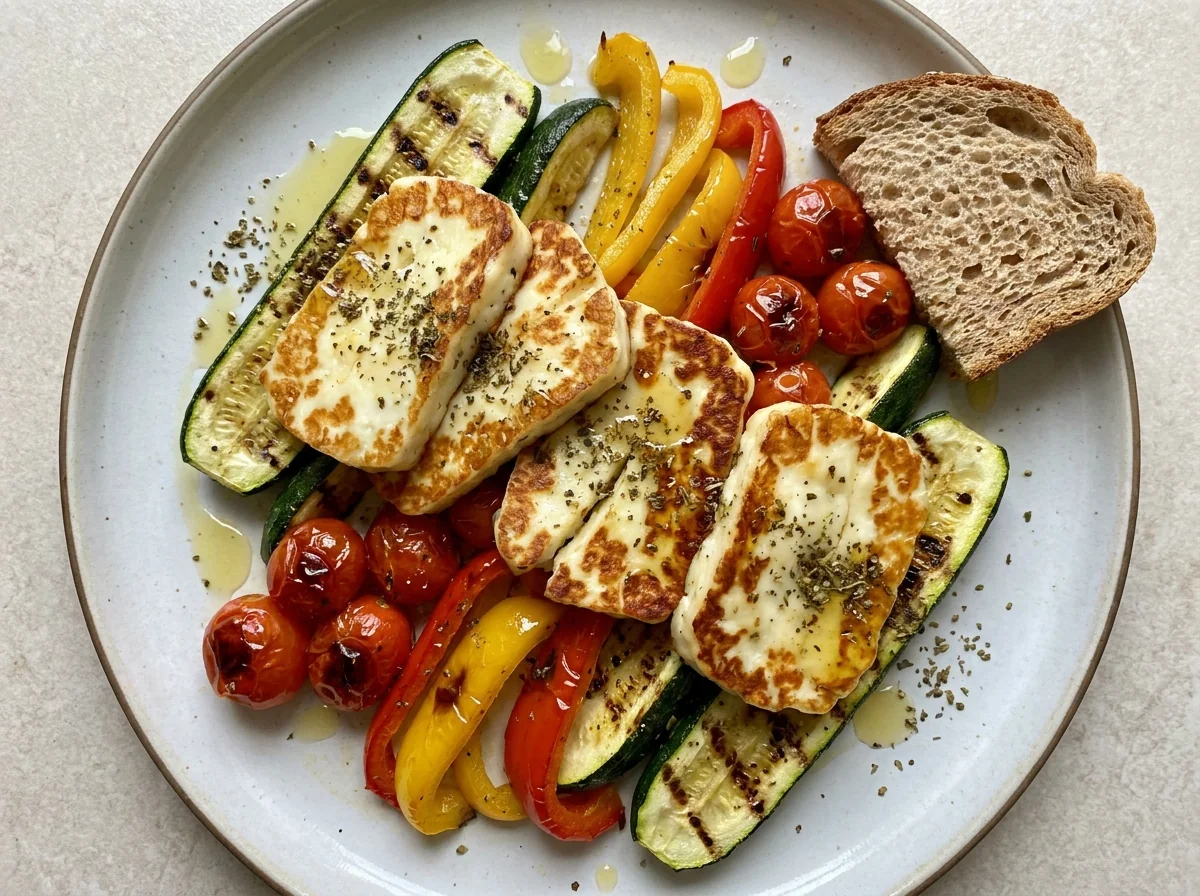
Halloumi is a Cypriot cheese distinguished by not melting over the fire, so it can be grilled in slices that take on golden lines while their texture stays firm.
It is a practical choice for anyone cooking for themselves: it needs no marinating and no waiting, and two slices are enough without waste.
Preparation Steps
Cut the vegetables and heat the grill pan
Wash the zucchini and cut it into lengthwise slices, cut the bell pepper into slices, and leave the cherry tomatoes whole. Then heat the ridged grill pan well, for all the plate's components will come off it in turn with less washing up.
Grill the vegetables with a brush of oil
Brush the vegetables with olive oil and grill them four minutes with a single turn until the grill lines appear and they soften, then move them to one side of the serving plate.
Grill the halloumi without oil
Place the thick halloumi slices on the hot, dry pan two minutes per side until golden lines appear and the center softens. Halloumi does not melt over the fire because its proteins crosslinked during its making through high heating, so it is a cheese naturally suited to grilling.
Add the honey and thyme
Drizzle a thin thread of honey over the hot halloumi slices and a pinch of thyme. Combining sweet with grilled savory is a common way to serve halloumi.
Assemble the plate and serve
Arrange the halloumi over the vegetables, squeeze the lemon over them, and set the whole-wheat bread alongside. A complete single dinner on one plate in eighteen minutes.
Blood Sugar Impact
The glycemic index (GI) measures how quickly a food raises blood sugar, while the glycemic load (GL) measures how much a full serving raises it. Together they give the complete picture.
Glycemic Index
GI
22Low
Low0–55Medium56–69High70+
A low value (≤55) means a gradual rise in blood sugar — the most suitable range for diabetes and insulin resistance.
Glycemic Load
GL
4Low
Low0–10Medium11–19High20+
Glycemic load reflects the impact of the full serving. To lower it: take half a serving, or pair the recipe with a source of protein and fiber.
Nutritional Information
Per ServingMakes 1 servings · one serving is about 460 g of raw ingredients
Calories570 kcal28%of Daily Value*
Protein30 g60%of Daily Value*
Carbohydrates24 g9%of Daily Value*
Fat40 g51%of Daily Value*
Fiber5 g18%of Daily Value*
Sodium737 mg32%of Daily Value*
Potassium909 mg19%of Daily Value*
Phosphorus543 mg43%of Daily Value*
* Percent Daily Values are based on a 2,000-calorie diet per FDA food-label reference values — your daily needs may be higher or lower. Values are derived from the recipe's ingredients via the USDA database.
Troubleshooting
The most common problems when preparing Grilled Halloumi and Vegetable Plate for One, and how to fix them:
The halloumi came out rubbery and tough
It cooled before eating or was grilled for a long time. Two minutes per side then eat it at once, for halloumi firms up the more it cools.
It stuck to the pan
The pan wasn't hot enough. A well-heated pan browns the cheese's surface so it releases on its own when turned.
The saltiness is high
Traditional halloumi is very salty. Soak it in cold water ten minutes before grilling, or choose the low-salt varieties.
The vegetables came out soft without grill lines
The pan is crowded or not heated. Grill the vegetables in batches and on a hot pan so they brown instead of steaming in their own moisture.
Storage and Make-Ahead
Immediately only
Halloumi is eaten hot the moment it's grilled, for after a quarter hour its texture firms up.
Leftover grilled vegetables
Kept in the refrigerator for the day and used in a sandwich or salad.
Raw halloumi
Kept in its brine in the refrigerator for months, one of the longest-keeping cheeses, and grilled slice by slice as needed.
Tested Ingredient Substitutions
Original Ingredient
Tested Substitute
Ratio
Flavor Difference
Halloumi
Thick mishallal or kashkaval cheese
~
Cheeses that tolerate grilling to varying degrees
Honey
Pomegranate molasses
~
Tartness instead of sweetness, and both suit grilled halloumi
Whole-wheat bread
Fluffed bulgur
~
A whole-grain carbohydrate base instead of bread
Upgrading the plate
A handful of chickpeas sautéed alongside
~
Extra plant protein
How Much Does It Make? Scaling Guide
Ingredient
1 plate
~
2 plates
Halloumi
120 g
~
240 g
Vegetables
260 g
~
520 g
Time
18 min
~
22 min
EEINA Nutrition Tip
Grill the halloumi on a very hot, dry pan without oil. Halloumi carries its salt and fat within it and releases them with heat, and added oil fries it instead of grilling it, so the lines disappear and the taste turns heavy. A hot, dry pan browns its surface within two minutes. Eat it the moment it comes off, because halloumi firms up and turns rubbery within a quarter hour of cooling, and this is the nature of this cheese, not an error in cooking.
Add This Recipe to Your Plan
The EEINA app saves your favorite recipes, calculates them from their real ingredients, and shows your daily numbers toward your goal. Try it free now.
Because its curd is heated at high temperature before pressing during its making, so its proteins crosslink into a network that withstands the fire. It is an old Cypriot method that made it a cheese fit for grilling.
How is the plate counted?
~540 calories with ~28 g protein from the cheese alone, and it is a complete vegetarian dinner. The saltiness of halloumi is counted for anyone watching their sodium, and soaking reduces it.
Why does it suit someone living alone?
Because the piece stays good for months in the refrigerator and is grilled slice by slice with no minimum and no waste, so nothing of it spoils from waiting.
How does it become a hosting plate?
Double the quantities, arrange them on one large plate, and pour the thread of honey right before serving, so a restaurant-level appetizer plate comes out in the same twenty minutes.