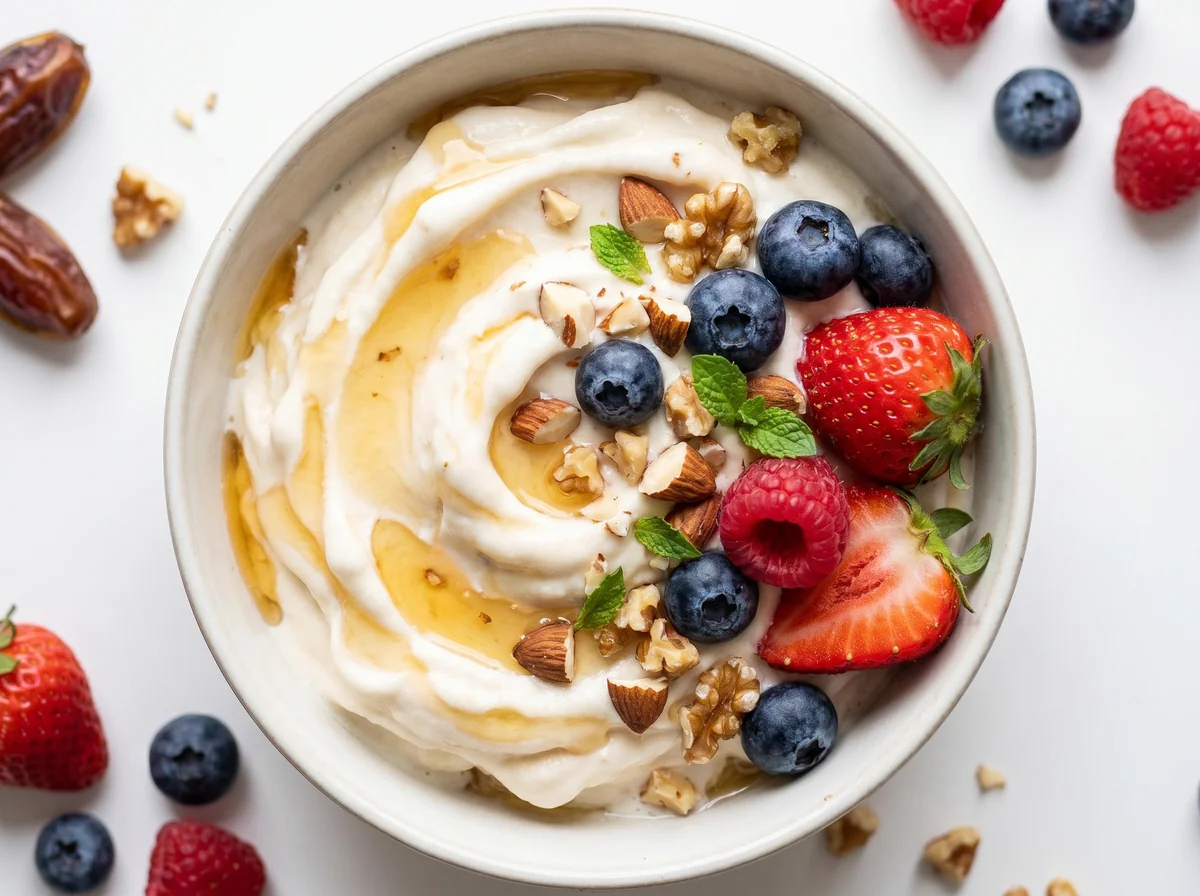
Homemade frozen yogurt with berries and honey — Greek yogurt blended with mixed frozen berries and a touch of honey, frozen and scraped repeatedly to achieve a creamy, light frozen dessert.
Homemade frozen yogurt is a simple idea that brings together the refreshment of a frozen treat and the lightness of yogurt. Instead of buying a tub of ice cream loaded with sugar and fat, blend thick Greek yogurt with frozen berries and a drizzle of honey, then freeze it in stages and scrape it with a fork until it becomes fine, soft flakes.
The result is a cold pink cup with the real taste of berries and a creamy texture — perfect for a hot summer afternoon or a light after-dinner treat. It differs from a fresh layered yogurt parfait and from the chewy mastic ice cream; this is scraped in texture and melts quickly on the tongue.
Preparation Steps
Soften the berries
Take the frozen berries out of the freezer and leave them in a bowl at room temperature for ten minutes until the surface softens slightly and they are easier to blend. The goal is berries that are soft on the outside but not completely thawed — keeping them cold preserves the thick consistency later.
Blend the mixture
Place the yogurt, berries, honey, lemon juice, vanilla, and a pinch of salt in a blender and blend for one to two minutes until the colour is even and the mixture is smooth and pink. Stop when the large berry pieces disappear and the consistency is thick enough to coat a spoon — this ensures easy scooping after freezing.
Taste and adjust
Taste the mixture and gradually add honey if you want more sweetness, remembering that cold mutes some sweetness, so make it slightly sweeter than the final result you want. Adjusting the taste before freezing is easier than after.
Pour into the dish
Pour the mixture into a shallow metal or glass dish at about two centimetres depth and level it with the back of a spoon. A shallow metal dish transfers cold faster, so the mixture freezes evenly and is easier to scrape.
First freeze
Cover the dish and place in the freezer for one and a half hours until the edges are frozen and the centre remains soft. This partial freeze forms small ice crystals rather than one solid block, and is the secret to a creamy texture.
First scrape
Take out the dish and scrape the surface with a strong fork using crossing motions until the frozen edges break up and mix with the centre. Breaking the crystals at this stage prevents a solid rock-hard layer forming.
Freeze and scrape repeatedly
Return the dish to the freezer and scrape every half hour (three to four times over about two hours) until the entire mixture becomes fine, cohesive frozen flakes resembling scraped ice cream. The more you scrape, the finer the texture becomes.
Serve
Scoop the frozen yogurt into cold cups and serve immediately. If you left it to freeze overnight, leave it at room temperature for five minutes then scrape it again with a fork before scooping to restore its softness.
Blood Sugar Impact
The glycemic index (GI) measures how quickly a food raises blood sugar, while the glycemic load (GL) measures how much a full serving raises it. Together they give the complete picture.
Glycemic Index
GI
43Low
Low0–55Medium56–69High70+
A low value (≤55) means a gradual rise in blood sugar — the most suitable range for diabetes and insulin resistance.
Glycemic Load
GL
10Low
Low0–10Medium11–19High20+
Glycemic load reflects the impact of the full serving. To lower it: take half a serving, or pair the recipe with a source of protein and fiber.
Nutritional Information
Per ServingMakes 4 servings · one serving is about 210 g of raw ingredients
Calories203 kcal10%of Daily Value*
Protein12 g24%of Daily Value*
Carbohydrates25 g9%of Daily Value*
Fat7 g9%of Daily Value*
Fiber2 g7%of Daily Value*
Sodium45 mg2%of Daily Value*
* Percent Daily Values are based on a 2,000-calorie diet per FDA food-label reference values — your daily needs may be higher or lower. Values are derived from the recipe's ingredients via the USDA database.
Troubleshooting
The most common problems when preparing Frozen Yogurt with Berries and Honey, and how to fix them:
It turned rock-solid after a whole night in the freezer
Leave it at room temperature for five to ten minutes then scrape it with a fork again before scooping. Next time, store it in a shallow container and add an extra spoonful of honey — sugar lowers the freezing point and keeps it softer.
The texture is grainy and rough rather than creamy
Not scraped enough. Commit to scraping every half hour three to four times, and use whole-milk yogurt — fat and repeated scraping are the secret to smoothness.
The taste is too sour
Some Greek yogurt brands are sharply acidic. Add a spoonful of honey or half a ripe banana and re-blend; a pinch of salt also softens acidity and brings out sweetness.
The mixture is watery and does not set well during freezing
Likely regular thin yogurt was used rather than strained Greek. Strain regular yogurt through cheesecloth over a strainer in the refrigerator for two hours to remove excess water, or replace with thick Greek yogurt.
The colour of the mixture is dull and unattractive
Increase the proportion of red berries and strawberries — they have stronger pigment than blueberries alone. Remember that freezing slightly dulls colour, so make the mixture darker than your target before freezing.
Storage and Make-Ahead
Freezer (optimal)
Keep in a sealed shallow container for up to two weeks. The thinner the layer, the easier it is to scrape and recover the texture.
Before serving
Take it out of the freezer five to ten minutes before scooping to soften the surface, then scrape with a fork and it returns to soft as it was first made.
Avoid
Do not refreeze after it has fully thawed — that creates large ice crystals, ruins the texture, and increases the risk of bacterial growth in dairy.
Refrigerator
Not suitable for the regular refrigerator as it melts within minutes. This is a frozen dessert to be served and eaten immediately or kept frozen.
Tested Ingredient Substitutions
Original Ingredient
Tested Substitute
Ratio
Flavor Difference
Honey
Mashed dates or date molasses
60 ml honey ← 70 g date paste
Raises fibre and potassium and gives a caramel-like flavour, but it is still natural sugar so the same moderation applies.
Whole-milk Greek yogurt
Low-fat Greek yogurt
1:1
Reduces fat and calories, but expect a less smooth texture and more crystallisation — increase the scraping.
Mixed berries
Frozen mango or frozen peach
1:1
Gives a yellow colour and a tropical flavour. Mango is naturally sweeter so reduce the honey slightly.
Greek yogurt
Vegan coconut yogurt
1:1
A lactose-free alternative for dairy sensitivity. The texture is richer and the flavour is gently coconutty; watch the added sugar on the label.
Lemon juice
Lime juice
1:1
Sharper acidity and a more fragrant note that complements the berries beautifully without changing the texture.
How Much Does It Make? Scaling Guide
Ingredient
4 servings
8 servings
12 servings
Whole-milk Greek yogurt
500 g
1000 g
1500 g
Frozen mixed berries
250 g
500 g
750 g
Natural honey
60 ml
120 ml
180 ml
Fresh lemon juice
15 ml
30 ml
45 ml
Vanilla extract
5 ml
10 ml
15 ml
EEINA Nutrition Tip
Choose whole-milk Greek yogurt rather than low-fat for this recipe — the fat breaks the harshness of ice crystals and gives a smoother, less solid texture. If you want to reduce honey, compensate the sweetness with a mashed ripe banana, which adds natural sugar and a creamy consistency without a large increase in calories.
Add This Recipe to Your Plan
The EEINA app saves your favorite recipes, calculates them from their real ingredients, and shows your daily numbers toward your goal. Try it free now.
It is lighter than commercial ice cream, but it contains honey and natural fruit sugar that raise the glycemic load of the serving, which is why it was not classified under diabetic dishes. Those monitoring their blood sugar can have a small amount in moderation after consulting a dietitian, or replace the honey with a suitable sweetener.
Why is repeated scraping needed instead of leaving it to freeze once?
Freezing without stirring creates a solid block with large ice crystals. Scraping every half hour breaks the crystals while they are small, producing a flaky, smooth texture resembling scraped ice cream rather than a solid frozen block.
Can I use fresh berries instead of frozen?
Yes, but add a handful of ice cubes when blending, or freeze the fresh berries for an hour before use. Frozen berries provide the cold temperature and density needed for a good texture.
Can it be made without a blender?
Yes. Mash the soft berries well with a fork, then whisk with the yogurt and honey by hand until combined. The texture may be slightly less smooth but it works.
How long does it keep in the freezer?
Up to two weeks in a well-sealed container. After that the flavour fades and larger crystals begin to form — best consumed fresh in the first few days.