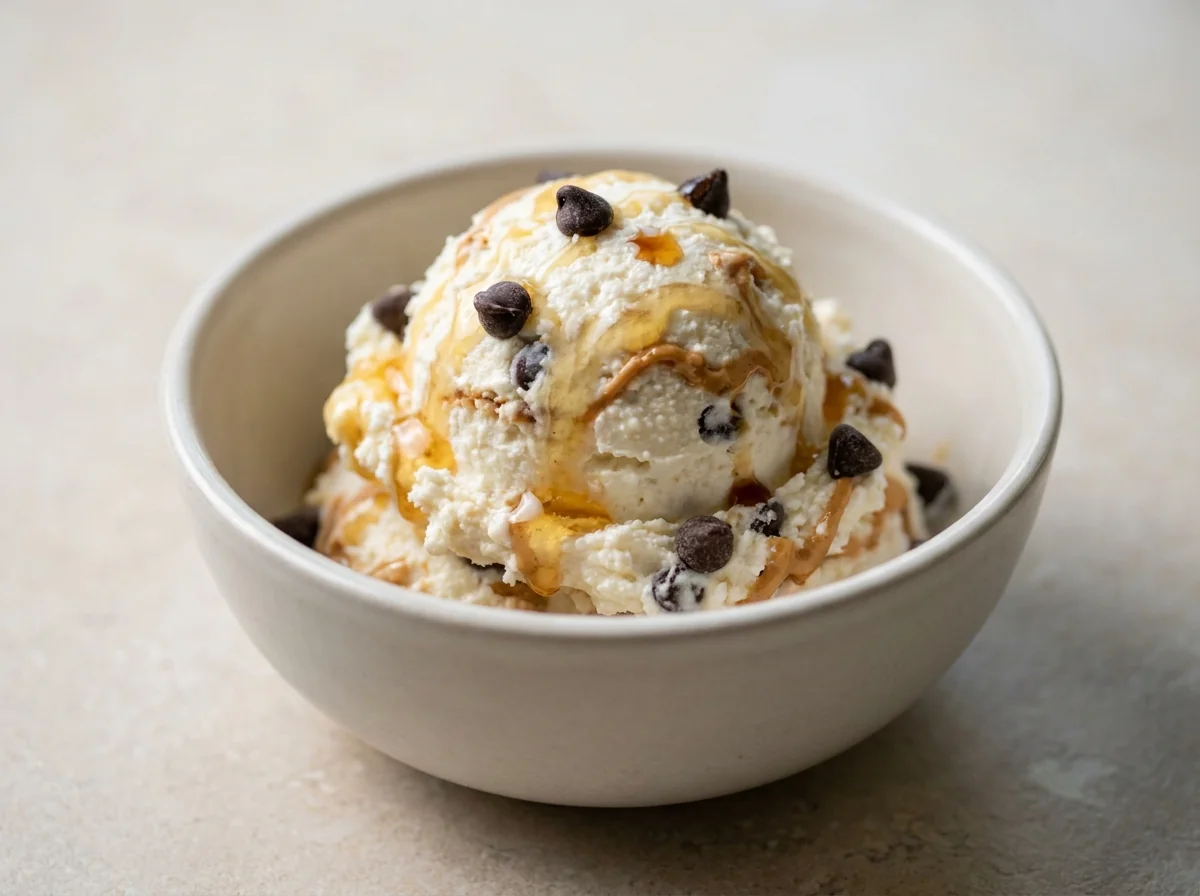
A recipe that spread widely on social media because it turns ordinary cottage cheese into a creamy frozen dessert with just a few ingredients; we tried it and adjusted the sweetness to a taste closer to the Arab kitchen.
Preparation Steps
Blend
Place the cottage cheese, honey, peanut butter, and vanilla in a food processor and blend until completely smooth with no lumps; full smoothness is the secret to a creamy rather than icy texture.
Add the chips
Fold the chocolate chips into the mixture with a spoon without further blending so they stay whole.
Freeze
Pour the mixture into a mold or airtight container, smooth the surface, then freeze for at least four hours until set.
Soften and serve
Take the ice cream out and let it sit five to ten minutes at room temperature until it softens, then scoop it with an ice cream scoop, because the short softening restores its scoopable texture.
Blood Sugar Impact
The glycemic index (GI) measures how quickly a food raises blood sugar, while the glycemic load (GL) measures how much a full serving raises it. Together they give the complete picture.
Glycemic Index
GI
44Low
Low0–55Medium56–69High70+
A low value (≤55) means a gradual rise in blood sugar — the most suitable range for diabetes and insulin resistance.
Glycemic Load
GL
11Medium
Low0–10Medium11–19High20+
Glycemic load reflects the impact of the full serving. To lower it: take half a serving, or pair the recipe with a source of protein and fiber.
Nutritional Information
Per ServingMakes 4 servings · one serving is about 150 g of raw ingredients
Calories267 kcal13%of Daily Value*
Protein15 g30%of Daily Value*
Carbohydrates26 g9%of Daily Value*
Fat12 g15%of Daily Value*
Fiber1 g4%of Daily Value*
Sodium358 mg16%of Daily Value*
Potassium251 mg5%of Daily Value*
Phosphorus220 mg18%of Daily Value*
* Percent Daily Values are based on a 2,000-calorie diet per FDA food-label reference values — your daily needs may be higher or lower. Values are derived from the recipe's ingredients via the USDA database.
Troubleshooting
The most common problems when preparing Cottage Cheese Ice Cream, and how to fix them:
Rock-hard texture after freezing
You froze it too long or scooped it straight away; let it sit five to ten minutes at room temperature before scooping.
The mixture is grainy, not smooth
It was not blended enough; blend longer, scrape the sides, and blend again until the lumps disappear completely.
Coarse ice crystals
You used low-fat cheese; swap it for full-fat, as the fat improves the texture.
Storage and Make-Ahead
Freezer
Keep it in an airtight container for up to two weeks, softening it before each serving.
Preventing ice crystals
Press a sheet of parchment paper onto the surface of the ice cream before sealing the container to reduce contact with air.
Tested Ingredient Substitutions
Original Ingredient
Tested Substitute
Ratio
Flavor Difference
Peanut butter
Almond butter
32 g
For those who want to avoid peanuts while keeping the rich texture.
Honey
Maple syrup
85 g
A plant-based alternative with roughly the same sweetness.
Chocolate chips
Frozen berries
30 g
For a lighter fruity flavor instead of chocolate.
How Much Does It Make? Scaling Guide
Ingredient
2 servings
4 servings (base)
8 servings
Full-fat cottage cheese
225 g
450 g
900 g
Honey
43 g
85 g
170 g
Peanut butter
16 g
32 g
64 g
Dark chocolate chips
15 g
30 g
60 g
EEINA Nutrition Tip
Choose full-fat cottage cheese, not low-fat, because the fat coats the water molecules and prevents coarse ice crystals from forming.
Add This Recipe to Your Plan
The EEINA app saves your favorite recipes, calculates them from their real ingredients, and shows your daily numbers toward your goal. Try it free now.