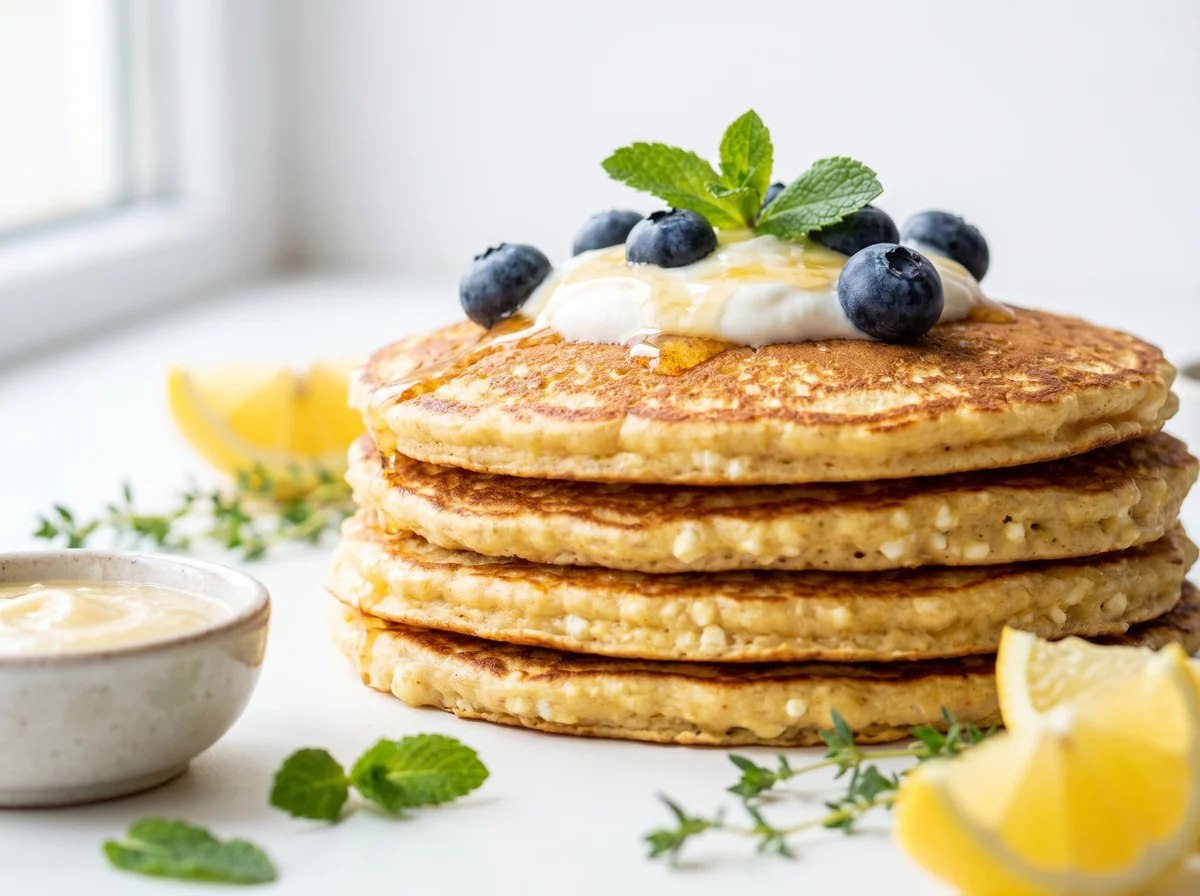
In its common form, pancake batter is starch-based, and the healthier versions build on oats and banana or Greek yogurt, leaving carbohydrates as the backbone. At EEINA we wanted a disc that flips the equation and makes protein the foundation rather than the add-on.
Here cottage cheese and eggs are the batter itself, and almond flour with a pinch of cornstarch are just a light binder that holds the shape. The result is a pancake that is softer than the traditional version, with a neutral and quiet flavour that accepts both sweet and savoury, and a breakfast that starts your day with a proper protein serving on fewer starches. It is a simple home recipe with ingredients found in every refrigerator, suited to a work morning and a Ramadan suhoor alike.
Preparation Steps
Mash the cottage cheese
Mash the cottage cheese in a bowl with a fork for two minutes until smooth and most of the coarse curds have disappeared, because a smooth texture here replaces flour and gives the pancakes their structure.
Beat in the eggs
Add the eggs and vanilla and beat with a fork for a full minute until the mixture is uniform and one colour — thorough beating distributes the protein evenly so the water does not separate from the mass during cooking.
Prepare the dry mix
Combine the almond flour, cornstarch, and baking powder in a separate bowl, then fold them into the wet mixture until all traces of dry powder have disappeared — this ensures even lift with no bitter pockets of baking powder.
Rest
Leave the batter to rest for five minutes at room temperature so the almond flour absorbs the moisture and the batter thickens slightly — a thicker batter holds its disc shape on the pan instead of spreading.
Heat the pan
Heat a non-stick pan over low to medium heat and brush with a thin layer of olive oil until shiny but not smoking — gentle heat cooks the inside before the outside surface burns.
Pour the discs
Pour about two tablespoons of batter per pancake, leaving space between them, and cook undisturbed for two to three minutes until small bubbles appear on the surface and the edges look dry — these are the signals that the first side is ready to flip.
Flip
Flip each pancake once with a decisive motion and cook for one and a half to two minutes until both sides are golden and the centre is firm rather than liquid when pressed lightly — a well-cooked disc protects against a raw egg centre.
Serve
Transfer the pancakes to a warm plate and serve immediately, because protein-base pancakes are at their most tender when hot and may firm up more as they cool.
Blood Sugar Impact
The glycemic index (GI) measures how quickly a food raises blood sugar, while the glycemic load (GL) measures how much a full serving raises it. Together they give the complete picture.
Glycemic Index
GI
61Medium
Low0–55Medium56–69High70+
A low value (≤55) means a gradual rise in blood sugar — the most suitable range for diabetes and insulin resistance.
Glycemic Load
GL
16Medium
Low0–10Medium11–19High20+
Glycemic load reflects the impact of the full serving. To lower it: take half a serving, or pair the recipe with a source of protein and fiber.
Nutritional Information
Per ServingMakes 2 servings · one serving is about 185 g of raw ingredients
Calories303 kcal15%of Daily Value*
Protein19 g38%of Daily Value*
Carbohydrates28 g10%of Daily Value*
Fat12 g15%of Daily Value*
Fiber1 g4%of Daily Value*
Sodium592 mg26%of Daily Value*
Potassium219 mg5%of Daily Value*
Phosphorus470 mg38%of Daily Value*
* Percent Daily Values are based on a 2,000-calorie diet per FDA food-label reference values — your daily needs may be higher or lower. Values are derived from the recipe's ingredients via the USDA database.
Troubleshooting
The most common problems when preparing Protein Pancakes with Cottage Cheese and Eggs, and how to fix them:
The pancakes fall apart when flipping
The heat is too high or the flip is too early. Lower the heat and wait for the bubbles to appear and the edges to dry before flipping, and flip decisively in one confident motion without hesitation.
The batter is runny and will not hold a shape
Usually the cottage cheese is too wet or it was not rested. Drain the excess water from the cheese before mashing, give the batter five minutes to rest and let the almond flour absorb the moisture, or add an extra tablespoon of cornstarch.
The inside is raw but the outside is burnt
The heat is stronger than needed. Reduce to low and extend the cooking time on each side slightly — a thick disc needs time for the heat to reach the centre without scorching the surface.
An overpowering egg flavour dominates
Insufficient beating or too little vanilla. Beat the eggs with the cottage cheese for a full minute until fully combined, increase the vanilla drops, and for a savoury version add a pinch of black pepper or dried thyme to break the egg flavour.
The disc is dense and heavy rather than fluffy
The baking powder is expired or the batter was over-mixed. Check the baking powder's expiry date, and fold only until the dry powder disappears without over-beating so the air is trapped.
Storage and Make-Ahead
Refrigerator
Store cooled pancakes in an airtight container for up to three days, separating layers with baking paper so they do not stick.
Freezer
Stack them separated by paper then in a freezer bag for up to one month. They can be reheated directly from frozen without prior thawing.
Reheating
Reheat in a pan over gentle heat for one minute per side or in a toaster until warmed through — they are best with a crispy edge rather than from a microwave which may make them too soft.
Advance preparation
The dry ingredients can be mixed the night before and kept dry; add the cottage cheese and eggs in the morning to speed up breakfast.
Tested Ingredient Substitutions
Original Ingredient
Tested Substitute
Ratio
Flavor Difference
Cottage cheese
Low-fat ricotta
1:1
Ricotta is smoother and slightly richer; drain it well as it is more moist to prevent a runny batter.
Almond flour
Coconut flour
Replace 40 g almond flour with about 15 g coconut flour
Coconut flour is highly absorbent; use roughly one-third of the quantity and add an extra egg or a splash of water to adjust the consistency. Removes the tree nuts allergen for those with that allergy.
Cornstarch
Potato starch or arrowroot
1:1
Both perform the same binding role and keep the recipe gluten-free.
Whole eggs
Egg whites only
Each egg = approximately 2 egg whites
Reduces fat and cholesterol and raises the protein ratio, but the pancake becomes slightly less tender and a little chewier.
Vanilla
Lemon zest or ground cardamom
To taste
For those who prefer a non-sweet flavour, or for a savoury version simply omit the flavouring and use salt and pepper instead.
How Much Does It Make? Scaling Guide
Ingredient
2 servings (original)
4 servings
6 servings
Cottage cheese
200 g
400 g
600 g
Eggs
2
4
6
Almond flour
40 g
80 g
120 g
Cornstarch
15 g
30 g
45 g
Baking powder
4 g
8 g
12 g
EEINA Nutrition Tip
Do not rush the flip. A protein base is more fragile than a flour batter, and if you move the disc before its edges dry and bubbles appear it will fall apart. Leave it on its gentle heat until the surface tells you it is ready, and flip it only once.
Add This Recipe to Your Plan
The EEINA app saves your favorite recipes, calculates them from their real ingredients, and shows your daily numbers toward your goal. Try it free now.
Yes — they rely on almond flour and cornstarch rather than wheat. Just make sure the baking powder label says gluten-free, as some brands contain wheat starch.
Why a protein base instead of oats or yogurt?
Because oats, banana, and yogurt make carbohydrates the backbone, while cottage cheese and eggs make protein the batter itself. The result is a breakfast that is higher in protein and lower in starches, with a softer texture and a neutral flavour.
Can they be made savoury?
Absolutely. Omit the vanilla and add salt, pepper, and herbs such as thyme or dill, and serve with labneh (strained yogurt) or vegetables. The neutral flavour of the base welcomes both directions.
Can I prepare them ahead for work days?
Yes — make a batch and keep it in the refrigerator for up to three days or in the freezer for up to one month, and reheat in a pan in the morning for one minute per side.
Are they suitable for Ramadan suhoor?
Yes — the high protein supports extended satiety during the fast, they are light on the stomach and quick to make. Drink enough water alongside them and make them part of a balanced suhoor.