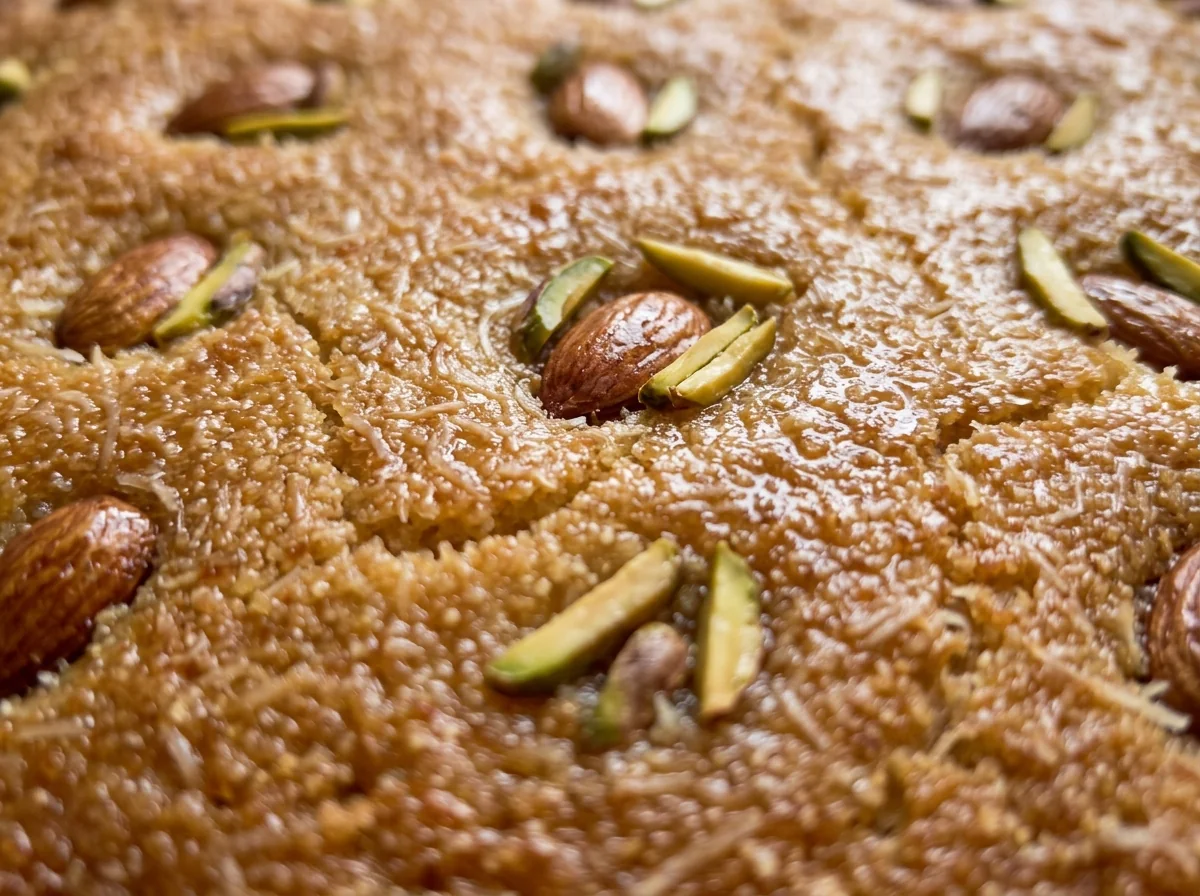
The original basbousa with yogurt and coconut, a classic Arab recipe with a golden crust and a moist interior that absorbs the syrup all at once. The flavor comes from the combination of orange blossom water and yogurt, and it differs from Turkish basbousa by the addition of coconut, which gives it a soft texture and distinctive aroma.
We prepare the original basbousa with clear ingredients and orderly steps, while preserving the essence of the recipe and its method of preparation as it appeared in its origin.
Preparation Steps
Mix the dry ingredients
Place the coarse semolina, shredded coconut, sugar, baking powder, and vanilla in a deep bowl, and stir with a spoon until the ingredients are evenly distributed and the flavor aromas are combined in one bowl.
Add the oil
Add the vegetable oil in a thin stream while continuing to stir with a wooden spoon, so the semolina clings to the oil and absorbs it gradually. Be careful to distribute the oil over the entire amount, because concentrating it in one area creates a non-uniform dough.
Melt the ghee
Add the ghee (or add it soft at room temperature) and knead by hand for two minutes until it melts completely and its lumps disappear, and the mixture becomes sandy in texture, crumbling between the fingers.
Add the yogurt
Add the full yogurt while stirring continuously with a spoon, forming a soft moist dough that is neither dry nor liquid. Note: if the dough becomes dry, add a tablespoon of liquid milk.
Add the water and orange blossom water
Pour the hot water (not boiling) and the orange blossom water all at once and stir quickly, forming a homogeneous mixture with a consistency that is slightly sticky but spreadable. Note: orange blossom water is strongly aromatic, so stick to the amounts mentioned in the recipe.
Spread the mixture in the pan
Grease a rectangular baking pan (approximately 30 × 25 cm) with a thin layer of oil or ghee, and spread the mixture to an even thickness of about 2 centimeters with our fingers moistened with water, so the surface appears smooth without gaps.
Bake the basbousa
Put the pan in a preheated oven at 180°C for 15 minutes, then raise the heat to 200° in the last 3 to 4 minutes until the top browns. Doneness sign: the top becomes dark golden.
Soak with syrup
Take the basbousa out of the oven and soak it immediately with cold syrup (sugar syrup) with a spoon over the entire surface evenly, so the surface absorbs it while it is hot and the heart soaks it up before it cools. Garnish it with nuts (Aleppo pistachios or almonds) and serve it warm or cold.
Blood Sugar Impact
The glycemic index (GI) measures how quickly a food raises blood sugar, while the glycemic load (GL) measures how much a full serving raises it. Together they give the complete picture.
Glycemic Index
GI
64Medium
Low0–55Medium56–69High70+
A low value (≤55) means a gradual rise in blood sugar — the most suitable range for diabetes and insulin resistance.
Glycemic Load
GL
61High
Low0–10Medium11–19High20+
Glycemic load reflects the impact of the full serving. To lower it: take half a serving, or pair the recipe with a source of protein and fiber.
Nutritional Information
Per ServingMakes 8 servings · one serving is about 220 g of raw ingredients
Calories655 kcal33%of Daily Value*
Protein9 g18%of Daily Value*
Carbohydrates99 g36%of Daily Value*
Fat26 g33%of Daily Value*
Fiber3 g11%of Daily Value*
Sodium64 mg3%of Daily Value*
* Percent Daily Values are based on a 2,000-calorie diet per FDA food-label reference values — your daily needs may be higher or lower. Values are derived from the recipe's ingredients via the USDA database.
Troubleshooting
The most common problems when preparing Classic Basbousa, and how to fix them:
The top is burnt before the base is cooked
Cover the top with aluminum foil in the last 5 minutes of baking, and continue at 180° only.
The syrup does not absorb and stays on the surface
Shorten the baking time by 3 minutes so the heart stays more moist, then pour it while still hot.
Storage and Make-Ahead
Refrigerator (4°)
Keep it in a covered container in the refrigerator for 5 to 6 days, and serve it at room temperature or heat a slice in the microwave for 20 seconds.
Tested Ingredient Substitutions
Original Ingredient
Tested Substitute
Ratio
Flavor Difference
ghee
vegetable oil
same amount
Gives the brittle texture and crunch, and removing it produces a softer basbousa.
coconut
without
omit
We get a purely traditional basbousa, but the texture will be less moist.
EEINA Nutrition Tip
Use cold syrup and the basbousa hot right out of the oven, as the temperature difference is the secret to the syrup saturating the core without it crumbling. The syrup is prepared in advance (2 cups sugar with 1 cup water and a teaspoon of lemon juice, boiled for 5 minutes) and left to cool completely before use.
Add This Recipe to Your Plan
The EEINA app saves your favorite recipes, calculates them from their real ingredients, and shows your daily numbers toward your goal. Try it free now.
It is boiled over medium heat for 5 minutes until it thickens slightly (its consistency is like a light syrup), and left to cool completely before use.
Why is coconut in the recipe?
It gives a distinctive flavor and a moist texture, and can be removed if we want the purely traditional recipe.
Can basbousa be stored in the freezer?
Yes, cut it into squares and keep it in freezer bags for a month, and reheat it in a 160° oven for 10 minutes.
Sources: USDA · University of Sydney · Our methodology · Updated on