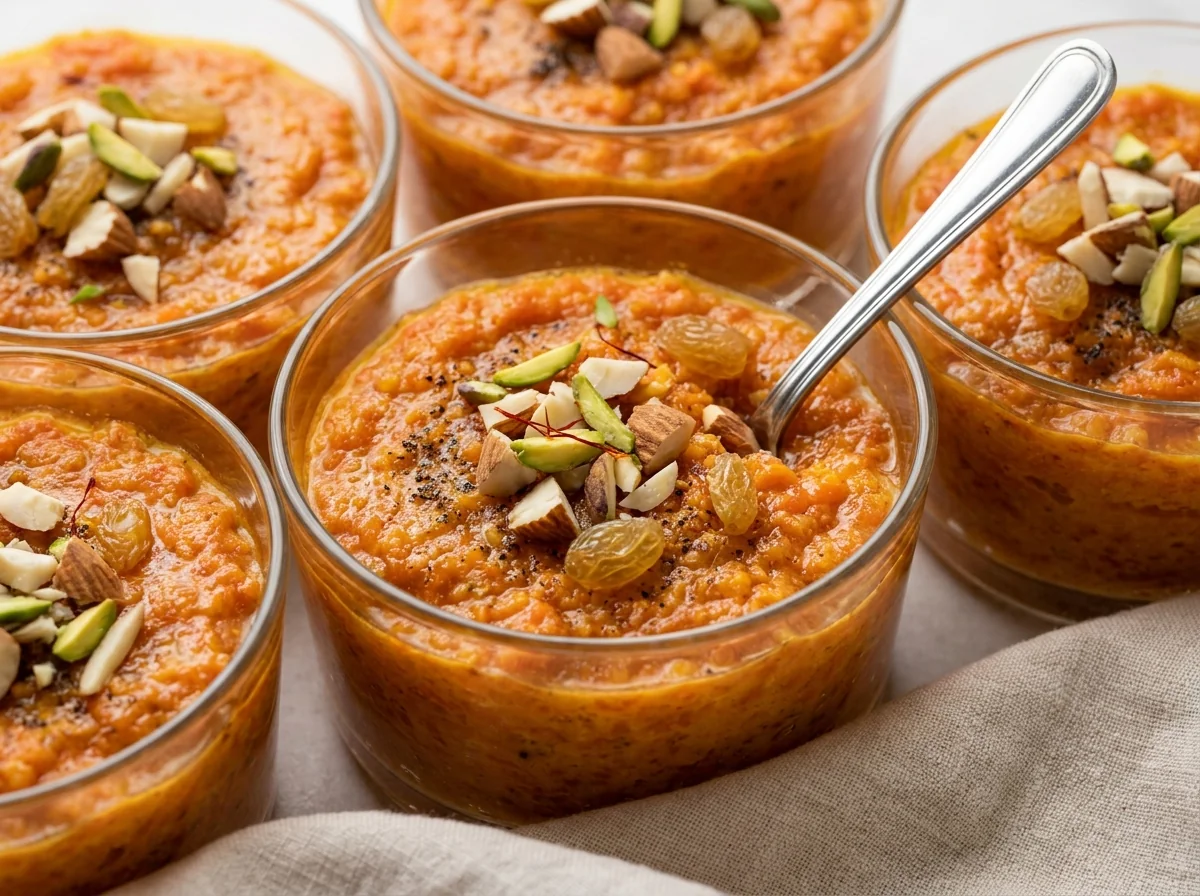
Carrot halwa (gajar ka halwa) is one of the most famous winter desserts of India, and it crossed into the Gulf with the ports and spices: grated carrot absorbs the reduced milk over low heat until it becomes an orange dessert scented with cardamom and saffron.
Preparation Steps
Wash, grate, and sauté the carrot in ghee
Wash, peel, and finely grate the carrot, then sauté it in the ghee over medium heat for ten minutes until it wilts and its sweet aroma fills the air. This first sautéing cooks the carrot's rawness and brings out its sweetness.
Pour in the milk and be patient with it
Pour in all the milk and leave the pot over low heat, stirring every few minutes for thirty-five minutes until the carrot absorbs the milk completely and dries. The slow reduction is what builds the flavor of the halwa, and there is no shortcut to it.
Sweeten after the milk dries, not before
Add the sugar after the milk has dried and stir for five minutes. Early sugar hinders the carrot from softening and draws out its water.
Flavor with cardamom, saffron, and raisins
Add the ground cardamom, saffron, and raisins and stir for two minutes.
Serve it warm with the nuts
Divide it into small cups and scatter the crushed almonds and pistachios over them, and it is eaten warm with a small spoon.
Blood Sugar Impact
The glycemic index (GI) measures how quickly a food raises blood sugar, while the glycemic load (GL) measures how much a full serving raises it. Together they give the complete picture.
Glycemic Index
GI
51Low
Low0–55Medium56–69High70+
A low value (≤55) means a gradual rise in blood sugar — the most suitable range for diabetes and insulin resistance.
Glycemic Load
GL
13Medium
Low0–10Medium11–19High20+
Glycemic load reflects the impact of the full serving. To lower it: take half a serving, or pair the recipe with a source of protein and fiber.
Nutritional Information
Per ServingMakes 6 servings · one serving is about 225 g of raw ingredients
Calories249 kcal12%of Daily Value*
Protein6 g12%of Daily Value*
Carbohydrates29 g11%of Daily Value*
Fat13 g17%of Daily Value*
Fiber4 g14%of Daily Value*
Sodium113 mg5%of Daily Value*
Potassium533 mg11%of Daily Value*
Phosphorus155 mg12%of Daily Value*
* Percent Daily Values are based on a 2,000-calorie diet per FDA food-label reference values — your daily needs may be higher or lower. Values are derived from the recipe's ingredients via the USDA database.
Troubleshooting
The most common problems when preparing Carrot Milk Halwa with Cardamom, and how to fix them:
It stayed milky and liquid
The evaporation time was too short. The sign is that the spoon cuts a path through the pot that stays open, since full evaporation is a sign, not a timing.
The bottom burned and its smell got in
The heat was high or the stirring was absent. Low heat, a thick-bottomed pot, and stirring every few minutes; a burned bottom cannot be saved, so start over.
The color came out pale
The carrot is pale or the saffron was missing. Choose dark orange carrots and soak the pinch of saffron in a spoonful of warm milk before adding it.
The sugar's sweetness is glaringly raw
The sugar went in early or was too much. Add it after the absorption and by taste, since sweet winter carrot needs less.
Storage and Make-Ahead
Warm, immediately
Its best serving is warm with a small spoon.
In the refrigerator
Five days, reheated with a spoonful of milk to restore its softness, and its taste deepens from the second day.
In the freezer
Two months in portions, and it is one of the most freezer-friendly desserts.
Tested Ingredient Substitutions
Original Ingredient
Tested Substitute
Ratio
Flavor Difference
The sugar
Date paste
80 g
A deeper sweetness with fiber
Whole milk
Low-fat with a longer patience
1:1
A lighter version with a thinner texture
The ghee
Butter or country ghee
1:1
Country ghee is its original flavor
The saffron
Omitting it and settling for the cardamom
same amount
It stays a complete dessert with a simpler aroma
How Much Does It Make? Scaling Guide
Ingredient
6 cups
3 cups
12 cups
Carrots
600 g
300 g
1.2 kg
Milk
600 ml
300 ml
1.2 L
Sugar
60 g
30 g
120 g
EEINA Nutrition Tip
Patience with evaporating the milk is the whole recipe: thirty-five minutes that cannot be shortened. The milk reduces slowly (this is what the Indians call khoa) and coats the carrot layer after layer, while high heat burns the bottom before it reduces or leaves boiled carrot swimming in milk.
Add This Recipe to Your Plan
The EEINA app saves your favorite recipes, calculates them from their real ingredients, and shows your daily numbers toward your goal. Try it free now.
A dessert from carrots, how do I serve it to someone hesitant?
Serve it before mentioning its ingredient: carrot soaked in milk and cardamom does not taste like raw carrot, and after the taste tell the story.
What is its share of health, honestly?
Whole vegetables, milk, and sixty grams of sugar for six servings: the cup is about 240 calories with ample vitamin A. A measured dessert in its category, not diet food.
Is it the same as Levantine jazariyya?
No. Jazariyya is set with sugar like a thick jam, and this is cooked with reduced milk so it is softer and less sweet.
When is its season?
Winter, when the carrot is at its sweetest, and pale summer carrot needs more sugar.