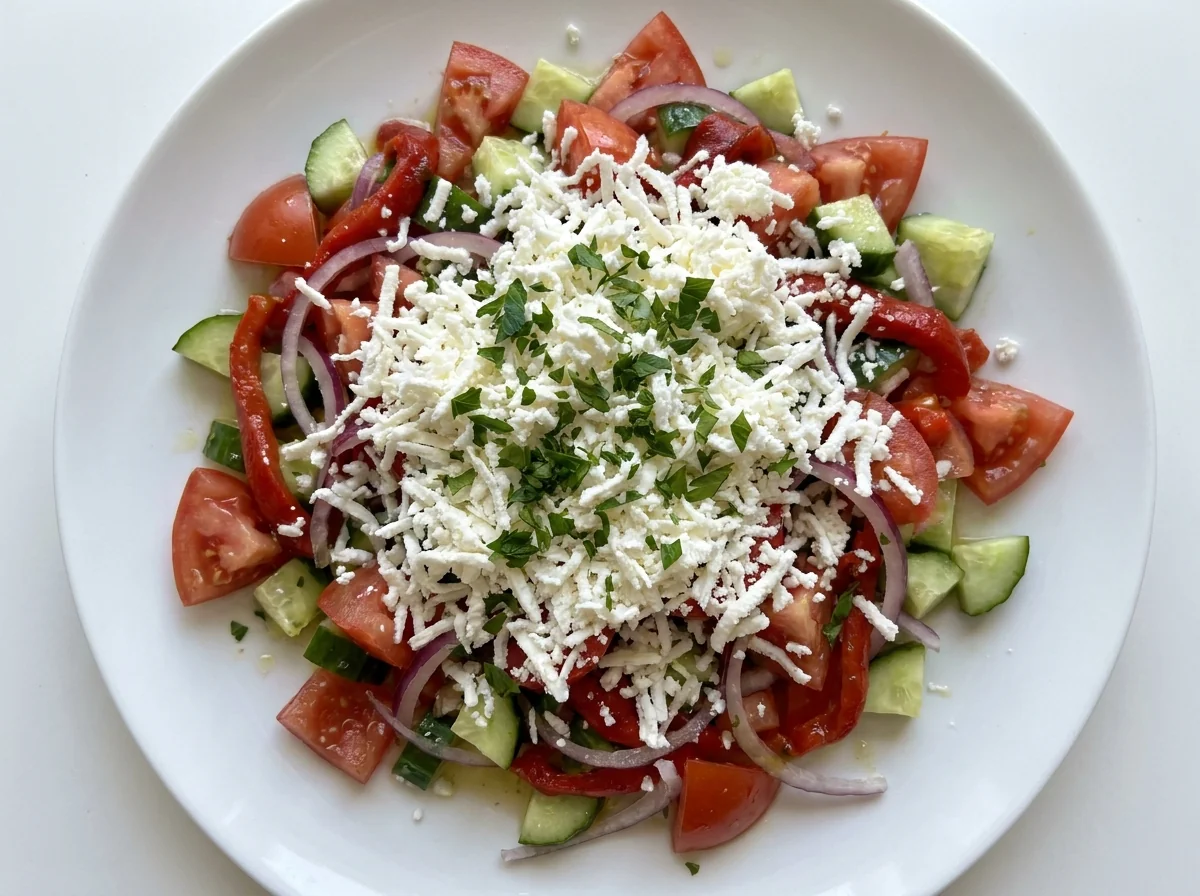
We prepare Shopska salad as it is served on the tables of Bulgaria, chopped summer vegetables of tomatoes, cucumber, pepper, and onion, crowned with a generous layer of grated white cheese until it looks like a snow-capped peak.
It is their national salad, simple and refreshing, which we serve cold alongside bread on a hot day.
Preparation Steps
Roasting the pepper
Roast the red pepper over a gas flame or in a hot oven until its skin blackens on all sides, then cover it for ten minutes, peel it, and cut it into medium pieces. To save time, use ready roasted red pepper.
Cutting the vegetables
Cut the tomatoes into quarters and the cucumber into thin half-moons, chop the red onion and parsley, then combine them with the roasted pepper in a wide bowl.
Dressing
Add the red wine vinegar, olive oil, and a pinch of salt, and toss gently until the vegetables are coated with the dressing.
Adding the cheese
Transfer the salad to a serving plate and grate the white cheese over it until it covers it like a white layer, which is the distinctive mark of Shopska salad.
Serving
Serve it cold as soon as it is prepared, alongside bread, for its flavor is freshest when eaten fresh.
Blood Sugar Impact
The glycemic index (GI) measures how quickly a food raises blood sugar, while the glycemic load (GL) measures how much a full serving raises it. Together they give the complete picture.
Glycemic Index
GI
12Low
Low0–55Medium56–69High70+
A low value (≤55) means a gradual rise in blood sugar — the most suitable range for diabetes and insulin resistance.
Glycemic Load
GL
1Low
Low0–10Medium11–19High20+
Glycemic load reflects the impact of the full serving. To lower it: take half a serving, or pair the recipe with a source of protein and fiber.
Nutritional Information
Per ServingMakes 4 servings · one serving is about 235 g of raw ingredients
Calories170 kcal8%of Daily Value*
Protein6 g12%of Daily Value*
Carbohydrates10 g4%of Daily Value*
Fat12 g15%of Daily Value*
Fiber3 g11%of Daily Value*
Sodium392 mg17%of Daily Value*
Potassium387 mg8%of Daily Value*
Phosphorus136 mg11%of Daily Value*
* Percent Daily Values are based on a 2,000-calorie diet per FDA food-label reference values — your daily needs may be higher or lower. Values are derived from the recipe's ingredients via the USDA database.
Troubleshooting
The most common problems when preparing Shopska Salad (Bulgarian Tomato, Cucumber and Cheese Salad), and how to fix them:
The salad is watery and runny
Salt the tomatoes and cucumber lightly and let them drain for a few minutes before mixing, and add the dressing only at serving.
The cheese does not settle on top of the salad
Grate it coarsely and spread it as a layer over the salad without deep tossing, for this is how Shopska is traditionally served.
The taste is too salty
Reduce the added salt and rely on the cheese's saltiness, and soak very salty cheese in cold water for ten minutes, then drain it.
Storage and Make-Ahead
Refrigerator
Keep it in an airtight container for up to one day, and it is best to add the cheese and dressing at serving so the vegetables stay crunchy.
Make ahead
Cut the vegetables and keep them separate from the cheese and dressing, and combine them shortly before serving.
Tested Ingredient Substitutions
Original Ingredient
Tested Substitute
Ratio
Flavor Difference
Bulgarian white cheese (sirene)
Greek feta or salted cottage cheese
same weight, 100 g
Feta is closer in texture and flavor, and cottage cheese is a lighter option in salt and fat
roasted red pepper
chopped raw red pepper
same weight, 120 g
The raw gives a clearer crunch and the roasted gives a deeper flavor
red wine vinegar
fresh lemon juice
same volume, 15 ml
Lemon refreshes the salad with a gentler acidity
parsley
chopped dill or mint
same weight, 15 g
The flavor differs a little and stays refreshing
How Much Does It Make? Scaling Guide
Ingredient
Half the quantity
The quantity (base)
Double
tomatoes
200 g
400 g
800 g
cucumber
100 g
200 g
400 g
roasted red pepper
60 g
120 g
240 g
red onion
30 g
60 g
120 g
Grated white cheese
50 g
100 g
200 g
olive oil
15 ml
30 ml
60 ml
EEINA Nutrition Tip
Add the cheese and dressing right at serving, not before, for this preserves the crunch of the vegetables and keeps the salad from turning watery.
Add This Recipe to Your Plan
The EEINA app saves your favorite recipes, calculates them from their real ingredients, and shows your daily numbers toward your goal. Try it free now.
Shopska is covered with a thick layer of grated white cheese and relies on pepper and onion without olives as a base, while Greek salad uses cubes of cheese and olives.
Which cheese do I use if I cannot find sirene cheese?
Greek feta is the closest substitute in texture and flavor, and grated salted white cheese can be used.
Do I use the pepper raw or roasted?
Both work; the roasted gives a deeper flavor and the raw gives a clearer crunch, and the choice is according to taste.