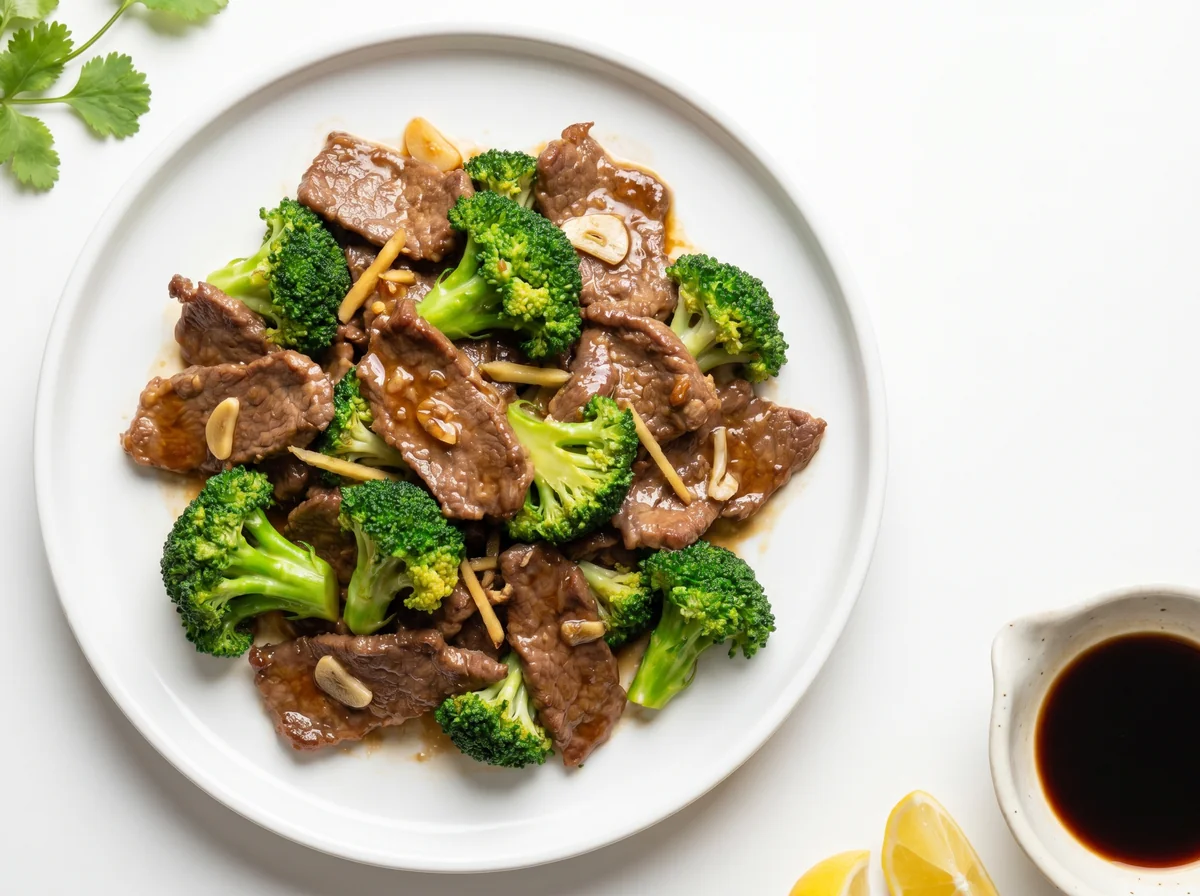
Flank steak and broccoli stir-fried in oyster sauce and soy sauce with ginger and sesame oil — a classic Chinese-style dish, high in protein, very low in carbohydrates, low glycemic index. Contains soy, sesame, and shellfish (oyster sauce).
Beef and broccoli is one of the most beloved Chinese-American dishes — a restaurant classic that translates beautifully to the home kitchen.
The technique of velveting (coating the beef in cornstarch before searing) and the layered umami from soy and oyster sauces with fresh ginger and garlic give this dish its signature silky texture and deep savory flavor. With very low carbohydrates and 37 grams of protein per serving, it is a powerhouse meal that satisfies without weight.
Preparation Steps
Marinate the beef
Slice the beef thinly against the grain (this is key for tenderness). Mix the beef slices with 1 tablespoon soy sauce, cornstarch, and a drizzle of sesame oil. Marinate for 15 minutes minimum — the cornstarch forms a protective coating that locks in juices during the high-heat stir fry (called velveting in Chinese cooking).
Blanch the broccoli
Bring a pot of salted water to a boil and blanch the broccoli florets for 2 minutes until bright green and just tender. Immediately transfer to ice water to stop cooking, then drain thoroughly. Blanching sets the vibrant green color and partially cooks the broccoli so it finishes perfectly in the wok without getting mushy.
Make the sauce
Whisk together the remaining soy sauce, oyster sauce, beef broth, and remaining sesame oil in a small bowl. Set aside — having the sauce ready before the wok is hot is essential for stir frying, which moves very fast.
Sear the beef
Heat the oil in a wok or large skillet over the highest heat until smoking. Add the beef in a single layer (work in batches if needed) and sear for 1 minute per side without stirring — just until browned. Remove and set aside. High heat and no crowding are the secrets to searing rather than steaming the beef.
Stir fry and finish
In the same wok, stir fry the garlic and ginger for 30 seconds until fragrant, then add the broccoli and toss for 1 minute. Return the beef to the wok, pour in the sauce, and toss everything together for 1 to 2 minutes until the sauce thickens slightly and coats everything. Taste and adjust the salt. Serve immediately over rice or cauliflower rice, garnished with sesame seeds.
Blood Sugar Impact
The glycemic index (GI) measures how quickly a food raises blood sugar, while the glycemic load (GL) measures how much a full serving raises it. Together they give the complete picture.
Glycemic Index
GI
46Low
Low0–55Medium56–69High70+
A low value (≤55) means a gradual rise in blood sugar — the most suitable range for diabetes and insulin resistance.
Glycemic Load
GL
2Low
Low0–10Medium11–19High20+
Glycemic load reflects the impact of the full serving. To lower it: take half a serving, or pair the recipe with a source of protein and fiber.
Nutritional Information
Per ServingMakes 4 servings · one serving is about 225 g of raw ingredients
Calories275 kcal14%of Daily Value*
Protein33 g66%of Daily Value*
Carbohydrates6 g2%of Daily Value*
Fat12 g15%of Daily Value*
Fiber1 g4%of Daily Value*
Sodium596 mg26%of Daily Value*
* Percent Daily Values are based on a 2,000-calorie diet per FDA food-label reference values — your daily needs may be higher or lower. Values are derived from the recipe's ingredients via the USDA database.
Troubleshooting
The most common problems when preparing Beef and Broccoli Stir Fry Chinese Style, and how to fix them:
Beef is tough and chewy
Two possible causes: slicing with the grain instead of against it, or overcooking. Always slice the flank steak against the grain (perpendicular to the muscle fibers) for tenderness. Sear on high heat very briefly — 1 minute per side only. Overcooked beef in stir fry is impossible to rescue.
Dish is watery and sauce does not thicken
The broccoli was not drained thoroughly after blanching, or the pan was not hot enough. Drain the broccoli completely and pat dry if needed. High heat is non-negotiable for stir frying — a wok that is not smoking hot will steam rather than sear, releasing water from the vegetables.
Broccoli turned olive green and mushy
Overcooked during blanching or too long in the wok. Blanch for exactly 2 minutes, transfer immediately to ice water, and add to the wok only in the final 2 minutes. The goal is bright emerald green and slightly crisp.
Storage and Make-Ahead
Refrigerator (4°C)
Keep in a sealed container for up to three days. The broccoli will soften on storage — this is normal. Reheat in a hot pan for 2 to 3 minutes rather than the microwave to maintain some texture.
Freezer (-18°C)
Freeze for up to two months. The broccoli texture changes significantly after freezing — acceptable for meal prep but not ideal for presentation. Thaw overnight in the refrigerator before reheating.
Meal prep
Marinate and slice the beef up to 24 hours ahead. Blanch and store the broccoli separately. Prepare the sauce in advance. This reduces active cooking time to under 10 minutes.
Food safety
Cook beef to a minimum internal temperature of 71°C (USDA FSIS). Do not leave cooked stir fry at room temperature for more than two hours. The high sodium content helps inhibit bacterial growth during short-term storage.
Tested Ingredient Substitutions
Original Ingredient
Tested Substitute
Ratio
Flavor Difference
[ingredient]
Shrimp or chicken breast
Same weight
Shrimp cooks in about 2 minutes per side (until pink); chicken needs 4 to 5 minutes. Both work well with the oyster-soy sauce combination — shrimp gives a lighter result, chicken is more filling.
Soy sauce
Tamari (gluten-free soy sauce) or coconut aminos
Same amount
Tamari is gluten-free and nearly identical in flavor; coconut aminos are lower in sodium and slightly sweeter. Both are suitable for those avoiding gluten.
Oyster sauce
Hoisin sauce or vegetarian oyster sauce (mushroom-based)
Same amount
Hoisin is sweeter and slightly thicker; vegetarian oyster sauce has a similar umami depth without shellfish — important for shellfish allergy.
How Much Does It Make? Scaling Guide
Servings
Ratio
2 (single × 2)
Half the ingredients
4 (base)
Ingredients as listed
6 (family)
1 1/2 times the ingredients
8 (hosting)
Double the ingredients
EEINA Nutrition Tip
Beef and broccoli is an excellent low-carbohydrate, high-protein choice. The main concern is sodium — 877 mg per serving is significant. To reduce it: use low-sodium soy sauce (tamari), reduce the oyster sauce by half, or dilute the sauce with more broth. For people with diabetes: this dish has a very low glycemic load (GL 2) making it an excellent choice — serve over cauliflower rice instead of white rice to keep carbohydrates minimal. Broccoli adds vitamin C, vitamin K, and sulforaphane (an anti-inflammatory compound). Note: oyster sauce contains shellfish — check carefully for allergies.
Add This Recipe to Your Plan
The EEINA app saves your favorite recipes, calculates them from their real ingredients, and shows your daily numbers toward your goal. Try it free now.
What does 'slice against the grain' mean and why does it matter?
Meat fibers run in a direction (the grain) — you can see parallel lines on the surface. Slicing against the grain means cutting perpendicular to these lines, which shortens the muscle fibers and results in much more tender meat. Slicing with the grain leaves long fibers that are chewy. For flank steak, this step is critical — it is the difference between silky and tough.
Can I make this without a wok?
Yes — a large, heavy skillet (cast iron or stainless steel) works well. The key is high heat. Preheat the pan thoroughly until smoking before adding the beef. A non-stick pan will not achieve the same searing temperature and will produce steamed rather than seared beef.
Is this dish suitable for people with PCOS?
Yes — beef and broccoli is an excellent PCOS-friendly dish because it is very high in protein (37 g), very low in carbohydrates (6 g), and has a low glycemic load (2), which supports blood sugar and insulin regulation central to PCOS management. Choose low-sodium soy sauce and serve without white rice (cauliflower rice instead) for maximum benefit.
Sources: USDA · University of Sydney · Gulf GSO · Our methodology · Updated on