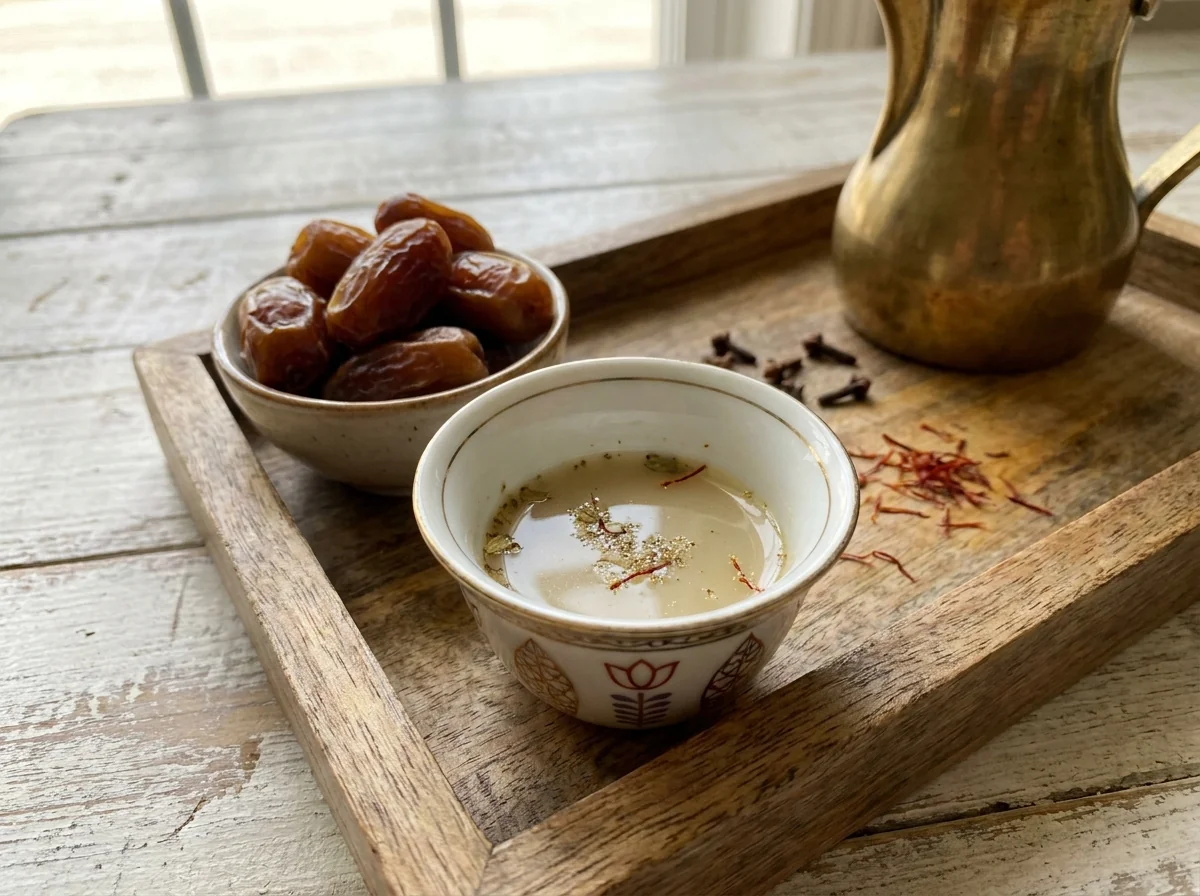
Arabic coffee is the foundation of Saudi hospitality: blond beans boiled long with cardamom and saffron and poured a third of a cup with the host's right hand.
UNESCO listed it as intangible cultural heritage, and its cup carries known social meanings in gatherings, with three cups being the proper measure of hospitality.
Preparation Steps
Boil the blond coffee in the dallah for twenty minutes
Boil the water in the dallah or kettle, then add the blond coffee and leave it over low heat for twenty minutes uncovered. Arabic coffee is boiled long, unlike most kinds of coffee, because the light-roast beans tolerate a boiling that would ruin dark beans.
Add the cardamom in the last five minutes
Grind the cardamom fresh and add it in the last five minutes, since long boiling evaporates its aromatic oils: the coffee is boiled long and the cardamom briefly.
Add the saffron off the heat
Take the dallah off the heat, add the saffron threads and rose water, and cover it for five minutes until the flavor steeps in, as saffron is steeped, not boiled.
Strain the coffee
Strain it through a fine sieve into a dallah preheated with hot water, as straining brings it out clear in color.
Pour by tradition with dates
The small cups are filled only to a third, and refills are offered to anyone who has not shaken their cup, in keeping with Saudi hospitality customs. Dates are always served alongside it.
Blood Sugar Impact
The glycemic index (GI) measures how quickly a food raises blood sugar, while the glycemic load (GL) measures how much a full serving raises it. Together they give the complete picture.
Glycemic Index
GI
48Low
Low0–55Medium56–69High70+
A low value (≤55) means a gradual rise in blood sugar — the most suitable range for diabetes and insulin resistance.
Glycemic Load
GL
0Low
Low0–10Medium11–19High20+
Glycemic load reflects the impact of the full serving. To lower it: take half a serving, or pair the recipe with a source of protein and fiber.
Nutritional Information
Per ServingMakes 8 servings · one serving is about 135 g of raw ingredients
Calories3 kcal0%of Daily Value*
Protein0 g0%of Daily Value*
Carbohydrates1 g0%of Daily Value*
Fat0 g0%of Daily Value*
Fiber0 g0%of Daily Value*
Sodium0 mg0%of Daily Value*
* Percent Daily Values are based on a 2,000-calorie diet per FDA food-label reference values — your daily needs may be higher or lower. Values are derived from the recipe's ingredients via the USDA database.
Troubleshooting
The most common problems when preparing Arabic Coffee with Cardamom and Saffron, and how to fix them:
It came out bitter
The cause is dark beans or strong heat. Use blond beans and low heat, as bitterness here is a fault in method, not in taste.
The cardamom aroma is missing
The cardamom went in too early so its aroma evaporated, or it was ground months ago. Add it in the last minutes and grind it at the time of use.
Its color is pale and faded
The beans were too few or the boiling time too short. Stick to the forty grams and twenty minutes, and the saffron completes the golden color.
Cloudy with sediment in the cup
The cause is a fine grind or skipping straining. Use a coarse grind, a fine sieve, and a slow, steady pour from the dallah.
Storage and Make-Ahead
In the preheated dallah
Two hours at its best, and a thermos keeps it for a full gathering.
Not reboiled
Reboiling loses its aroma, so prepare only as much as will be drunk.
The ground beans
In an airtight tin away from light for a month, and grinding the beans weekly is best.
Tested Ingredient Substitutions
Original Ingredient
Tested Substitute
Ratio
Flavor Difference
Saffron
Omit it
same amount
It becomes plain northern coffee, as regional schools differ: the northern is plain blond beans and the Hijaz is more aromatic
Cloves
Two cloves with the boil
same amount
A known southern touch
Rose water
Orange-blossom water or omit it
same amount
The optional aromatics are to taste
What is served with it
Sukkari dates or Kleeja (cardamom-stuffed cookies) from our library
same amount
Coffee is not served on its own
How Much Does It Make? Scaling Guide
Ingredient
dallah (8 cups)
0.5 dallah
2 dallahs
Light-roast coffee beans
40 g
20 g
80 g
Water
1 liter
500 ml
2 liters
Cardamom
10 g
5 g
20 g
EEINA Nutrition Tip
Blond beans do not burn with long boiling, as the light roast keeps the coffee's acids and oils intact so it tolerates twenty minutes of boiling that draws out its flavor without burnt bitterness. Dark beans do not work for this method, which is why Italian coffee does not suit the dallah nor dallah beans suit their machines: each roast has its method.
Add This Recipe to Your Plan
The EEINA app saves your favorite recipes, calculates them from their real ingredients, and shows your daily numbers toward your goal. Try it free now.
This is part of hospitality custom: a full cup among the Bedouin signals haste to the guest, and the third means the dallah is present and more is available, while shaking the cup signals enough.
Its caffeine compared to Western coffee?
A single cup is lighter due to the concentration and size, but the gathering's cups keep coming: three cups approach one cup of coffee, so moderation is called for.
Ready ground beans or beans ground at home?
Blond beans are ground weekly with cardamom ground at preparation time, and the difference in aroma is clear, as the aroma of Arabic coffee is half its value.
Its calories?
Near zero without sugar by nature, and its sweetness is in the date served alongside, making it the lightest of hospitality drinks.