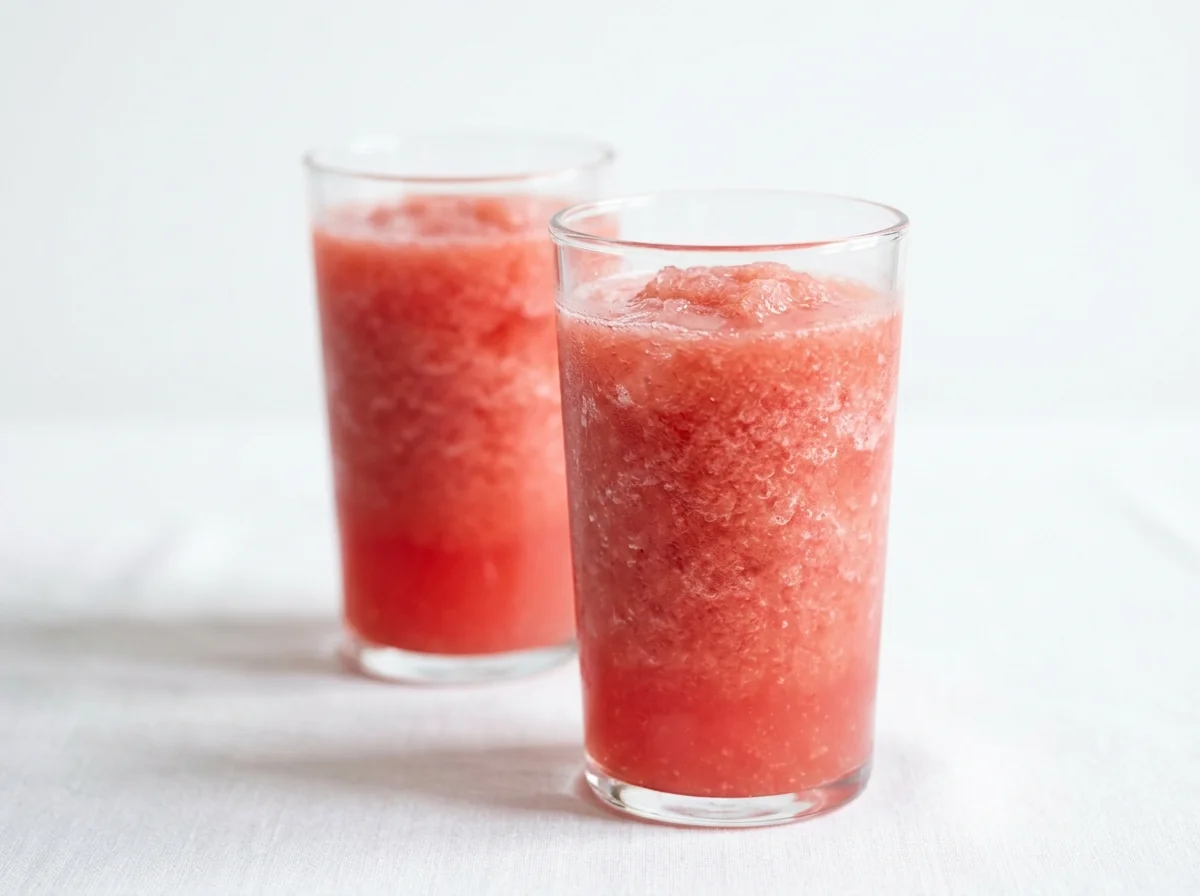
A smoothie with three ingredients and no more, and the watermelon carries its own water so no liquid needs adding.
The ice here is not only for chilling but for body: it is what turns thin juice into a heavy mixture you drink through a wide straw.
Preparation Steps
Put everything in the blender
Add all the ingredients to the blender jug: the watermelon, the ice, and the sugar.
Blend until thick
Blend until a thick, heavy mixture forms that does not run like juice, then pour it into two tall clear glasses and serve immediately.
Blood Sugar Impact
The glycemic index (GI) measures how quickly a food raises blood sugar, while the glycemic load (GL) measures how much a full serving raises it. Together they give the complete picture.
Glycemic Index
GI
71High
Low0–55Medium56–69High70+
A low value (≤55) means a gradual rise in blood sugar — the most suitable range for diabetes and insulin resistance.
Glycemic Load
GL
6Low
Low0–10Medium11–19High20+
Glycemic load reflects the impact of the full serving. To lower it: take half a serving, or pair the recipe with a source of protein and fiber.
Nutritional Information
Per ServingMakes 2 servings · one serving is about 60 g of raw ingredients
Calories33 kcal2%of Daily Value*
Protein0 g0%of Daily Value*
Carbohydrates8 g3%of Daily Value*
Fat0 g0%of Daily Value*
Fiber0 g0%of Daily Value*
Sodium1 mg0%of Daily Value*
Potassium64 mg1%of Daily Value*
Phosphorus6 mg0%of Daily Value*
* Percent Daily Values are based on a 2,000-calorie diet per FDA food-label reference values — your daily needs may be higher or lower. Values are derived from the recipe's ingredients via the USDA database.
Troubleshooting
The most common problems when preparing Watermelon Smoothie, and how to fix them:
The smoothie is thin, not thick
There is too little ice or it melted before blending. Use solid cubes from the freezer and blend them with the watermelon straight away.
The taste is watery and flat
The watermelon is underripe or there is too much ice. Choose ripe red watermelon, and add a spoon of sugar or a squeeze of lemon.
It separated after a few minutes
That is normal in a drink with no stabilizer. Stir it before drinking or serve it right after blending.
The blender will not crush the ice
Its blades are not made for ice. Crush the cubes first, or use frozen watermelon instead.
Storage and Make-Ahead
Serving
Immediately after blending; it is a drink of its moment.
Refrigerator (4°C)
Not kept: it separates and loses its body within half an hour.
Make ahead
Cut the watermelon and freeze it, then blend at serving with no ice.
Not recommended
Re-blending after it separates, since the texture does not come back.
Tested Ingredient Substitutions
Original Ingredient
Tested Substitute
Ratio
Flavor Difference
Sugar
Honey
8 g
A more fragrant sweetness, added after blending to preserve its flavor.
Ice
Frozen watermelon
114 g
A thicker body and stronger flavor with no dilution.
Watermelon
Cantaloupe
114 g
A gentler, slightly sweeter flavor, with the same texture.
Sugar
No sugar
zero
Ripe watermelon is sweet on its own, and leaving it out drops the calories to their lowest.
How Much Does It Make? Scaling Guide
Servings
Watermelon
Ice
Sugar
1 serving (half amount)
57 g
5 cubes
4 g
2 servings (base)
114 g
10 cubes
8 g
4 servings (double)
228 g
20 cubes
16 g
EEINA Nutrition Tip
Use watermelon chilled from the refrigerator and cut the ice back slightly for a stronger flavor, since a lot of ice thins the taste even as it thickens the body. And serve it at once, because it separates within minutes.
Add This Recipe to Your Plan
The EEINA app saves your favorite recipes, calculates them from their real ingredients, and shows your daily numbers toward your goal. Try it free now.
Three quarters of a cup of watermelon for two servings, isn't that little?
That is the source's amount and we carried it across as published without changing it. The ten ice cubes multiply the volume, so the two glasses fill with the frozen blend rather than with watermelon alone.
Should I use seedless watermelon?
Better, otherwise remove the seeds before blending since they give a faint bitterness when ground.
Why does it separate so fast?
Because it is water and ice with no fat and no stabilizer. Separation is natural, and the answer is to serve it at once rather than to add anything.
Does it work without sugar?
Entirely, if the watermelon is ripe. The source uses only two teaspoons, so leaving it out does not change the texture.
Sources: USDA · University of Sydney · Our methodology · Updated on