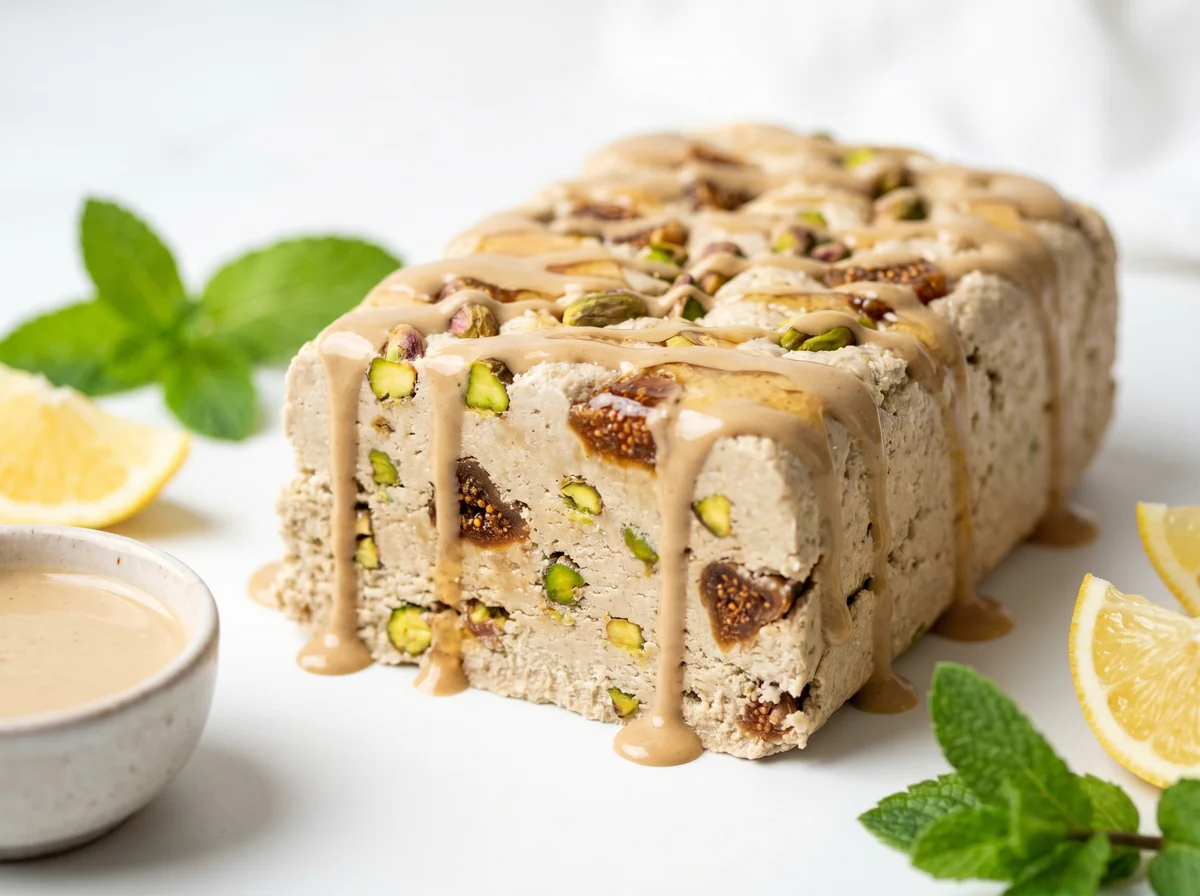
A time-honored Eastern sweet — tahini beaten with whipped sugar syrup until it forms a confection with a distinctive fibrous texture. Energy-rich, low glycemic load, contains sesame (tahini).
Tahini halva is a time-honored Eastern confection widespread across the Levant, Turkey, the Balkans, and the entire Arab East, made from tahini (sesame paste) combined with whipped sugar syrup to form a confection with a uniquely fibrous, stranded texture.
It has a long history in the region, sold in sweet shops and made at home, eaten as a sweet with tea or as a breakfast with bread. The rich sesame flavor and its melting fibrous texture have made it one of the most beloved popular sweets — present in memory as a childhood treat and pantry staple, a symbol of simple, authentic confectionery rich in sesame.
Preparation Steps
Prepare the tahini
Stir the tahini well (the oil floats to the top) and use good-quality tahini at room temperature. The quality of the tahini determines the quality of the halva — fresh, smooth tahini gives a silky confection; old tahini turns bitter.
Cook the sugar syrup
Boil the sugar, water, and lemon juice in a saucepan over medium heat until the syrup reaches the soft-ball stage (about 118–120°C, when it forms a thread between the fingers). The lemon juice prevents the sugar from crystallizing, and reaching the soft-ball stage is essential for the texture of the halva.
Beat the syrup
Remove the syrup from the heat and beat it (with a whisk or hand mixer) until it turns slightly white and becomes creamy and opaque. This beating develops the distinctive fibrous texture of tahini halva. Stir in the vanilla or orange blossom water.
Fold in the tahini
Add the tahini to the warm beaten syrup and fold together gently and quickly until just combined. Do not over-mix (over-mixing makes the halva oily and crumbly) — stop as soon as the syrup is distributed through the tahini and the mixture begins to hold together. Fold in the nuts if using.
Press into the mold
Pour the mixture into a lined or greased mold and press it firmly so it holds its shape. Cover and refrigerate for several hours until it firms up completely and its fibrous texture develops. Patience with the chilling is essential for the texture.
Slice and serve
Unmold the halva and slice it into pieces. Serve as a sweet or alongside breakfast with bread. It is a time-honored Levantine, Turkish, and Balkan confection, beloved throughout the region, distinguished by its unique fibrous texture and rich sesame flavor. Sold in sweet shops and made at home, it is eaten as a sweet with tea or as a breakfast with bread — an energy treat and a symbol of authentic popular confectionery rich in sesame.
Blood Sugar Impact
The glycemic index (GI) measures how quickly a food raises blood sugar, while the glycemic load (GL) measures how much a full serving raises it. Together they give the complete picture.
Glycemic Index
GI
56Medium
Low0–55Medium56–69High70+
A low value (≤55) means a gradual rise in blood sugar — the most suitable range for diabetes and insulin resistance.
Glycemic Load
GL
13Medium
Low0–10Medium11–19High20+
Glycemic load reflects the impact of the full serving. To lower it: take half a serving, or pair the recipe with a source of protein and fiber.
Nutritional Information
Per ServingMakes 10 servings · one serving is about 70 g of raw ingredients
Calories221 kcal11%of Daily Value*
Protein4 g8%of Daily Value*
Carbohydrates25 g9%of Daily Value*
Fat13 g17%of Daily Value*
Fiber2 g7%of Daily Value*
Sodium9 mg0%of Daily Value*
Potassium115 mg2%of Daily Value*
Phosphorus190 mg15%of Daily Value*
* Percent Daily Values are based on a 2,000-calorie diet per FDA food-label reference values — your daily needs may be higher or lower. Values are derived from the recipe's ingredients via the USDA database.
Troubleshooting
The most common problems when preparing Tahini Halva, and how to fix them:
The halva did not set (stayed soft)
The syrup did not reach the soft-ball stage. Cook the syrup until it reaches the soft-ball stage (about 118–120°C, it forms a thread between the fingers) — runny syrup does not produce firm halva. A candy thermometer helps.
The halva is oily and crumbly
It was over-mixed. Fold the tahini into the syrup gently and quickly until just combined — over-mixing separates the tahini oil and destroys the fibrous texture. Gentle folding preserves the texture.
The sugar crystallized (turned grainy)
Not enough lemon juice, or stirring while boiling. Add a squeeze of lemon to the syrup (prevents crystallization), and do not stir the syrup much while it boils. Crystallized sugar gives a sandy rather than smooth halva.
The halva is bitter
The tahini is old. Use good-quality fresh tahini (old tahini turns bitter and ruins the halva) and stir it well before using. The quality of the tahini is the foundation of the halva's quality and flavor.
Rock hard
The syrup was cooked past the soft-ball stage. Stop the syrup at the soft-ball stage — higher stages produce hard candy — and fold quickly before it sets. The target halva is firm but tender and melts in the mouth, not rock hard.
Storage and Make-Ahead
Room temperature
Tahini halva keeps in an airtight container at room temperature for weeks (a stable confection that keeps well), away from heat and humidity. Sesame and sugar are natural preservatives — it is a pantry sweet that lasts.
Refrigerator (4°C)
Keeps longer refrigerated (a month or more) and firms up further. Remove a few minutes before serving so it softens slightly (it is more tender at room temperature). Good for advance preparation.
Advance preparation
An ideal make-ahead sweet (keeps for weeks) — make it, slice it, and store it ready to serve. Practical as a pantry sweet, a gift, or a quick treat with tea.
Food safety
Tahini halva is a dry, stable confection (tahini and sugar) that keeps well with no issues. Use fresh tahini and clean utensils, and store tightly sealed away from moisture.
Tested Ingredient Substitutions
Original Ingredient
Tested Substitute
Ratio
Flavor Difference
Sugar
Honey or molasses (alternative versions)
According to the recipe
Honey or molasses versions are possible but the texture will differ (sugar syrup gives the classic fibrous texture) — healthy experiments.
Plain halva
Add pistachios, almonds, or chocolate
To taste
Nuts add crunch and nutritional value (adds allergens to note); chocolate is a modern twist (chocolate halva is popular).
Tahini
No substitute (tahini is the essence of halva)
—
Tahini (sesame) is the heart of tahini halva — those with a sesame allergy must avoid it entirely (it cannot be substituted).
How Much Does It Make? Scaling Guide
Servings
Tahini
Sugar
Water
5 (half recipe)
3/4 cup
1/2 cup
3 tablespoons
10 (base)
1 1/2 cups
1 cup
1/3 cup
20 (occasion)
3 cups
2 cups
2/3 cup
EEINA Nutrition Tip
Tahini halva is nutritionally richer than many sweets thanks to the tahini: sesame is an excellent source of calcium, iron, magnesium, healthy fats, and plant protein, and the fats and protein slow sugar absorption so its glycemic load is relatively low. Its challenge is that it is calorie- and sugar-dense (sugar syrup). Enjoy a small piece in moderation — it is a good source of minerals despite its sweetness, especially compared to empty-calorie confections.
Add This Recipe to Your Plan
The EEINA app saves your favorite recipes, calculates them from their real ingredients, and shows your daily numbers toward your goal. Try it free now.
A time-honored Eastern confection of tahini (sesame paste) combined with whipped sugar syrup to form a distinctive fibrous texture. Widespread in the Levant, Turkey, and the Balkans — eaten as a sweet with tea or as a breakfast with bread, sold in sweet shops and made at home.
What is the secret to the fibrous texture?
Beating the sugar syrup (at the soft-ball stage) until it turns white and opaque, then folding it into the tahini gently without over-mixing. The beating develops the fibrous texture; gentle folding preserves it; over-mixing destroys it and makes it oily. Chilling sets the texture.
Is tahini halva healthy?
Nutritionally richer than many sweets: tahini (sesame) is an excellent source of calcium, iron, magnesium, healthy fats, and protein, and the fats slow sugar absorption so the glycemic load is relatively low. Its challenge is that it is calorie- and sugar-dense, so enjoy a small piece. A good source of minerals despite its sweetness.
Why do I add lemon to the syrup?
A squeeze of lemon (an acid) prevents the sugar from crystallizing and turning grainy during cooking, giving a smooth syrup and a silky halva. It is an important step in cooking sugar syrup — sugar crystallizes easily without acid.