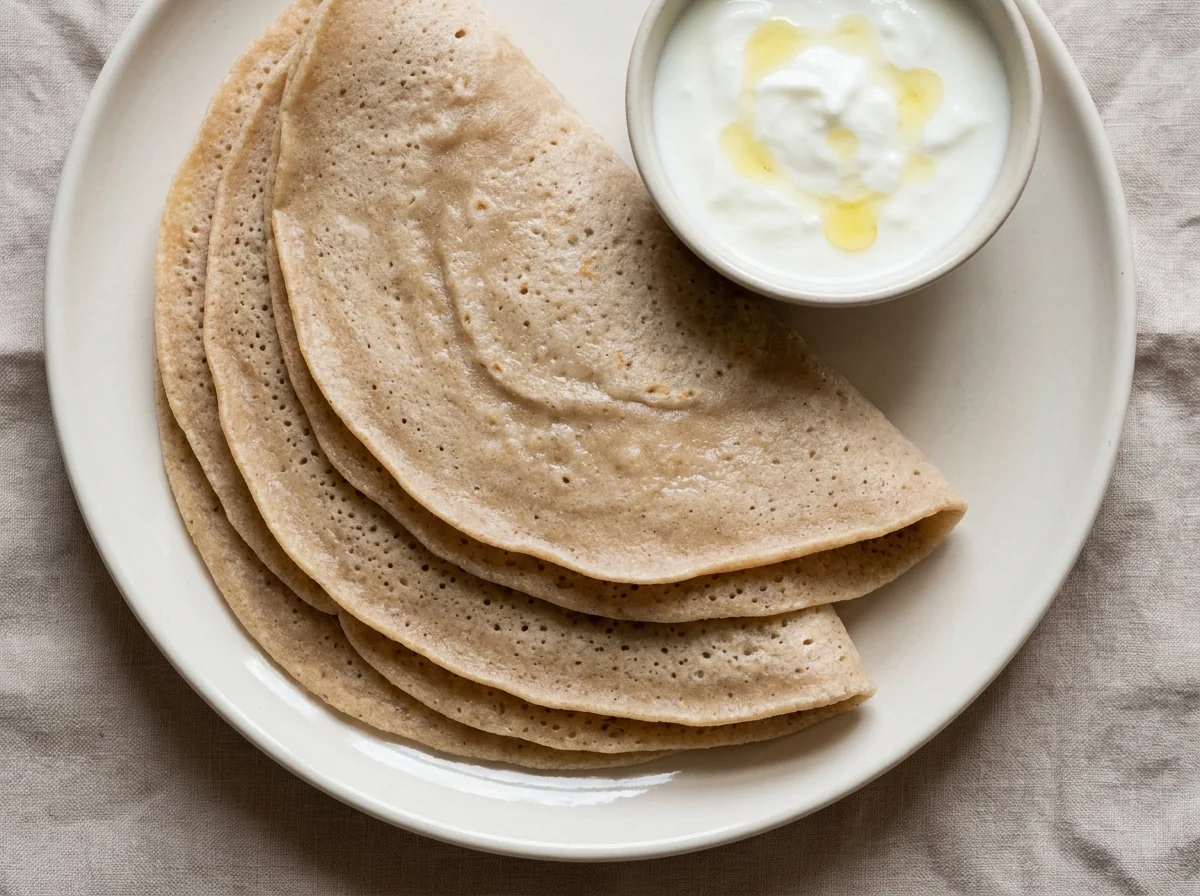
Kisra is the everyday bread of Sudan, thin sheets of fermented sorghum flour poured onto a griddle so they come out light and speckled.
Cooks keep a little batter as a starter for the next batch, so the fermented flavor is passed down from home to home.
Preparation Steps
The batter
Mix the sorghum flour with half the water and the starter in a bowl until you get a smooth, runny blend, as this is the kisra batter known as al-ajeen.
Fermenting
Cover the bowl and leave it in a warm place for 12 to 24 hours until bubbles appear and the taste turns lightly sour, and this fermentation gives the kisra its distinctive flavor and improves its digestibility.
Thinning
Add the wheat flour and the rest of the water and whisk well until the blend is very thin, like the consistency of milk, because thinness is the condition for it to form sheets.
Heating the griddle
Heat a griddle or flat pan over medium heat and grease it with a thin layer of oil using a paper towel so the kisra does not stick.
Pouring and spreading
Pour a small ladle of the batter and immediately spread it in a single motion with a flat tool from one side to the other until it covers the surface in a very thin layer.
Cooking and lifting
Cook it for one to two minutes until it dries and its surface sets, then lift it as a single sheet onto a plate, and repeat, stacking the sheets on top of one another.
Blood Sugar Impact
The glycemic index (GI) measures how quickly a food raises blood sugar, while the glycemic load (GL) measures how much a full serving raises it. Together they give the complete picture.
Glycemic Index
GI
75High
Low0–55Medium56–69High70+
A low value (≤55) means a gradual rise in blood sugar — the most suitable range for diabetes and insulin resistance.
Glycemic Load
GL
26High
Low0–10Medium11–19High20+
Glycemic load reflects the impact of the full serving. To lower it: take half a serving, or pair the recipe with a source of protein and fiber.
Nutritional Information
Per ServingMakes 8 servings · one serving is about 145 g of raw ingredients
Calories183 kcal9%of Daily Value*
Protein5 g10%of Daily Value*
Carbohydrates36 g13%of Daily Value*
Fat2 g3%of Daily Value*
Fiber1 g4%of Daily Value*
Sodium4 mg0%of Daily Value*
Potassium61 mg1%of Daily Value*
Phosphorus57 mg5%of Daily Value*
* Percent Daily Values are based on a 2,000-calorie diet per FDA food-label reference values — your daily needs may be higher or lower. Values are derived from the recipe's ingredients via the USDA database.
Troubleshooting
The most common problems when preparing Thin Sorghum Flatbread (Sudanese Kisra), and how to fix them:
The kisra does not spread out
Thin the batter with a little water until it is very runny, as a thick batter will not spread.
It sticks to the griddle
Grease a thin layer of oil before each sheet and make sure the griddle is hot enough.
No fermentation bubbles appear
Ferment longer in a warmer place, and in cold weather it may need two days.
Too sour a taste
Shorten the fermentation time in the next batch, as the acidity increases the longer it sits.
Storage and Make-Ahead
Room temperature
Covered with a cloth for the same day, as it is tastiest fresh.
The starter
Keep 60 g of the batter in the refrigerator for up to two weeks as a starter for the next batch.
Tested Ingredient Substitutions
Original Ingredient
Tested Substitute
Ratio
Flavor Difference
sorghum flour
millet flour
same weight, 250 g
A gluten-free whole grain with a similar flavor.
wheat flour
extra sorghum flour
same weight, 120 g
To make a fully gluten-free kisra with a thinner spread.
starter from a previous batter
yogurt
same weight, 60 g
Starts the fermentation on the first batch with no ready starter.
warm water
room-temperature water
same volume, 720 ml
Ferments a little slower with a similar result.
How Much Does It Make? Scaling Guide
Ingredient
Four servings
Eight servings (base)
Sixteen servings
sorghum flour
125 g
250 g
500 g
wheat flour
60 g
120 g
240 g
warm water
360 ml
720 ml
1440 ml
starter or yogurt
30 g
60 g
120 g
EEINA Nutrition Tip
The thinner the batter, the softer the kisra comes out, and we keep about 60 g of the fermented batter as a starter for next time, which shortens the fermentation and sets the flavor.
Add This Recipe to Your Plan
The EEINA app saves your favorite recipes, calculates them from their real ingredients, and shows your daily numbers toward your goal. Try it free now.