A timeless Moroccan energy sweet — toasted flour and almonds and sesame are ground and blended with honey and ghee and spices into a rich, sandy paste eaten by the spoonful. Low glycaemic load, contains gluten, tree nuts, sesame, and dairy.
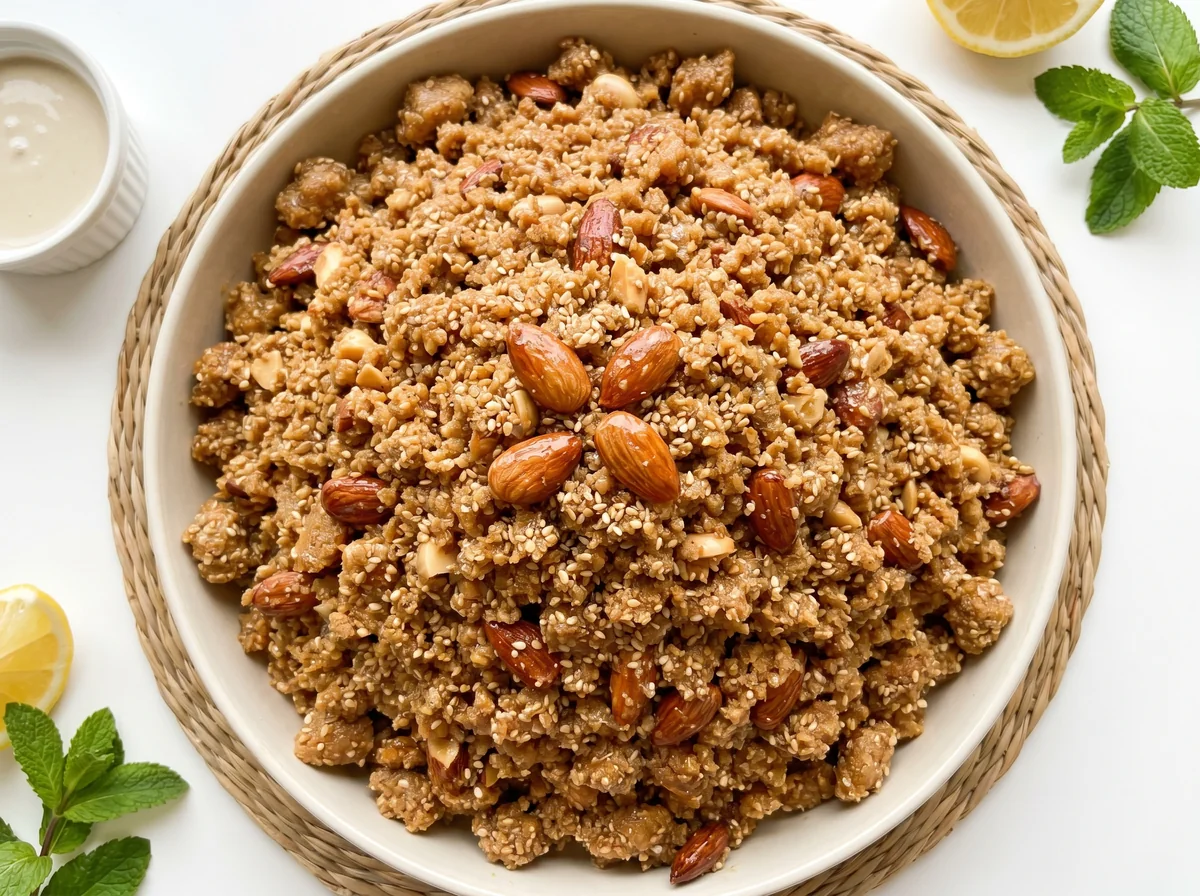
Sellou (also known as sfouf or zammita) is a timeless Moroccan energy sweet — a rich, sandy paste of toasted flour and ground almonds and sesame blended with honey, ghee, and spices (cinnamon and aniseed). It is made especially in Ramadan (a quick energy food after fasting) and after childbirth (served to the new mother to strengthen her and support milk production, similar to rfissa).
Eaten in small amounts by the spoonful with tea or milk. Its richness in nuts and sesame (concentrated energy and nutrients) made it a nourishing and hospitality sweet, and it carries deep emotional significance as a symbol of care, generosity, and Moroccan heritage — particularly in Ramadan and birth celebrations.
Preparation Steps
Toast the flour
Toast the flour in a dry pan (or oven) over low heat, stirring continuously, until it turns golden brown and a nutty toasted aroma rises — about twenty minutes. Thoroughly toasting the flour is the foundation and the flavour of sellou (and completely eliminates any raw taste), so do not rush.
Toast and grind the nuts
Toast the almonds and sesame separately until golden and fragrant, then grind most of them (keeping a little back for decoration). The almonds, sesame, and toasted flour are the three-ingredient base of sellou. Grinding gives the sandy texture.
Mix the dry ingredients
Combine the sifted toasted flour with the ground almonds and sesame, cinnamon, aniseed, and ground Arabic gum. Cinnamon and aniseed are sellou's distinctive flavours. Mix well until the aromatic sandy mixture is uniform.
Add the honey and ghee
Add the honey and warm melted ghee gradually to the dry mixture, kneading by hand until everything is absorbed and comes together into a moist, sandy texture that holds together when pressed (not a sticky dough, not dry and crumbly). Ghee and honey bind the sellou and give it its richness.
Adjust the texture
Adjust the texture: if too dry, add more ghee or honey; if too wet, add a little toasted flour. The desired texture is a moist, sandy paste that holds together (can be rolled or pressed but stays sandy in the mouth). Taste and adjust the sweetness and spices.
Shape and serve
Press the sellou into a dish and decorate with whole almonds and icing sugar, or roll into balls, or serve in a bowl to be eaten by the spoonful. Sellou is a timeless Moroccan energy sweet (also known as sfouf or zammita), prepared especially in Ramadan and after childbirth (strengthening and nourishing). Eat in small amounts with tea or milk — a symbol of Moroccan hospitality and nourishment.
Blood Sugar Impact
The glycemic index (GI) measures how quickly a food raises blood sugar, while the glycemic load (GL) measures how much a full serving raises it. Together they give the complete picture.
Glycemic Index
GI
63Medium
Low0–55Medium56–69High70+
A low value (≤55) means a gradual rise in blood sugar — the most suitable range for diabetes and insulin resistance.
Glycemic Load
GL
23High
Low0–10Medium11–19High20+
Glycemic load reflects the impact of the full serving. To lower it: take half a serving, or pair the recipe with a source of protein and fiber.
Nutritional Information
Per ServingMakes 12 servings · one serving is about 85 g of raw ingredients
Calories426 kcal21%of Daily Value*
Protein9 g18%of Daily Value*
Carbohydrates42 g15%of Daily Value*
Fat26 g33%of Daily Value*
Fiber5 g18%of Daily Value*
Sodium3 mg0%of Daily Value*
Potassium221 mg5%of Daily Value*
Phosphorus216 mg17%of Daily Value*
* Percent Daily Values are based on a 2,000-calorie diet per FDA food-label reference values — your daily needs may be higher or lower. Values are derived from the recipe's ingredients via the USDA database.
Troubleshooting
The most common problems when preparing Sellou (Moroccan Energy Sweet), and how to fix them:
A raw flour taste
The flour was not toasted enough. Toast over low heat with continuous stirring until golden brown and the nutty aroma rises (about 20 minutes). Good toasting is the foundation of sellou and completely eliminates any raw taste.
Sellou is dry and crumbly and won't hold together
Not enough ghee or honey. Add warm ghee or honey gradually and knead until the moist, sandy texture holds when pressed. The fat and honey bind the dry ingredients together.
Sellou is sticky and paste-like
Too much ghee or honey. Add toasted flour (or ground almonds) to absorb the excess. Sellou's texture is sandy and moist, not a sticky paste. The balance between dry and liquid gives the right consistency.
A bitter taste
The flour or nuts burned. Toast everything over low heat, monitoring until just golden — not burned. Burned flour and nuts give bitterness. Low heat and stirring are essential.
Heavy on the stomach
This is natural — sellou is a concentrated energy food and rich. Eat in small amounts (one or two spoonfuls), not large portions, with tea or milk. Its nutritional density is high, so a small portion satisfies and fills.
Storage and Make-Ahead
Room temperature
Sellou keeps in an airtight container at room temperature for weeks to a month (a relatively dry sweet; ghee and honey are natural preservatives), away from moisture. Ideal for advance preparation in Ramadan — made in a large batch and eaten gradually.
Refrigerator / Freezer
For longer shelf life (months), store sellou refrigerated or frozen in an airtight container (slows rancidity of nut and sesame oils). Remove to room temperature before eating to let it soften.
Advance preparation
An ideal sweet for advance preparation (keeps well), made before Ramadan or a birth and stored ready. Practical as a quick energy food for suhoor, iftar, or for a new mother.
Food safety
Sellou is a stable dry sweet (toasted flour, nuts, honey, and ghee) that keeps well as long as it is dry. Store sealed away from moisture. Honey should not be given to children under one year old. Use fresh nuts.
Tested Ingredient Substitutions
Original Ingredient
Tested Substitute
Ratio
Flavor Difference
Honey and ghee
Reduce both
to taste
Lowers calories. Sellou is rich in almonds and sesame, so ghee and honey can be reduced slightly while maintaining cohesion (do not reduce too much or it will crumble)
Almonds
Walnuts or peanuts or a mixed nut blend
same quantity
Almonds are traditional; a mixed nut blend enriches the flavour (still tree nuts; peanuts add their own allergen)
White flour
Wholemeal flour or toasted oats
same quantity
Raises fibre content with a deeper toasted flavour. Toasted white flour is the traditional choice in sellou.
How Much Does It Make? Scaling Guide
Amount
Flour
Almonds
Sesame
Half recipe
1.5 cups
1/2 cup
1/2 cup
Base
3 cups
1 cup
1 cup
Ramadan amount
6 cups
2 cups
2 cups
EEINA Nutrition Tip
Sellou is among the most nutritionally rich sweets: almonds and sesame are excellent sources of healthy fats, protein, fibre, calcium, iron, magnesium, and vitamin E; honey is a natural local sweetener; and the fats and fibre lower sugar absorption, keeping the glycaemic load low. It is a genuine concentrated energy food (beneficial for new mothers and athletes). Its only challenge is calorie density (nuts, ghee, and honey), so eat a spoonful or two, not large quantities. An excellent nourishing sweet in moderation.
Add This Recipe to Your Plan
The EEINA app saves your favorite recipes, calculates them from their real ingredients, and shows your daily numbers toward your goal. Try it free now.
A Moroccan energy sweet (also known as sfouf or zammita) — a rich, sandy paste of toasted flour and ground almonds and sesame blended with honey, ghee, and spices (cinnamon and aniseed). Eaten in small amounts by the spoonful with tea, especially in Ramadan and after childbirth. A nourishing energy food.
Why are the flour and nuts toasted?
Toasting brings out a deep nutty flavour and eliminates any raw flour taste, giving sellou its distinctive toasted character. Thoroughly toasting the flour (until golden brown) and the almonds and sesame is the foundation of a successful sellou. Take time over low heat — do not rush.
Is sellou healthy?
Yes — among the most nutritionally rich sweets: almonds and sesame provide healthy fats, protein, fibre, calcium, iron, magnesium, and vitamin E; honey is a natural sweetener; and the glycaemic load is low. A genuine concentrated energy food (beneficial for new mothers and athletes). Its only challenge is calorie density — eat a spoonful or two, not large quantities.
Why is it served to new mothers?
Sellou is rich in energy and concentrated nutrients (nuts, sesame, and honey), so it is traditionally served to new mothers after birth to strengthen them, restore their energy, and support milk production (similar to rfissa). It is part of the Moroccan tradition of caring for the mother after birth with nourishing, dense food.
Sources: University of Sydney · Gulf GSO · Our methodology · Updated on