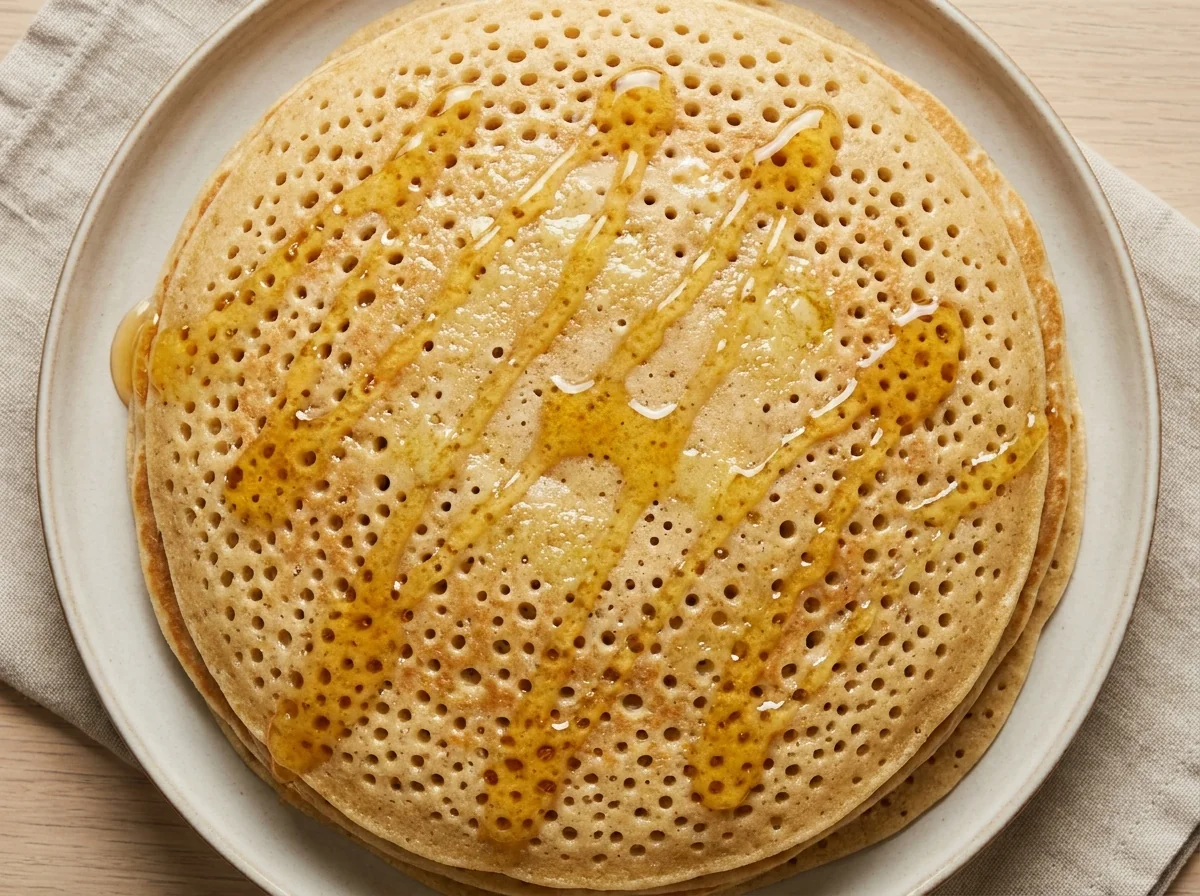
Lahoh is a spongy bread with a perforated surface, cooked on one side only, present in the Hejaz and the Saudi south with its Yemeni roots running deep, and served sweet with honey and ghee at breakfast as documented in Saudi cooking pages.
Preparation Steps
Whisk a liquid batter and ferment it
In a bowl, whisk the flour, semolina, yeast, sugar, and salt with the warm water well until it becomes a smooth liquid batter like thick crepe batter, and cover it for an hour until its surface bubbles and breathes. These fermentation bubbles are the eyes of the lahoh to come.
Add the baking powder at the moment of cooking
Just before cooking, sprinkle the baking powder and give it a light stir. Together with the fermented yeast they guarantee a surface full of holes.
Cook on one side only. The rule of lahoh
Heat a non-stick pan over medium heat. Gentle and with no fat, pour in a ladleful and swirl it into a disc. The eyes open across its surface into dozens of holes and its top dries within three minutes, and we never flip it: lahoh is cooked from its bottom only and keeps its spongy, perforated top, and that is its first law.
Stack under a towel
Lift each disc onto a cotton towel and cover it to keep it tender, and repeat until the batter runs out, with a quick swipe of fat between discs if needed.
Drizzle with ghee and honey and serve
Arrange the discs perforated-side up, brush them with melted ghee, and draw the honey in threads that sink into their eyes. Every hole carries its share of the drizzle, and that is why the eyes were made in the first place. Serve warm with the morning tea.
Blood Sugar Impact
The glycemic index (GI) measures how quickly a food raises blood sugar, while the glycemic load (GL) measures how much a full serving raises it. Together they give the complete picture.
Glycemic Index
GI
70High
Low0–55Medium56–69High70+
A low value (≤55) means a gradual rise in blood sugar — the most suitable range for diabetes and insulin resistance.
Glycemic Load
GL
66High
Low0–10Medium11–19High20+
Glycemic load reflects the impact of the full serving. To lower it: take half a serving, or pair the recipe with a source of protein and fiber.
Nutritional Information
Per ServingMakes 3 servings · one serving is about 270 g of raw ingredients
Calories541 kcal27%of Daily Value*
Protein11 g22%of Daily Value*
Carbohydrates98 g36%of Daily Value*
Fat11 g14%of Daily Value*
Fiber4 g14%of Daily Value*
Sodium368 mg16%of Daily Value*
Potassium150 mg3%of Daily Value*
Phosphorus226 mg18%of Daily Value*
* Percent Daily Values are based on a 2,000-calorie diet per FDA food-label reference values — your daily needs may be higher or lower. Values are derived from the recipe's ingredients via the USDA database.
Troubleshooting
The most common problems when preparing Saudi Lahoh with Honey, and how to fix them:
The eyes did not open
Thick batter or under-fermentation. Thin it with a quarter cup of warm water and be patient with it for an extra half hour.
The bottom burned and the top is raw
High heat. Medium. A gentle heat cooks the top with the rising steam before the bottom darkens.
The lahoh stuck to the pan
An ordinary pan with no non-stick layer. Non-stick is a must, and a quick swipe of fat with cotton when needed.
It came out rubbery after cooling
It was stacked uncovered so it dried out. A cotton towel right after lifting keeps its steam and tenderness.
Storage and Make-Ahead
Warm
Drizzled within an hour of cooking. Its peak.
At room temperature
As dry discs for a day in a sealed bag. Drizzle at serving, not before.
In the freezer
As discs between sheets of parchment for a month. Revive on a gentle pan and drizzle fresh.
Tested Ingredient Substitutions
Original Ingredient
Tested Substitute
Ratio
Flavor Difference
Honey and ghee
Milk and lentil broth
~
The savory Yemeni original top for lahoh
White flour
Half white corn flour
1:1 for the half
Closer to its southern roots
Baking powder
Yeast alone with an extra hour
~
The traditional path of patience
Ghee
Melted butter
1:1
Milder in aroma
How Much Does It Make? Scaling Guide
Ingredient
~8 discs
~4 discs
~16 discs
Flour
250 g
125 g
500 g
Water
400 ml
200 ml
800 ml
Honey
60 g
30 g
120 g
EEINA Nutrition Tip
The heat is medium, gentle and the pan has no fat; fat blocks the eyes before they open, and high heat burns the bottom before the top cooks. And the batter of the first disc is your gauge: few eyes means a thick batter, so add water.
Add This Recipe to Your Plan
The EEINA app saves your favorite recipes, calculates them from their real ingredients, and shows your daily numbers toward your goal. Try it free now.
All three are fermented batters, but lahoh is the thinnest, cooked on one side with open eyes; masabeeb is thicker, drizzled with milk; and khameer is a disc flipped on both sides. Each has its own form and method.
Why is lahoh never flipped?
Its spongy perforated surface is its identity and the reservoir of its drizzle. Flipping it closes the eyes and turns it into an ordinary crepe.
Is it eaten savory?
In its Yemeni original it accompanies broth and salad; the sweet Saudi top with honey is the child of this recipe, and both are legitimate.
How many discs are a reasonable breakfast?
Two discs drizzled in moderation with a cup of milk, and eyes greedy for honey are tamed with a thin thread, not a pour.