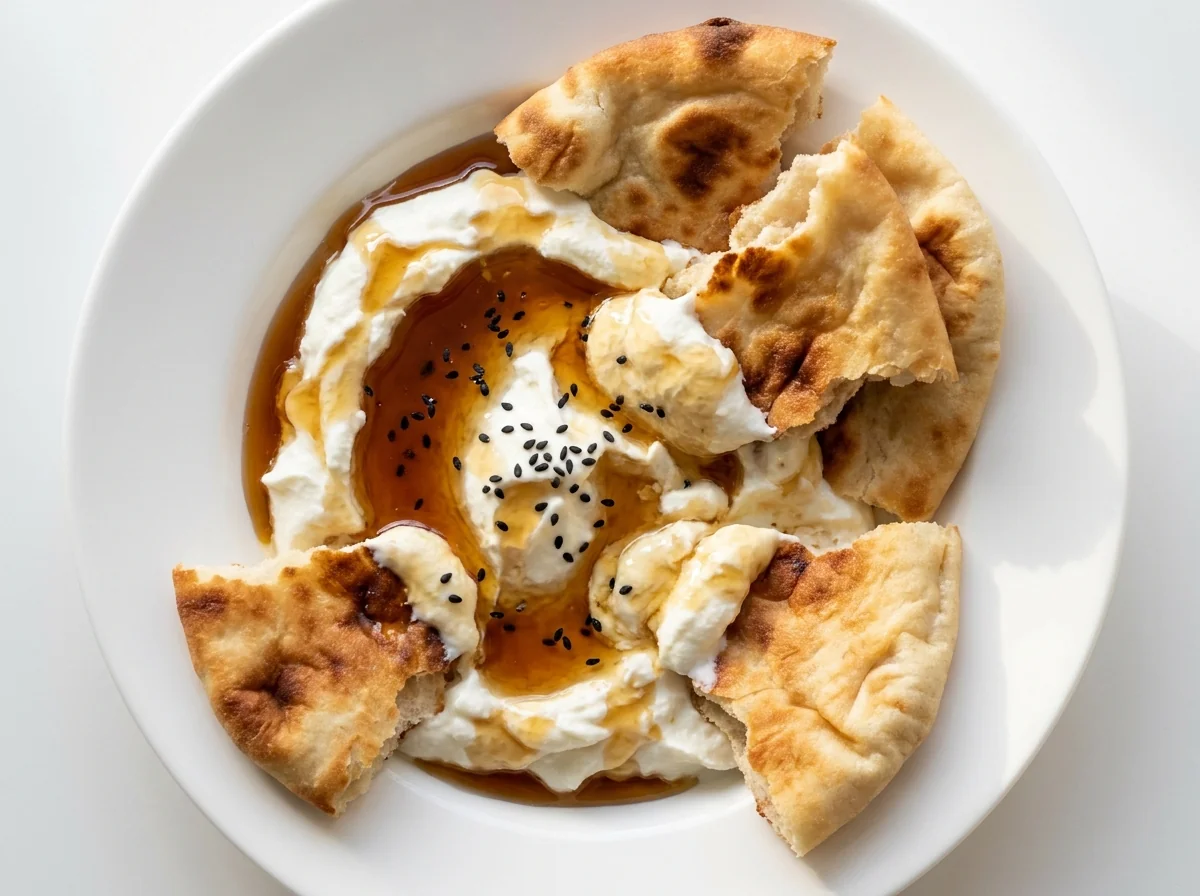
Qishta with honey is among the fixtures of the Hijaz tables in the morning and at suhoor, paired in Mecca and Jeddah with hot Tamees bread the way tea pairs with mint.
Cold richness meets golden sweetness over bread that steams.
Preparation Steps
Spread the cold cream
Spread the fresh qishta in a small flat plate in a generous, rippled layer. Its coldness against the heat of the bread is part of the dish's beauty.
Draw the honey
Drizzle the Sidr honey over it in golden crossing lines without mixing. The eye eats before the hand, and every bite will gather its own share.
A pinch of nigella seeds
For those who want it in the way of the old Hijazi homes. A warm aroma that breaks the richness of the cream.
Serve with the hot bread
Hot Tamees straight from the baker or toasted shreek. It is torn by hand and dipped in a way that gathers the cream and honey in every pocket.
Blood Sugar Impact
The glycemic index (GI) measures how quickly a food raises blood sugar, while the glycemic load (GL) measures how much a full serving raises it. Together they give the complete picture.
Glycemic Index
GI
66Medium
Low0–55Medium56–69High70+
A low value (≤55) means a gradual rise in blood sugar — the most suitable range for diabetes and insulin resistance.
Glycemic Load
GL
41High
Low0–10Medium11–19High20+
Glycemic load reflects the impact of the full serving. To lower it: take half a serving, or pair the recipe with a source of protein and fiber.
Nutritional Information
Per ServingMakes 2 servings · one serving is about 200 g of raw ingredients
Calories342 kcal17%of Daily Value*
Protein10 g20%of Daily Value*
Carbohydrates64 g23%of Daily Value*
Fat5 g6%of Daily Value*
Fiber2 g7%of Daily Value*
Sodium428 mg19%of Daily Value*
Potassium275 mg6%of Daily Value*
Phosphorus185 mg15%of Daily Value*
* Percent Daily Values are based on a 2,000-calorie diet per FDA food-label reference values — your daily needs may be higher or lower. Values are derived from the recipe's ingredients via the USDA database.
Troubleshooting
The most common problems when preparing Qishta with Honey, Hijazi Style, and how to fix them:
The cream ran and melted
A warm plate or a hot kitchen. Keep it in the fridge until the moment of spreading.
Overwhelming sweetness
The honey hand was heavy. Forty grams to two hundred of cream is the Hijaz homes' ratio.
The bread cooled and let it down
Cold Tamees is half a Tamees. Revive it a minute in a dry pan or hot oven.
Cream sour on the surface
It passed its days. Fresh cream has a short life that is not to be gambled with.
Storage and Make-Ahead
Immediately
A dish assembled and eaten where you sit. Not before and not after.
Disassembled
The cream in its sealed container three days at the coldest of the fridge, and the honey for all its lifetime.
Not suitable for freezing
The cream separates into water and fat.
Tested Ingredient Substitutions
Original Ingredient
Tested Substitute
Ratio
Flavor Difference
Fresh milk qishta
Local cream from the neighborhood dairy
1:1
The original you measure against
Sidr honey
Date molasses
1:1
A second well-known Hijazi style
Tamees bread
Hot whole-wheat bread
1:1
Higher in fiber
To lighten
Half cream and half labneh whisked together
1:1
Broken richness and gentle tartness
How Much Does It Make? Scaling Guide
Ingredient
2 servings
1 serving
4 servings
The cream
200 g
100 g
400 g
The honey
40 g
20 g
80 g
The bread
160 g
80 g
320 g
EEINA Nutrition Tip
Fresh milk qishta from the chiller, not the long-pasteurized canned cream. The difference between them is the difference between farm butter and industrial ghee.
Add This Recipe to Your Plan
The EEINA app saves your favorite recipes, calculates them from their real ingredients, and shows your daily numbers toward your goal. Try it free now.
Its richness is the secret of its long satiety. The fats slow gastric emptying, and the moderate serving with whole-wheat bread makes it a solid suhoor, not a glut. Those watching their calories should make it a guest of special occasions.
Qishta or labneh?
Labneh is light and tart and qishta is sweet and stately, and the Hijaz keeps each in its place and has a style for mixing them too.
A particular honey?
Sidr is the sultan of the Hijazi tables, and any honest mountain honey sits beside it with dignity.
Is it good for children?
They adore it. With the reminder that honey is not given to those under one year of age according to the approved safety guidelines.