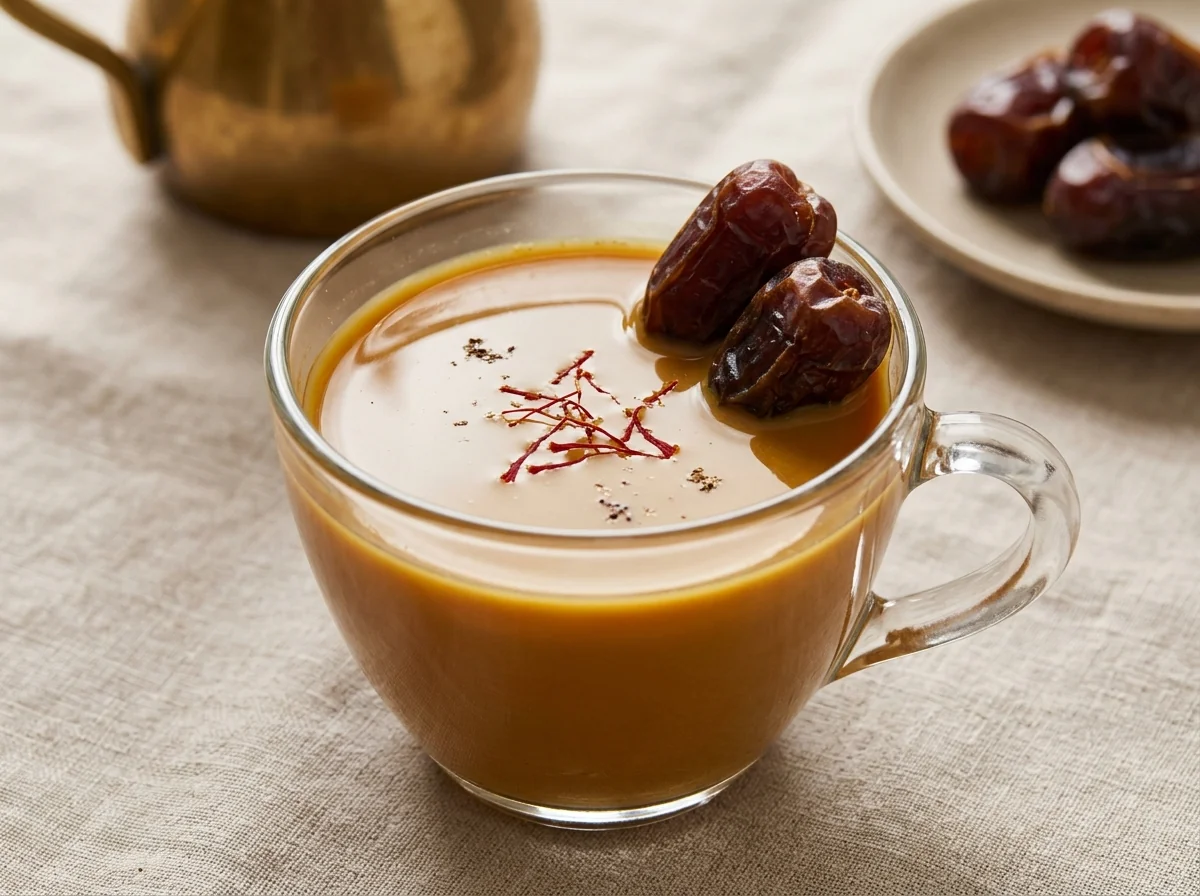
Saudi-style Arabic coffee brewed three times in a dallah with cardamom and saffron, naturally sweetened with Ajwa dates — served in small cups with floating date pieces.
Mazboot coffee is a Gulf coffee sweetened with dates for natural sweetness and depth of flavor, an old Bedouin custom before sugar became widespread.
The name 'mazboot' means 'tied in sweetness' because the dates tie the coffee flavor together and soften its bitterness. At suhoor the dates provide quick energy and warmth.
Preparation Steps
Boil the water with the coffee
Pour the water into a traditional rakwa (dallah) and add the ground coffee. Heat over medium heat until the first foam (zafrā) appears, then remove from the heat.
Bring to a boil twice more
Return the rakwa to the heat three times, lifting it off each time foam appears. This extracts the full coffee flavor and yields a strong, dark-colored coffee.
Add the cardamom and saffron
Add the freshly ground cardamom and the saffron. Leave the coffee over low heat for 3 more minutes. The saffron gives a golden color and a luxurious aroma.
Sweeten with dates
Add the pitted Ajwa dates and crush them with the back of a spoon inside the rakwa. Leave them for 3 minutes so the natural sugars of the dates dissolve into the coffee.
Serve
Pour the coffee into small finjan (cups) through a fine strainer. Garnish each cup with two dates and serve with floating saffron threads.
Blood Sugar Impact
The glycemic index (GI) measures how quickly a food raises blood sugar, while the glycemic load (GL) measures how much a full serving raises it. Together they give the complete picture.
Glycemic Index
GI
48Low
Low0–55Medium56–69High70+
A low value (≤55) means a gradual rise in blood sugar — the most suitable range for diabetes and insulin resistance.
Glycemic Load
GL
7Low
Low0–10Medium11–19High20+
Glycemic load reflects the impact of the full serving. To lower it: take half a serving, or pair the recipe with a source of protein and fiber.
Nutritional Information
Per ServingMakes 2 servings · one serving is about 285 g of raw ingredients
Calories57 kcal3%of Daily Value*
Protein0 g0%of Daily Value*
Carbohydrates15 g5%of Daily Value*
Fat0 g0%of Daily Value*
Fiber1 g4%of Daily Value*
Sodium1 mg0%of Daily Value*
* Percent Daily Values are based on a 2,000-calorie diet per FDA food-label reference values — your daily needs may be higher or lower. Values are derived from the recipe's ingredients via the USDA database.
Troubleshooting
The most common problems when preparing Mazboot Coffee with Dates, and how to fix them:
The coffee is bitter
Add two more dates or reduce the coffee. Too much coffee brings out the bitterness.
The color is dull
Double the saffron or return the rakwa to the heat for 3 minutes. Saffron needs high heat to release its color.
The dates clumped
Blend them first with a spoon of water. Dry dates need to be crushed before adding.
The cardamom flavor is lost
Use fresh cardamom and add it after lifting the rakwa off the heat. High heat evaporates the aromatic oils.
Storage and Make-Ahead
In the rakwa
One hour on very low heat. Arabic coffee loses its freshness quickly.
In the refrigerator
One day in a bottle. Reheat with a spoon of water over low heat.
Tested Ingredient Substitutions
Original Ingredient
Tested Substitute
Ratio
Flavor Difference
Ajwa dates
Saq'i dates
1:1
Less sweet — increase the amount by 30%.
Arabic coffee
Brazilian coffee
1:1
A sweeter flavor with less acidity.
Saffron
Turmeric
Half the amount
Color only, no saffron flavor.
How Much Does It Make? Scaling Guide
Ingredient
2 people
4 people
6 people
Water
500 ml
1000 ml
1500 ml
Coffee
20 g
40 g
60 g
Cardamom
4 g
8 g
12 g
Dates
40 g
80 g
120 g
EEINA Nutrition Tip
Choose light-roasted (not dark) Arabic coffee. The light roast keeps a gentle acidity that balances the date sugar. Use coffee ground no more than a week ago.
Add This Recipe to Your Plan
The EEINA app saves your favorite recipes, calculates them from their real ingredients, and shows your daily numbers toward your goal. Try it free now.
What is the difference between mazboot and regular coffee?
Mazboot is sweetened with dates instead of sugar. The date flavor deepens the coffee and gives it body. Regular coffee is sweetened with white sugar or left bitter.
How many calories per cup?
About 30 kcal. The coffee itself is nearly calorie-free — the calories come from the dates and natural sugars.
Is it suitable for people with high blood pressure?
Consult your doctor. Caffeine raises blood pressure temporarily. A small cup is safe, but excess makes it worse.
Is it suitable for children?
Above the age of 12. Caffeine affects children's sleep. Offer them decaf coffee (dates + cardamom without the coffee).