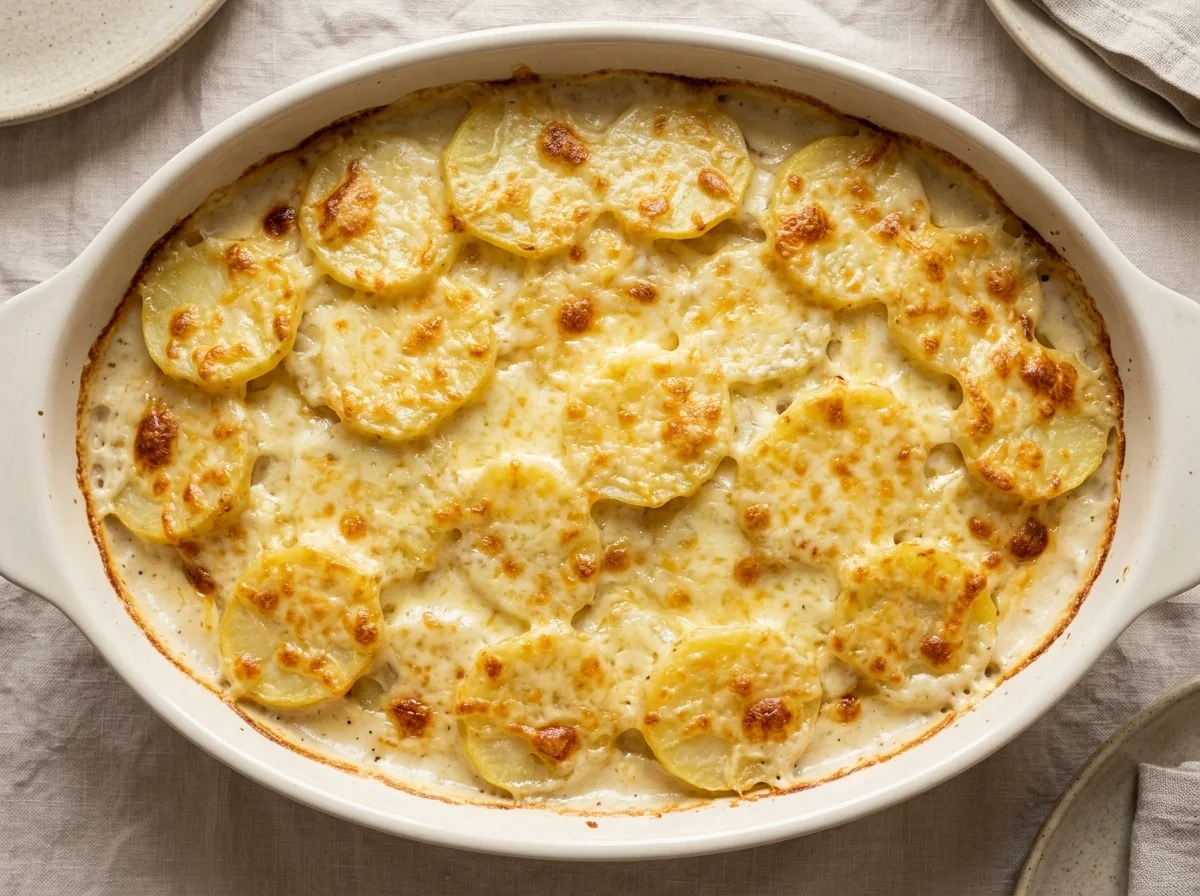
Béchamel made from butter, flour, and milk seasoned with salt and peppers, then layered with potato slices in a pan, sprinkled with cheese on top, and baked until done.
A homemade pan when the kitchen has potatoes, milk, and cheese: here the béchamel is intentionally thin and light, two tablespoons of flour to two cups of milk, so its job is to cook the potatoes in its steam and coat them rather than bury them.
And the layers are the method, so every slice gets its share of sauce instead of swimming in it.
Preparation Steps
Toast the Flour in the Butter
Melt the butter in a pot over medium heat, then add the flour and stir well for two minutes until the ingredients come together and the flour gives off a faint aroma without browning; these two minutes are what remove the raw flour taste from the sauce.
Pour in the Milk
Pour in the milk while stirring continuously until a thick, even mixture forms that coats the back of a spoon; the continuous stirring here is what prevents lumps from forming in the first place.
Season the Béchamel
Season the sauce with the salt, white pepper, and black pepper, then stir until the ingredients intermingle and the seasoning is distributed throughout the sauce; taste it at this moment because adjusting after assembly is difficult.
Layer the First Layer
Arrange a quarter of the quantity of potatoes in a baking pan, then pour a small amount of the béchamel mixture over them so it covers them with a thin layer that does not drown them.
Repeat the Layers
Repeat with a potato layer and a sauce layer until the quantity runs out, making sure the last layer is sauce because it is what protects the top potatoes from drying out in the oven.
Sprinkle the Cheese
Sprinkle the shredded mozzarella evenly over the entire surface so no spot is left without color after baking.
Bake Until Done
Place the pan in an oven preheated to 180 degrees Celsius for about thirty-five minutes until the potatoes are cooked, a knife goes through them without resistance, and the surface becomes golden and taut.
Blood Sugar Impact
The glycemic index (GI) measures how quickly a food raises blood sugar, while the glycemic load (GL) measures how much a full serving raises it. Together they give the complete picture.
Glycemic Index
GI
72High
Low0–55Medium56–69High70+
A low value (≤55) means a gradual rise in blood sugar — the most suitable range for diabetes and insulin resistance.
Glycemic Load
GL
32High
Low0–10Medium11–19High20+
Glycemic load reflects the impact of the full serving. To lower it: take half a serving, or pair the recipe with a source of protein and fiber.
Nutritional Information
Per ServingMakes 5 servings · one serving is about 380 g of raw ingredients
Calories395 kcal20%of Daily Value*
Protein15 g30%of Daily Value*
Carbohydrates49 g18%of Daily Value*
Fat15 g19%of Daily Value*
Fiber5 g18%of Daily Value*
Sodium683 mg30%of Daily Value*
* Percent Daily Values are based on a 2,000-calorie diet per FDA food-label reference values — your daily needs may be higher or lower. Values are derived from the recipe's ingredients via the USDA database.
Troubleshooting
The most common problems when preparing Potato Béchamel Bake, and how to fix them:
The potatoes remained raw
The slices are thick or the sauce was scant so the pan dried out before they cooked. Thin the slices and cover the pan with aluminum foil for the first twenty minutes, then uncover it to brown the top.
The béchamel became lumpy
The milk was poured in all at once or stirring was interrupted. Pour it gradually while stirring continuously, and if it lumps, pass it through a sieve or beat it with a hand whisk.
The top burned before the dish was done
The pan is too close to the top broiler. Move the rack to the middle and cover the top with aluminum foil until the potatoes are cooked, then uncover for the last five minutes.
The sauce is runny on the plate
The béchamel did not thicken enough on the heat. Cook it until it coats the back of a spoon and leaves a line when you run your finger through it before pouring it over the potatoes.
Storage and Make-Ahead
Refrigerator (4°C)
In a sealed container for three days, and reheated in the oven not the microwave so the surface regains its firmness.
Freezing
Freeze it cooked and sliced for up to two months, and thaw it in the refrigerator overnight before reheating.
Advance preparation
Assemble the full pan and store it in the refrigerator unbaked for a day, then bake it when needed adding ten minutes.
Serving
Serve hot after resting for five minutes outside the oven, since immediate slicing breaks up the layers.
Tested Ingredient Substitutions
Original Ingredient
Tested Substitute
Ratio
Flavor Difference
Mozzarella
Grated cheddar
Equal measure
Sharper taste.
Full-fat milk
Low-fat milk
Equal measure
Lower fat.
Potatoes
Cooked cauliflower
Equal measure
Lower-carb option.
Butter
Olive oil
Equal measure
Mediterranean version.
How Much Does It Make? Scaling Guide
Servings
Potatoes
Milk
Flour
Cheese
2.5 servings (half amount)
600 g
244 g
7.5 g
83 g
5 servings (base)
1200 g
488 g
15 g
165 g
10 servings (double)
2400 g
976 g
30 g
330 g
EEINA Nutrition Tip
Cut the potatoes into rounds of equal thickness as much as you can, because a thick slice stays raw and a thin one falls apart, and the pan cooks evenly in one thickness, not in varying thicknesses. Those who want more assurance can boil them for five minutes before arranging.
Add This Recipe to Your Plan
The EEINA app saves your favorite recipes, calculates them from their real ingredients, and shows your daily numbers toward your goal. Try it free now.
We estimated them at 1200 grams based on an average potato weight of 150 grams in the USDA table; the source mentions the count without weight. Potatoes vary, so whoever uses larger potatoes should add a little more sauce.
Should I boil the potatoes before arranging?
The source arranges them raw and relies on thirty-five minutes in the oven. Boiling for five minutes before arranging is a safe shortcut for those whose slices are thick or who want less oven time.
Why both white and black pepper?
White has a deeper flavor and does not leave dark spots in the white sauce, while black gives visible heat. The source combines them at a quarter teaspoon each.
Can ground meat be added?
That is another pan with its own measurements and method. The measurements of this source are potatoes, béchamel, and cheese only, and what is added to it takes it outside the transcribed recipe.
How long is the baking time and at what temperature?
The source specifies a preheated oven at 180 degrees Celsius for about thirty-five minutes until done. The thickness of the potato slices is the biggest thing that changes this time.
Sources: USDA · University of Sydney · Our methodology · Updated on