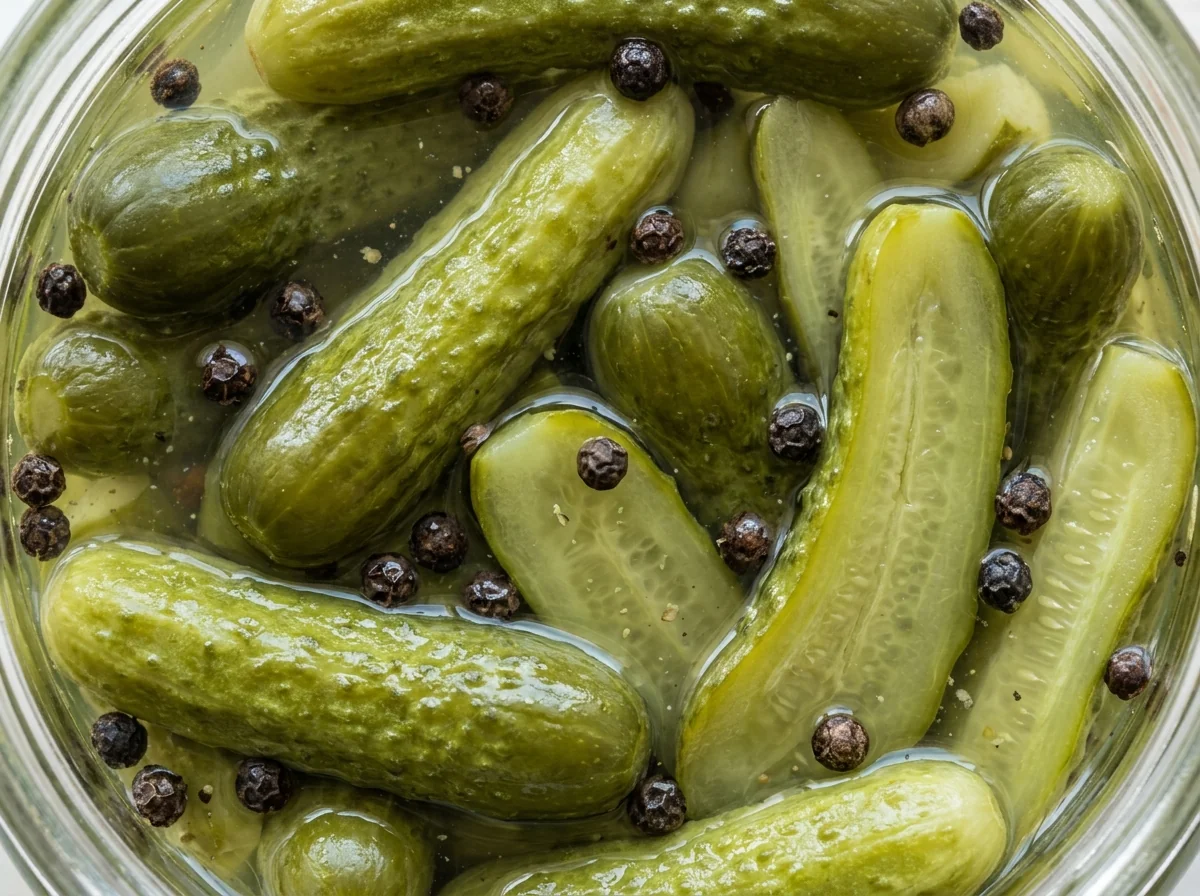
Small fresh cucumbers, each slit and packed into a jar with black peppercorns, covered in a brine of water, salt, vinegar, and sugar, then sealed tight and left for at least two weeks to cure.
The simplest and best known of pickles: small cucumbers, a salt brine, and two weeks of patience.
The small slit in each cucumber is the key to the recipe, letting the brine into the center so the cucumber cures from within instead of staying salty only at the skin. And the source gives the golden rule of the brine: one tablespoon of salt for every cup of water, so the amount grows and shrinks with the size of the jar.
Preparation Steps
Prepare the cucumbers
Wash and dry the cucumbers, then cut a slit in each one with a knife so the brine reaches its center.
Pack the jar
Arrange the cucumbers in the jar and scatter the black peppercorns among them.
Pour the brine
Mix the water with the salt, sugar, and vinegar, and pour the mixture over the cucumbers until the liquid covers them completely.
Seal and wait
Close the jar tightly and leave it for at least two weeks until it cures and is ready to eat.
Blood Sugar Impact
The glycemic index (GI) measures how quickly a food raises blood sugar, while the glycemic load (GL) measures how much a full serving raises it. Together they give the complete picture.
Glycemic Index
GI
15Low
Low0–55Medium56–69High70+
A low value (≤55) means a gradual rise in blood sugar — the most suitable range for diabetes and insulin resistance.
Glycemic Load
GL
0Low
Low0–10Medium11–19High20+
Glycemic load reflects the impact of the full serving. To lower it: take half a serving, or pair the recipe with a source of protein and fiber.
Nutritional Information
Per ServingMakes 8 servings · one serving is about 265 g of raw ingredients
Calories15 kcal1%of Daily Value*
Protein1 g2%of Daily Value*
Carbohydrates3 g1%of Daily Value*
Fat0 g0%of Daily Value*
Fiber1 g4%of Daily Value*
Sodium1011 mg44%of Daily Value*
* Percent Daily Values are based on a 2,000-calorie diet per FDA food-label reference values — your daily needs may be higher or lower. Values are derived from the recipe's ingredients via the USDA database.
Troubleshooting
The most common problems when preparing Pickled Cucumbers, and how to fix them:
The brine turned cloudy and lost its clarity
Light cloudiness is normal in home pickling. Thick cloudiness with a bad smell, though, is a sign of contamination: discard the batch and start with a sterilized jar.
The cucumbers came out soft, not crisp
The cucumbers were large or wilted, or the pickling ran long in a warm spot. Choose small, firm, fresh cucumbers, and keep the jar somewhere cool once it has cured.
A white film on the surface
A surface yeast that forms when a cucumber floats above the brine or too much air gets in. Skim the film off at once, and make sure the liquid covers every cucumber and the seal is tight.
The pickles are too salty
The source's ratio is one tablespoon per cup of water; more salt than that makes them sharper. Rinse the cucumbers in cold water before serving to soften the saltiness.
Storage and Make-Ahead
While curing
In a spot of moderate temperature away from the sun, for at least two weeks as the source specifies, and the jar is not opened during that time.
Once cured
Move the jar to the refrigerator so curing stops where it is and the cucumbers stay crisp for weeks.
After opening
Use a clean, dry spoon every time you take some, reseal the lid, and the pickles keep in the refrigerator for about a month.
Signs of spoilage
A bad smell, visible mold, or a bulging lid: throw the whole batch out without tasting.
Tested Ingredient Substitutions
Original Ingredient
Tested Substitute
Ratio
Flavor Difference
Sea salt
Coarse non-iodized salt
Same amount
Iodized salt can change the color of the brine and cloud it; coarse non-iodized salt is the more reliable pickling choice.
Vinegar
Apple cider vinegar
120 ml
Similar acidity with a light fruity note that shows in the pickles.
Whole black peppercorns
Black peppercorns with garlic cloves and dill
5 peppercorns with 2 cloves and 2 sprigs
The classic pickling aromatics for anyone who likes a more fragrant pickle; they are not in the source's ingredients.
Sugar
Leaving it out
Omit
The source's tablespoon softens the edge of the salt and vinegar; leaving it out is fine and the difference in balance is slight.
How Much Does It Make? Scaling Guide
Servings
Cucumbers
Water
Sea salt
Vinegar
4 servings (half batch)
500 g
480 ml (2 cups)
36 g (2 tablespoons)
60 ml
8 servings (base recipe)
1000 g
960 ml (4 cups)
72 g (4 tablespoons)
120 ml
16 servings (double, two jars)
2000 g
1920 ml (8 cups)
144 g (8 tablespoons)
240 ml
EEINA Nutrition Tip
A clean jar is the whole of pickling: wash it in hot water and dry it completely before packing, because any leftover washing water or clinging oil clouds the brine and ruins the batch. And keep the cucumbers fully submerged; a cucumber floating above the liquid is the first thing to spoil.
Add This Recipe to Your Plan
The EEINA app saves your favorite recipes, calculates them from their real ingredients, and shows your daily numbers toward your goal. Try it free now.
Where do the nutrition values come from, given how much salt dissolves in the brine?
Because dividing a pickle's ingredients by its servings does not hold: most of the salt and vinegar stays in the liquid that gets thrown away, not in the cucumber that gets eaten. So we took the laboratory-measured value for ready pickles from USDA (FDC 168558) for a 125 gram serving, which is the source's kilo of cucumbers divided by its eight servings. Pickles remain high in sodium, so count them within your day's salt.
How much salt does the brine need if I use a bigger jar?
The source's rule: one tablespoon of salt for every cup of water, with the water set by the size of the jar. The amount grows and shrinks on that ratio however the size changes.
Why a full two weeks?
That is the time the source sets for the cucumbers to cure: the acidity and salt need time to reach the center of each cucumber and turn its flavor. Opening early gives you cucumbers that are salty on the outside only.
Do I need to boil the brine or sterilize the jar in boiling water?
The source's method mixes the brine cold, with no boiling, and settles for a clean, tightly sealed jar. Anyone wanting extra caution can wash the jar in hot water and dry it completely before packing.
When is it ready, and how do I know?
After at least two weeks as in the source: the skin turns a pale olive shade and the cucumber's texture carries the flavor through, sour and salty all the way to its center.
Sources: USDA · University of Sydney · Our methodology · Updated on