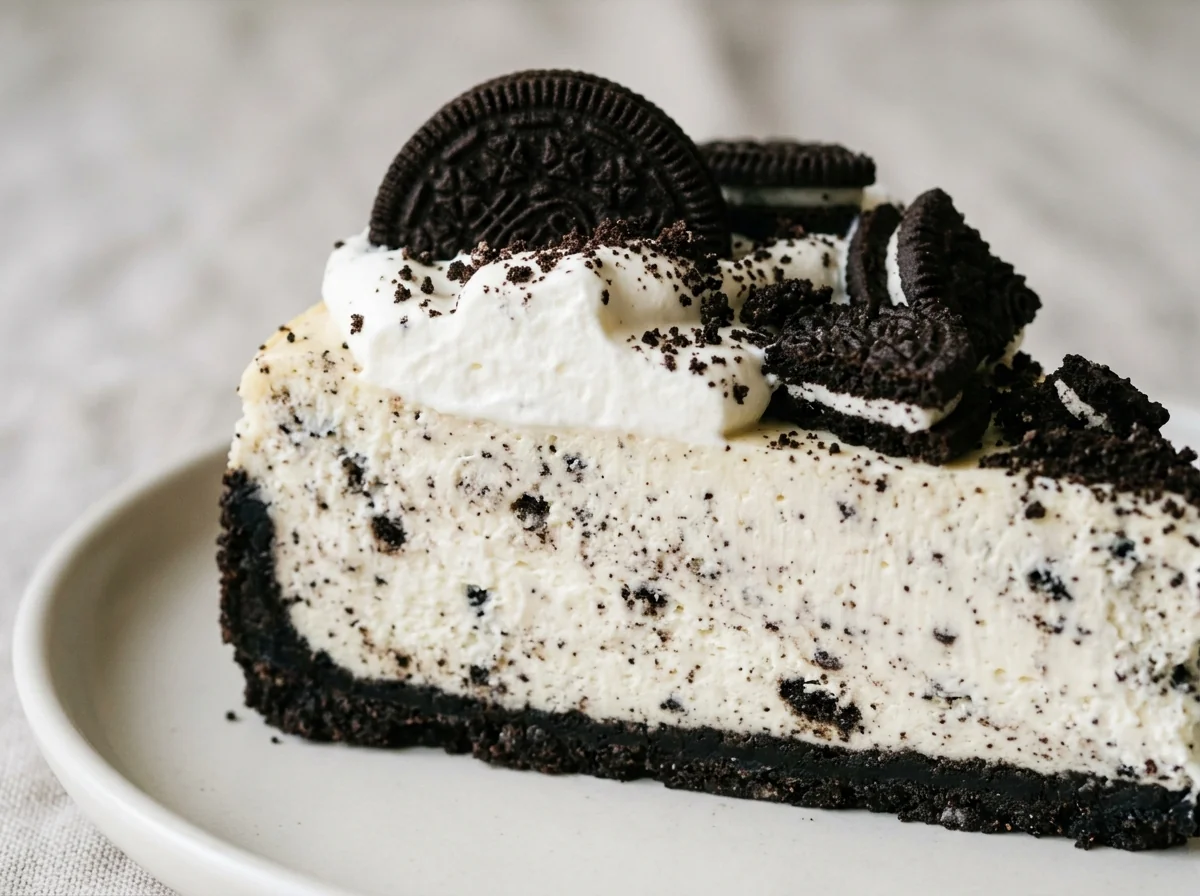
A base of ground Oreo biscuits with butter that sets in the oven for seven minutes, topped with a layer of cream cheese, whipping cream, and vanilla set with gelatin, chilled for six hours and garnished with cream and Oreo cookies.
A cold cheesecake built on Oreo twice over: the whole base is the biscuit ground with butter, and a little of it goes back into the cheese layer itself so it comes out speckled with chocolate crumbs.
Seven minutes of oven for the base alone, then the gelatin and the refrigerator take over, and the six-hour wait is the price of a slice that stands firm and does not collapse when cut.
Preparation Steps
Prepare the base mixture
Mix the ground biscuits with the butter, reserving a little of the biscuit aside to fold into the cheese layer later.
Press the base
Spread the mixture over the bottom of a springform pan, pressing evenly until compact.
Set the base in the oven
Place the pan in the oven for seven minutes until the base sets, then leave it aside to cool completely.
Whip the cheese layer
In an electric blender, whip the cream cheese and the cream with the vanilla, and once the cream has doubled in volume, add the dissolved gelatin and the reserved biscuit and mix.
Pour and chill
Pour the mixture over the cooled base and smooth the surface, then leave the pan in the refrigerator for at least six hours until set.
Garnish and serve
Garnish the top with cream and Oreo cookies and serve cold.
Blood Sugar Impact
The glycemic index (GI) measures how quickly a food raises blood sugar, while the glycemic load (GL) measures how much a full serving raises it. Together they give the complete picture.
Glycemic Index
GI
67Medium
Low0–55Medium56–69High70+
A low value (≤55) means a gradual rise in blood sugar — the most suitable range for diabetes and insulin resistance.
Glycemic Load
GL
31High
Low0–10Medium11–19High20+
Glycemic load reflects the impact of the full serving. To lower it: take half a serving, or pair the recipe with a source of protein and fiber.
Nutritional Information
Per ServingMakes 6 servings · one serving is about 155 g of raw ingredients
Calories629 kcal31%of Daily Value*
Protein11 g22%of Daily Value*
Carbohydrates48 g17%of Daily Value*
Fat45 g58%of Daily Value*
Fiber2 g7%of Daily Value*
Sodium526 mg23%of Daily Value*
* Percent Daily Values are based on a 2,000-calorie diet per FDA food-label reference values — your daily needs may be higher or lower. Values are derived from the recipe's ingredients via the USDA database.
Troubleshooting
The most common problems when preparing Oreo Cheesecake, and how to fix them:
The layer did not set after chilling
The gelatin was not properly dissolved, or the refrigerator time fell short. Dissolve it in hot water until completely clear, and keep to the six hours minimum as in the source.
Stringy lumps of gelatin inside the layer
The gelatin cooled before going into the mixture. Add it warm and fluid while still whipping so it spreads through before it sets.
The base crumbled when cutting
There was less butter than the source's measure, or the base was not pressed well. Press it down with the bottom of a glass until compact; the seven minutes in the oven fix it in place.
The layer is runny in texture even though it set
The cream was not whipped until doubled in volume before the gelatin went in. Whip it first as the source specifies, since that airiness is the structure of the layer.
Storage and Make-Ahead
Refrigerator (4°C)
Keeps covered for up to 4 days, and covering keeps it from picking up refrigerator odors.
Freezing
Freeze wrapped slices for up to a month, and thaw them in the refrigerator for a few hours before serving, not at room temperature.
Serving
Cold, straight from the refrigerator, and cut with a knife dipped in hot water for clean-edged slices.
The garnish
Added before serving rather than before storing, since Oreo cookies soften on the damp surface over time.
Tested Ingredient Substitutions
Original Ingredient
Tested Substitute
Ratio
Flavor Difference
Gelatin
Plant-based agar agar
1 teaspoon boiled in water
A plant-based swap that sets more firmly than gelatin, and it must be boiled to work, unlike gelatin which is only dissolved.
Whipping cream
Non-dairy whipping cream
240 ml
Works for anyone cutting back on dairy; it holds its air less firmly, so add an hour of chilling.
Cream cheese
Strained cottage cheese whipped smooth
220 g
Much more protein and much less fat, with a less rich taste.
Oreo biscuits in the base
Chocolate digestive biscuits
300 g
A less sweet base for anyone who finds Oreo very sweet, and the chocolate character stays.
How Much Does It Make? Scaling Guide
Servings
Ground Oreo
Cream cheese
Whipping cream
3 servings (half batch)
150 g
110 g
120 ml
6 servings (base recipe)
300 g
220 g
240 ml
12 servings (double)
600 g
440 g
480 ml
EEINA Nutrition Tip
Cheese and cream at room temperature are the condition for a well-whipped, airy layer, while the gelatin is dissolved in hot water and poured in warm and fluid: if it cools and sets before pouring it forms stringy lumps in the mixture, and if poured very hot it deflates the whipped cream.
Add This Recipe to Your Plan
The EEINA app saves your favorite recipes, calculates them from their real ingredients, and shows your daily numbers toward your goal. Try it free now.
The source sets the time at seven minutes and gives no temperature, and the cue is the base setting rather than its color. A moderate oven does the job, and watching by eye is more accurate than a number.
How much do the eight Oreo cookies weigh?
About 74 grams, that is 9.2 g per cookie. We took it from the product label itself: the 'Oreo Original Oreo Cookies' pack weighs 36.8 grams and holds four cookies, and its label defines a serving as two cookies. The garnish cookies are counted in the nutrition on that weight.
Why six hours in the refrigerator?
That is the source's time for the gelatin to set the whole layer. Cutting early gives a slice that runs from the middle even if the surface has firmed.
Does it set without gelatin?
The source's method is built on gelatin and mentions nothing else. Anyone wanting an alternative can use plant-based agar as in the substitutions, since a layer with no setting agent will not stand as a slice.
Sources: USDA · University of Sydney · Our methodology · Updated on