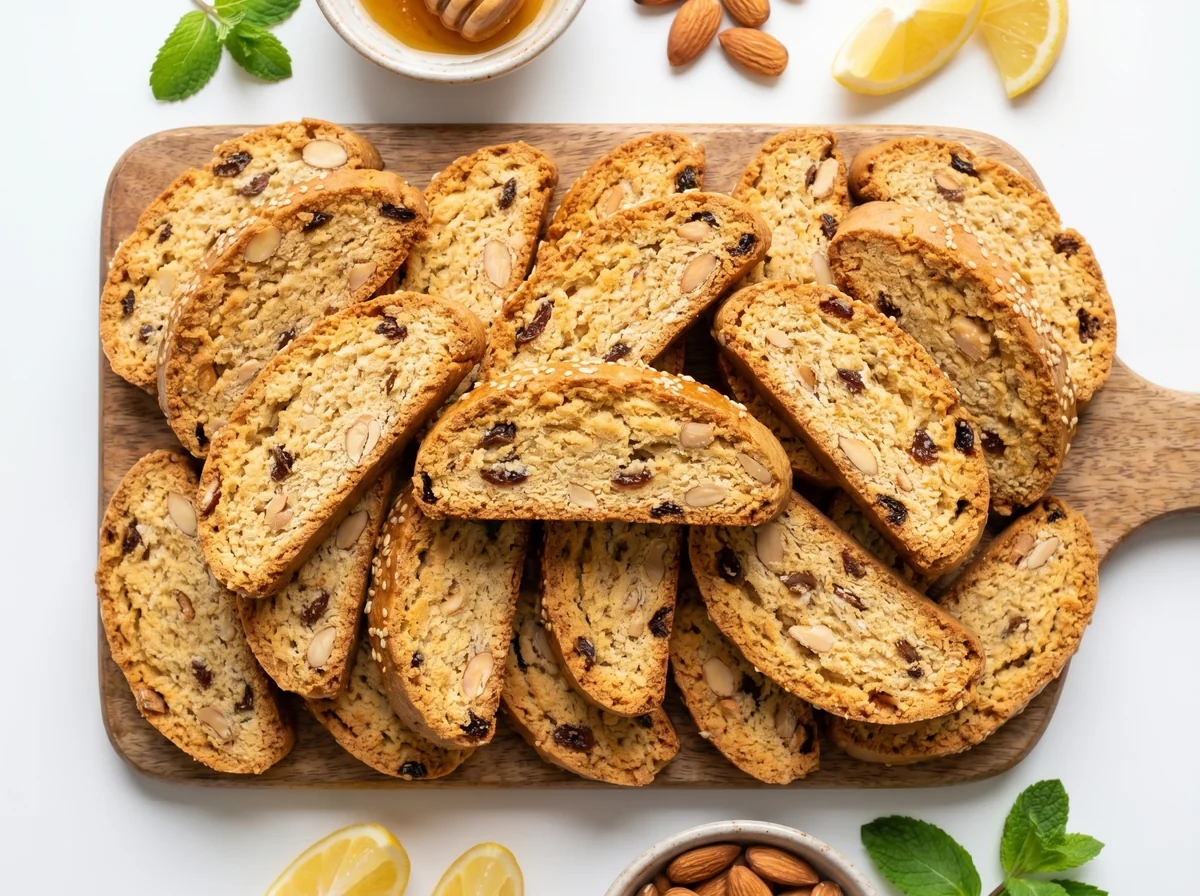
Moroccan twice-baked biscuit — a dough with almonds, raisins, anise and sesame is shaped into logs, baked, sliced and baked again until crisp. A delicate hospitality biscuit for dipping in tea, sweetened and best enjoyed in moderation; contains gluten, tree nuts, eggs and sesame.
Fekkas (or fkkas) is a beloved, traditional crisp Moroccan biscuit — a staple of Moroccan hospitality, holiday and Ramadan sweet tables. It resembles Italian biscotti in technique (twice-baked): the dough (rich with almonds, raisins, anise, sesame and orange zest) is shaped into logs, baked, then sliced and baked again until dry and crunchy.
Double baking gives a lasting crunch (the biscuit keeps for weeks), making it a practical hospitality provision. Fekkas is richly flavoured — anise, toasted sesame, almonds, raisins and orange zest form a fragrant Moroccan medley — and is served alongside Moroccan mint tea or coffee, perfect for dipping. Its crunch and complex flavour have made it a distinctive Moroccan hospitality biscuit, a symbol of Moroccan home baking and the gracious tradition of its tea table.
Preparation Steps
Make the dough
Mix the flour, sugar, butter, eggs, baking powder and salt into a firm dough, then work in the toasted almonds, raisins, anise, sesame and orange zest. Fekkas is a Moroccan nut-and-seed biscuit (like Italian biscotti), richly flavoured with anise, sesame and almonds.
Shape into logs
Shape the dough into cylindrical logs and arrange them on a baking tray. Leave them to rest a little (they can rise slightly if yeast is used). Shaping into long logs is essential (they will be sliced after the first bake, like biscotti) — do not shape them into individual pieces now.
First bake
Bake the logs in a moderate oven until set, lightly golden and firm (not completely dry), about twenty minutes. The first bake sets the logs so they can be sliced (half-baked). Leave them to cool slightly so the slices come out clean.
Slice
Cut the baked logs (warm, not hot) into thin slices (about 1 cm) with a sharp knife. Thin slicing gives biscuits that will crisp up fully during the second bake (like biscotti) — make the slices even and thin so they dry out uniformly.
Second bake (toast)
Arrange the slices on the tray and bake again at a low temperature until dried out and crisp on both sides, about twenty minutes, turning halfway. Double baking is the secret to the crunch (it dries the slices so they become brittle and keep well), exactly like biscotti.
Cool and serve
Leave the fekkas to cool completely (they crisp further as they cool) and serve with Moroccan mint tea or coffee (for dipping). A treasured, crisp Moroccan heritage biscuit (a hospitality, holiday and Ramadan treat) — rich in almonds, raisins, anise and sesame, its multiple flavours and satisfying crunch make it a distinctive hospitality biscuit that keeps well, a symbol of Moroccan home baking and the generosity of its celebrated tea table.
Blood Sugar Impact
The glycemic index (GI) measures how quickly a food raises blood sugar, while the glycemic load (GL) measures how much a full serving raises it. Together they give the complete picture.
Glycemic Index
GI
69Medium
Low0–55Medium56–69High70+
A low value (≤55) means a gradual rise in blood sugar — the most suitable range for diabetes and insulin resistance.
Glycemic Load
GL
8Low
Low0–10Medium11–19High20+
Glycemic load reflects the impact of the full serving. To lower it: take half a serving, or pair the recipe with a source of protein and fiber.
Nutritional Information
Per ServingMakes 40 servings · one serving is about 25 g of raw ingredients
Calories84 kcal4%of Daily Value*
Protein2 g4%of Daily Value*
Carbohydrates12 g4%of Daily Value*
Fat4 g5%of Daily Value*
Fiber1 g4%of Daily Value*
Sodium4 mg0%of Daily Value*
Potassium49 mg1%of Daily Value*
Phosphorus26 mg2%of Daily Value*
* Percent Daily Values are based on a 2,000-calorie diet per FDA food-label reference values — your daily needs may be higher or lower. Values are derived from the recipe's ingredients via the USDA database.
Troubleshooting
The most common problems when preparing Moroccan Fekkas (Double-Baked Almond Biscotti), and how to fix them:
Fekkas is not crunchy
Second bake was too short. Bake the slices a second time at low heat until they are fully dried out and crisp (this is the secret to the crunch, like biscotti), and turn them so both sides dry. A thorough second bake dries and crisps them.
Crumbles when sliced
Sliced hot or wrong knife. Slice the logs while warm, not hot (they firm up slightly as they cool), using a sharp serrated knife and a gentle motion. Cooling slightly and a sharp knife give clean, uncrumbled slices.
Tooth-breakingly hard
Second bake too long or slices too thick. Bake only until crunchy and dry (do not overdo it) and slice thinly. Fekkas should be crisp for dipping in tea (like biscotti) but not rock-hard.
Dough does not come together
Not enough liquid or eggs. Add an egg or a little liquid to bring the dough together (it needs to hold the nuts), without making it too soft. A firm dough can be shaped into logs that slice cleanly.
Bland flavour
Not enough anise, sesame or orange zest. These flavours are the soul of Moroccan fekkas — do not hold back on them (anise, toasted sesame, orange zest and toasted almonds). This fragrant mix is what distinguishes it from a plain biscuit.
Storage and Make-Ahead
Room temperature
Fekkas keeps in a sealed container at room temperature for weeks (a twice-baked dry biscuit that naturally keeps well — its heritage advantage). Stays crisp. Perfect for preparing ahead for hospitality, holidays and Ramadan.
Freezer
Baked fekkas can be frozen for two months in a sealed container (it already keeps well, so this is rarely necessary). Or freeze the logs after the first bake, then slice and bake them fresh for the second bake. Practical for large quantities.
Meal prep
Ideal for preparing ahead (keeps for weeks) — make it before the occasion or holiday and store sealed. A hospitality biscuit always ready for guests. Double baking extends its shelf life.
Food safety
A dry biscuit that keeps well in a sealed dry container (moisture softens it and ruins the crunch). Use fresh almonds and seeds (nuts go rancid over time) and store away from moisture and heat.
Tested Ingredient Substitutions
Original Ingredient
Tested Substitute
Ratio
Flavor Difference
Butter/oil
Vegetable oil
Same quantity
Oil makes it dairy-free (if used instead of butter) and fekkas is already relatively low-fat; both work
Almonds and raisins
Walnuts, more sesame or dried figs
Same quantity
Fekkas can be made with various fillings (almonds, walnuts, sesame, figs, dates); all nuts, seeds and dried fruits add flavour and value
White flour
Flour with some whole wheat
Mostly white
Some whole wheat adds fibre with a slightly denser texture; white flour gives the classic crunch
How Much Does It Make? Scaling Guide
Pieces
Flour
Sugar
Almonds
20 (small)
1.5 cups
1/4 cup
1/4 cup
40 (base)
3 cups
1/2 cup
1/2 cup
80 (holiday)
6 cups
1 cup
1 cup
EEINA Nutrition Tip
Fekkas is a hospitality biscuit with relative value: almonds and sesame are healthy fats, protein, vitamin E and calcium; raisins provide fibre and minerals; anise is a digestive; and the glycemic load per small piece is low (the nuts and seeds slow sugar release). Its challenges are the sugar, white flour and how easy it is to eat several pieces. Best at one or two pieces with tea in moderation. To lighten: reduce the sugar, use some whole-wheat flour, and increase the almonds and sesame. A delicious hospitality biscuit — the nuts and seeds add value, in moderation.
Add This Recipe to Your Plan
The EEINA app saves your favorite recipes, calculates them from their real ingredients, and shows your daily numbers toward your goal. Try it free now.
A traditional crisp Moroccan twice-baked biscuit (like Italian biscotti): the dough (with almonds, raisins, anise, sesame and orange zest) is shaped into logs, baked, sliced and baked again until crunchy. A hospitality, holiday and Ramadan treat, served with Moroccan mint tea or coffee for dipping — richly flavoured.
Why is it baked twice?
Double baking (like biscotti) is the secret to fekkas's crunch and keeping quality: the first bake sets the logs so they can be sliced, and the second bake dries the slices until brittle and crunchy, lasting for weeks (a dry biscuit that does not spoil quickly). This made it a practical hospitality provision historically — prepared in quantity and kept ready for guests.
What is the difference between fekkas and biscotti?
Both are twice-baked nut biscuits (same technique), but fekkas is Moroccan with distinctive Moroccan flavours (anise, toasted sesame, orange zest and raisins with almonds), while biscotti is Italian (almonds and sometimes chocolate). Fekkas is more aromatic from the seeds and anise; the technique is identical (twice-baked).
Is fekkas healthy?
A hospitality biscuit with relative value: almonds and sesame offer healthy fats, protein, vitamin E and calcium; raisins add fibre; anise is a digestive; and the glycemic load per piece is low. Challenges are the sugar, white flour and how easy it is to eat several. One or two pieces with tea, reduce the sugar and use some whole wheat. Delicious — the nuts add value, in moderation.
Sources: University of Sydney · Gulf GSO · Our methodology · Updated on