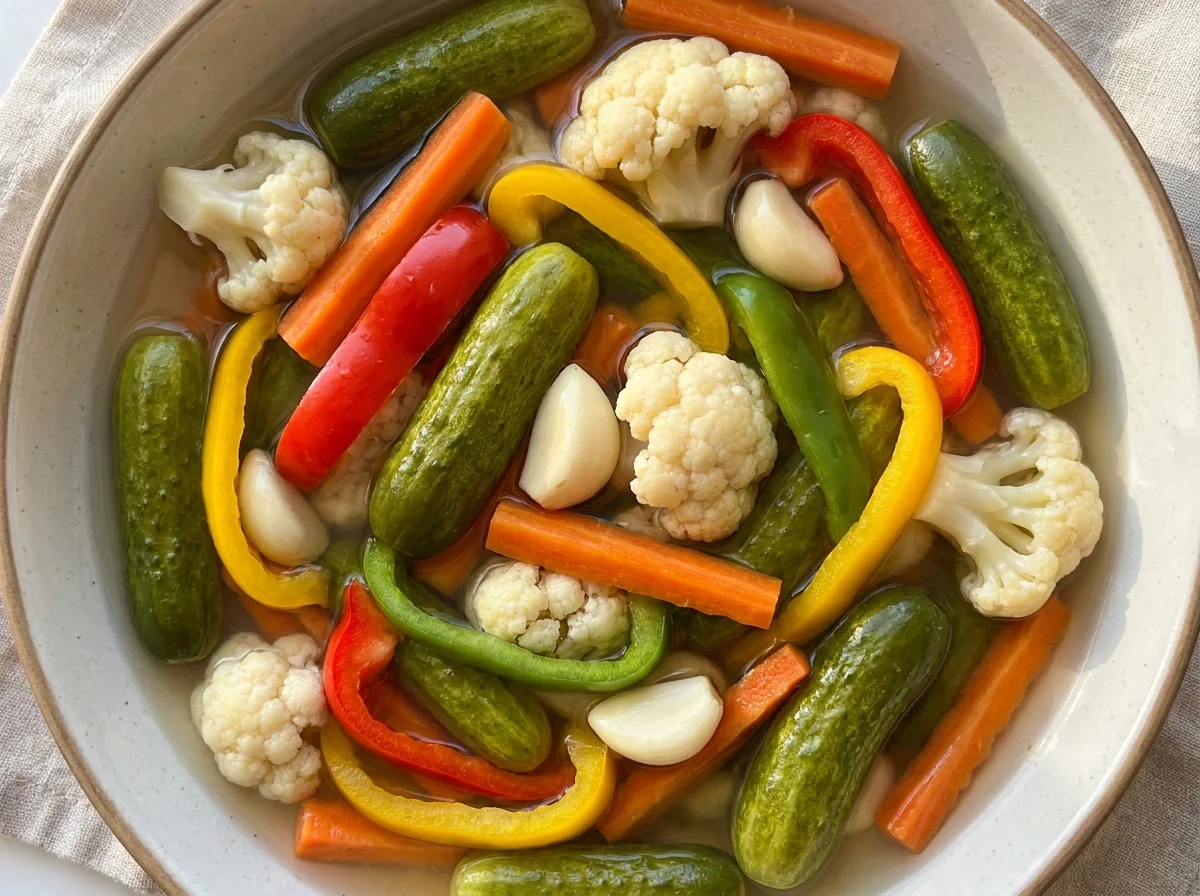
Mukabbas pickles are present on our tables alongside rice and grills; we prepare them quickly in a jar that we store for days, and they accompany us on trips as a refreshing appetizer.
Preparation Steps
Prepare the vegetables
Wash the vegetables well and cut them into pieces of similar size so they pickle evenly, for similar sizes ensure uniform curing in the brine.
Prepare the brine
Heat the water, vinegar, and salt just until the salt dissolves without a long boil, then let it cool a little. Heating the brine dissolves the salt and speeds up the pickling.
Pack
Pack the vegetables and garlic tightly into a clean, sterilized glass jar, for sterilization prevents unwanted growth and extends the pickles' shelf life.
Pour the brine
Pour the cooled brine over the vegetables until they are fully submerged, and make sure nothing floats above the surface. Fully submerging the vegetables is an essential condition for successful and safe pickling.
Ferment and store
Close the jar and leave it in a moderate place for two days, then move it to the refrigerator. It is ready to eat within two to four days, when the vegetables take on the sour taste and stay crisp.
Blood Sugar Impact
The glycemic index (GI) measures how quickly a food raises blood sugar, while the glycemic load (GL) measures how much a full serving raises it. Together they give the complete picture.
Glycemic Index
GI
19Low
Low0–55Medium56–69High70+
A low value (≤55) means a gradual rise in blood sugar — the most suitable range for diabetes and insulin resistance.
Glycemic Load
GL
1Low
Low0–10Medium11–19High20+
Glycemic load reflects the impact of the full serving. To lower it: take half a serving, or pair the recipe with a source of protein and fiber.
Nutritional Information
Per ServingMakes 8 servings · one serving is about 170 g of raw ingredients
Calories38 kcal2%of Daily Value*
Protein1 g2%of Daily Value*
Carbohydrates8 g3%of Daily Value*
Fat0 g0%of Daily Value*
Fiber2 g7%of Daily Value*
Sodium997 mg43%of Daily Value*
Potassium263 mg6%of Daily Value*
Phosphorus38 mg3%of Daily Value*
* Percent Daily Values are based on a 2,000-calorie diet per FDA food-label reference values — your daily needs may be higher or lower. Values are derived from the recipe's ingredients via the USDA database.
Troubleshooting
The most common problems when preparing Quick Mixed Vegetable Pickles (Mukabbas), and how to fix them:
The vegetables became soft
Choose fresh, firm vegetables and shorten the pickling time outside the refrigerator, as long warmth softens the texture.
Cloudiness or strange foam appears
Discard the whole batch; abnormal cloudiness and a foul smell are a sign of spoilage that must not be eaten.
The taste is too salty
Increase the proportion of water in the brine a little next time, but do not reduce the salt much, as it is essential for preservation.
The vegetables did not take on flavor
Leave them a little longer and make sure they are fully submerged, for the exposed parts do not pickle.
Storage and Make-Ahead
Refrigerator
Keep in a sealed jar submerged in the brine for up to a month, and use a clean spoon each time to prevent contamination.
Outside the refrigerator
Leave for only two days for the initial fermentation then move it to the refrigerator, and do not leave it long at room temperature.
Tested Ingredient Substitutions
Original Ingredient
Tested Substitute
Ratio
Flavor Difference
Cucumber
Small firm zucchini
1 to 1
Gives a similar texture and pickles well.
Cauliflower
Cut turnip
1 to 1
A common Gulf option in mukabbas pickles.
White vinegar
Apple cider vinegar
1 to 1
A softer, more agreeable flavor with a slightly darker color.
Colored bell peppers
Small hot peppers
To taste
Adds heat for those who like spicy pickles.
How Much Does It Make? Scaling Guide
Ingredient
2 servings
4 servings
8 servings (base)
Chopped cucumber
63 g
125 g
250 g
Chopped carrot
50 g
100 g
200 g
Cauliflower florets
50 g
100 g
200 g
White vinegar
63 ml
125 ml
250 ml
Salt
5 g
10 g
20 g
EEINA Nutrition Tip
Pickles are high in sodium due to the salt and brine, so they are eaten in small amounts as an appetizer, not as a main dish. Sterilizing the jar and fully submerging the vegetables in the brine are two conditions for food safety and preventing spoilage.
Add This Recipe to Your Plan
The EEINA app saves your favorite recipes, calculates them from their real ingredients, and shows your daily numbers toward your goal. Try it free now.
Within two to four days it takes on a pleasant sour taste, and the longer it stays in the refrigerator, the deeper the flavor.
Why are pickles high in salt?
Salt and vinegar are what preserve the vegetables and prevent their spoilage, so pickles are salty by nature and are eaten in small amounts.
Can I reduce the salt a lot?
Reducing it a lot is not recommended because it is the basis of preservation and safety; those who want less sodium should eat a smaller amount instead of reducing the salt.