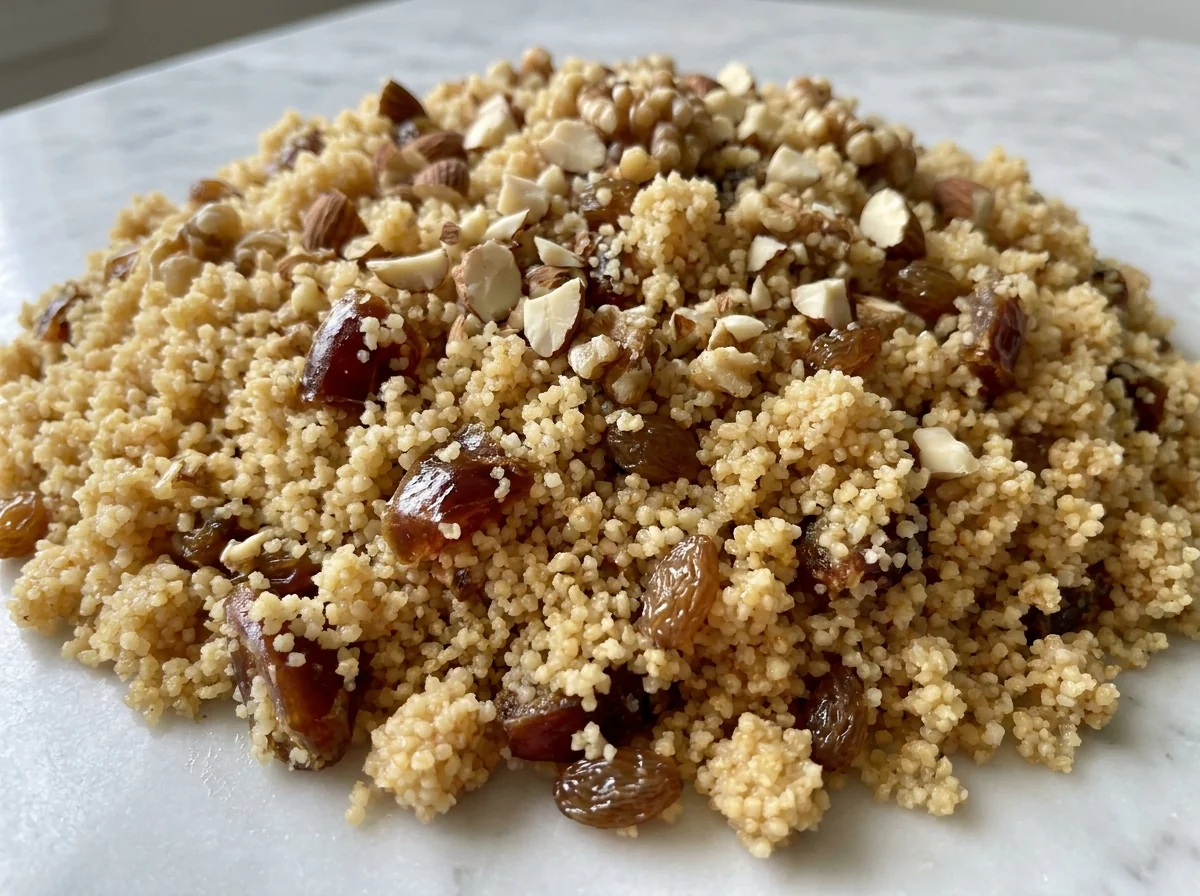
A sweet Tunisian couscous steamed and mixed with dates, raisins, butter, and orange blossom water, and garnished with almonds, walnuts, and pomegranate seeds; a homemade Maghrebi dessert common at the suhoor table and on special occasions.
Masfouf is a time-honored Maghrebi dessert for which Tunisia and Algeria are known; it belongs to the couscous family but without meat or vegetables, a sweet couscous we steam, sweeten with dates and raisins, perfume with orange blossom water, and garnish with nuts and pomegranate seeds.
It is common in Ramadan at the suhoor table because it provides energy and prolongs the feeling of fullness, and it is also served on holidays and special occasions. Every household has its touch: some add pomegranate seeds and grapes, and some are content with dates and raisins, while its tender, fragrant texture remains its distinctive signature.
Preparation Steps
Rub the couscous with oil
Put the couscous in a wide bowl, add the olive oil, and rub it with your fingertips until its grains separate and become coated with oil. Rubbing the couscous with oil prevents it from clumping and gives it a separated texture after cooking.
Steam the couscous the first time
Sprinkle half of the warm water over the couscous and toss it, then place it in a steamer over a pot of boiling water and leave it to steam for about fifteen minutes. The steam cooks the semolina gradually and keeps it light.
Add the dates and raisins
Turn the couscous out into the bowl, add the chopped dates and raisins and toss, then sprinkle the rest of the warm water and rub the grains so they separate again and absorb the moisture.
Steam a second time
Return the couscous to the steamer and leave it to steam for another fifteen minutes until it is fully cooked and soft. Double steaming is the secret to masfouf's tender texture.
Sweeten and perfume
Transfer the couscous to a serving dish, add the butter so its warmth melts into it, then the sugar, orange blossom water, and rose water, and toss gently until it is uniform. Taste and add more sugar if needed, for the sweetness of the dates may be enough.
Garnish and serve
Spread the masfouf on the dish and scatter the almonds, walnuts, and pomegranate seeds over it. Serve it warm or cold; it is a homemade Maghrebi dessert common at suhoor tables and on special occasions in Tunisia and Algeria.
Blood Sugar Impact
The glycemic index (GI) measures how quickly a food raises blood sugar, while the glycemic load (GL) measures how much a full serving raises it. Together they give the complete picture.
Glycemic Index
GI
61Medium
Low0–55Medium56–69High70+
A low value (≤55) means a gradual rise in blood sugar — the most suitable range for diabetes and insulin resistance.
Glycemic Load
GL
46High
Low0–10Medium11–19High20+
Glycemic load reflects the impact of the full serving. To lower it: take half a serving, or pair the recipe with a source of protein and fiber.
Nutritional Information
Per ServingMakes 6 servings · one serving is about 135 g of raw ingredients
Calories490 kcal24%of Daily Value*
Protein10 g20%of Daily Value*
Carbohydrates82 g30%of Daily Value*
Fat15 g19%of Daily Value*
Fiber6 g21%of Daily Value*
Sodium3 mg0%of Daily Value*
Potassium496 mg11%of Daily Value*
Phosphorus151 mg12%of Daily Value*
* Percent Daily Values are based on a 2,000-calorie diet per FDA food-label reference values — your daily needs may be higher or lower. Values are derived from the recipe's ingredients via the USDA database.
Troubleshooting
The most common problems when preparing Tunisian Sweet Couscous with Dates (Masfouf), and how to fix them:
The couscous is clumpy and sticky
It was not rubbed well or had too much water. Rub the grains with oil before steaming and between the two rounds, and add the water gradually rather than all at once.
The couscous is dry or half-cooked
There was too little steam or water. Extend the steaming a little, sprinkle warm water, and cover, for the steam completes the cooking and softens the grains.
Too sweet
The dates and raisins are naturally sweet, so start with a little sugar and taste, and add a dash of lemon juice if the sweetness is too much.
The nuts lost their crunch
Add them at serving rather than during cooking, and toast them lightly before scattering so they stay crunchy.
The butter didn't spread evenly
Add it while the couscous is hot so its warmth melts into it, and toss gently until it works its way into the grains.
Storage and Make-Ahead
Refrigerator
Keep it in an airtight container for up to three days, and add the nuts and pomegranate seeds fresh at serving. Sprinkle a little water and reheat it by steaming or in the microwave so it softens.
Freezer
The cooked couscous can be frozen without garnish for up to a month in an airtight container; thaw it and reheat it by steaming with a splash of water so it returns to being tender.
Make ahead
Steam the couscous ahead of time and keep it chilled, then sweeten, perfume, and garnish it at the moment of serving.
Tested Ingredient Substitutions
Original Ingredient
Tested Substitute
Ratio
Flavor Difference
butter
olive oil or ghee
same amount
Oil makes it lighter and dairy-free, and ghee is closer to the traditional flavor
sugar
reducing it or date molasses
depending on the sweetness
The dates and raisins sweeten the dish, so often a little sugar or none is enough
white couscous
whole-wheat couscous
same amount
Raises the fiber and softens the effect of sugar on the blood
the garnish
almonds, pistachios, pomegranate, or grapes
to taste
Variety enriches the dish in color and flavor
How Much Does It Make? Scaling Guide
Ingredient
Half amount
Full amount (base)
Double
Couscous
180 g
360 g
720 g
Chopped dates
80 g
160 g
320 g
Raisins
40 g
75 g
150 g
Butter
15 g
30 g
60 g
Nuts for garnish
20 g
40 g
80 g
EEINA Nutrition Tip
The secret to a successful masfouf is steaming it twice and rubbing its grains with oil in between, for this prevents clumping and gives a separated, tender texture. We rely on the sweetness of the dates and raisins and reduce the added sugar, for it is a rich dessert eaten in a small portion. For those who want it lighter, we replace part of the white couscous with whole-wheat couscous to raise the fiber.
Add This Recipe to Your Plan
The EEINA app saves your favorite recipes, calculates them from their real ingredients, and shows your daily numbers toward your goal. Try it free now.
A Maghrebi couscous dessert from Tunisia and Algeria, steamed and sweetened with dates, raisins, and butter, perfumed with orange blossom water, and garnished with nuts and pomegranate seeds. It is common at suhoor and on special occasions.
Why do we steam the couscous twice?
Double steaming with rubbing the grains in between gives a tender, separated, non-clumpy texture, and it is the secret to a successful masfouf.
Is masfouf suitable for people with diabetes?
It is a dessert rich in carbohydrates and natural sugar with a high glycemic load, so it is eaten in a small portion and with care. Switching to whole-wheat couscous and reducing the added sugar soften its effect.
When do we serve masfouf?
It is served warm or cold, and it is common at the suhoor table in Ramadan and on holidays and special occasions, because it is filling and provides energy.