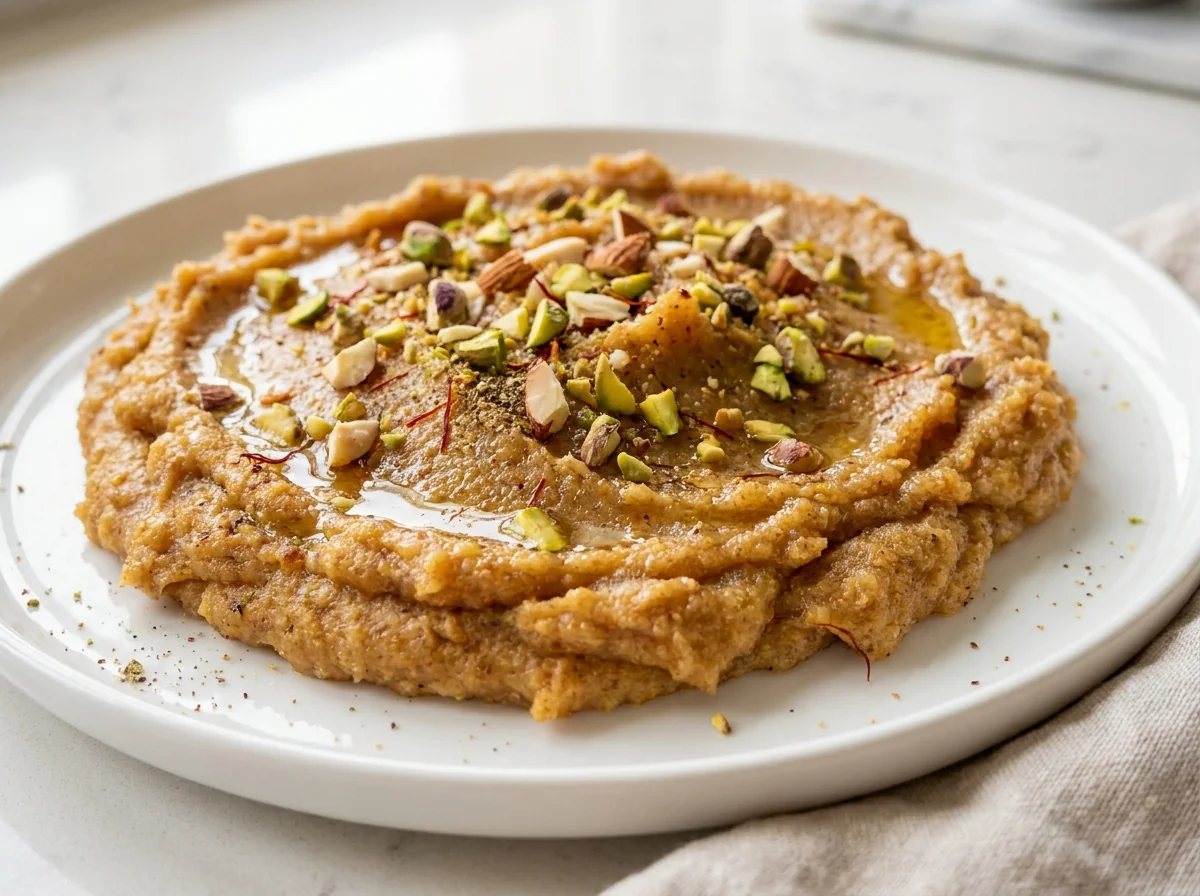
We make khabeesa the way it is made in Emirati homes on winter nights, when the flour is toasted slowly until it turns golden, then worked with saffron syrup and ghee until it becomes a warm, glossy sweet.
It is one of the oldest Gulf sweets and among the simplest in its ingredients, served with Arabic coffee at gatherings and majlis, and loved by elders for its simplicity and the depth of its toasted flavor.
Preparation Steps
Toasting the flour
Toast the whole flour in a wide pan over medium heat, stirring constantly, until it turns golden and its toasted aroma rises, for good toasting is the foundation of khabeesa's flavor.
The saffron syrup
Boil the water with the sugar until it dissolves completely, then add the saffron threads and rose water and let it boil for a minute until the syrup takes on color and becomes fragrant.
Combining the syrup with the flour
Lower the heat and pour the hot syrup gradually over the toasted flour while whisking constantly so no lumps form, giving you a moist, cohesive paste.
Adding the ghee and cardamom
Add the ghee and ground cardamom and stir until the ghee melts, the mixture is coated, and it begins to pull away from the sides of the pan.
Serving and garnishing
Pour the khabeesa into a serving dish and smooth its surface, then garnish it with the chopped nuts and saffron threads, and serve it warm.
Blood Sugar Impact
The glycemic index (GI) measures how quickly a food raises blood sugar, while the glycemic load (GL) measures how much a full serving raises it. Together they give the complete picture.
Glycemic Index
GI
59Medium
Low0–55Medium56–69High70+
A low value (≤55) means a gradual rise in blood sugar — the most suitable range for diabetes and insulin resistance.
Glycemic Load
GL
27High
Low0–10Medium11–19High20+
Glycemic load reflects the impact of the full serving. To lower it: take half a serving, or pair the recipe with a source of protein and fiber.
Nutritional Information
Per ServingMakes 6 servings · one serving is about 145 g of raw ingredients
Calories371 kcal19%of Daily Value*
Protein6 g12%of Daily Value*
Carbohydrates50 g18%of Daily Value*
Fat17 g22%of Daily Value*
Fiber4 g14%of Daily Value*
Sodium2 mg0%of Daily Value*
* Percent Daily Values are based on a 2,000-calorie diet per FDA food-label reference values — your daily needs may be higher or lower. Values are derived from the recipe's ingredients via the USDA database.
Troubleshooting
The most common problems when preparing Emirati Khabeesa (Saffron Toasted-Flour Pudding), and how to fix them:
The khabeesa has lumps
Pour the hot syrup in gradually while whisking constantly, and run the mixture through a whisk until it becomes smooth.
Its texture is dry and crumbly
Add a little hot water and stir over gentle heat until it softens, for the flour absorbs the liquid gradually.
Its taste is bitter
The flour has burned during toasting, so next time toast it over gentler heat only until it is golden.
Storage and Make-Ahead
Refrigerator
Keep it in an airtight container for up to three days, and reheat it gently with a splash of water to restore its softness.
Freezing
It can be frozen in an airtight container for up to a month; thaw it in the refrigerator, then reheat it over gentle heat.
Tested Ingredient Substitutions
Original Ingredient
Tested Substitute
Ratio
Flavor Difference
whole flour
fine semolina
same weight, 200 g
Semolina gives a grainy texture and is the original in some Emirati homes
sugar
honey
same weight, 150 g
Honey lends a deeper flavor and reduces the share of refined sugar
ghee
butter
same weight, 80 g
Butter is lighter in flavor while ghee is closer to the traditional taste
saffron
a little turmeric with cardamom
a pinch
Turmeric approximates the color, not the flavor, while saffron is authentic in taste
How Much Does It Make? Scaling Guide
Ingredient
Half amount
Base amount (base)
Double
Toasted whole wheat flour
100 g
200 g
400 g
Water
200 ml
400 ml
800 ml
Sugar
75 g
150 g
300 g
Ghee
40 g
80 g
160 g
Ground cardamom
1.5 g
3 g
6 g
EEINA Nutrition Tip
Toast the flour over gentle heat without rushing, for the even golden color is what gives khabeesa its flavor, while haste burns the flour and turns its taste bitter.
Add This Recipe to Your Plan
The EEINA app saves your favorite recipes, calculates them from their real ingredients, and shows your daily numbers toward your goal. Try it free now.
What is the difference between khabeesa made with flour and khabeesa made with semolina?
Flour gives a smoother, more cohesive texture, while semolina gives it light grains, and both are authentic in the Gulf depending on the household and region.
Why do we toast the flour?
Toasting drives off the raw taste of the flour and gives khabeesa its golden color and distinctive aroma, and it is the most important step in the recipe.
Is it served hot or cold?
It is usually served warm with Arabic coffee, and it stays delicious cold, though its texture becomes a little denser.