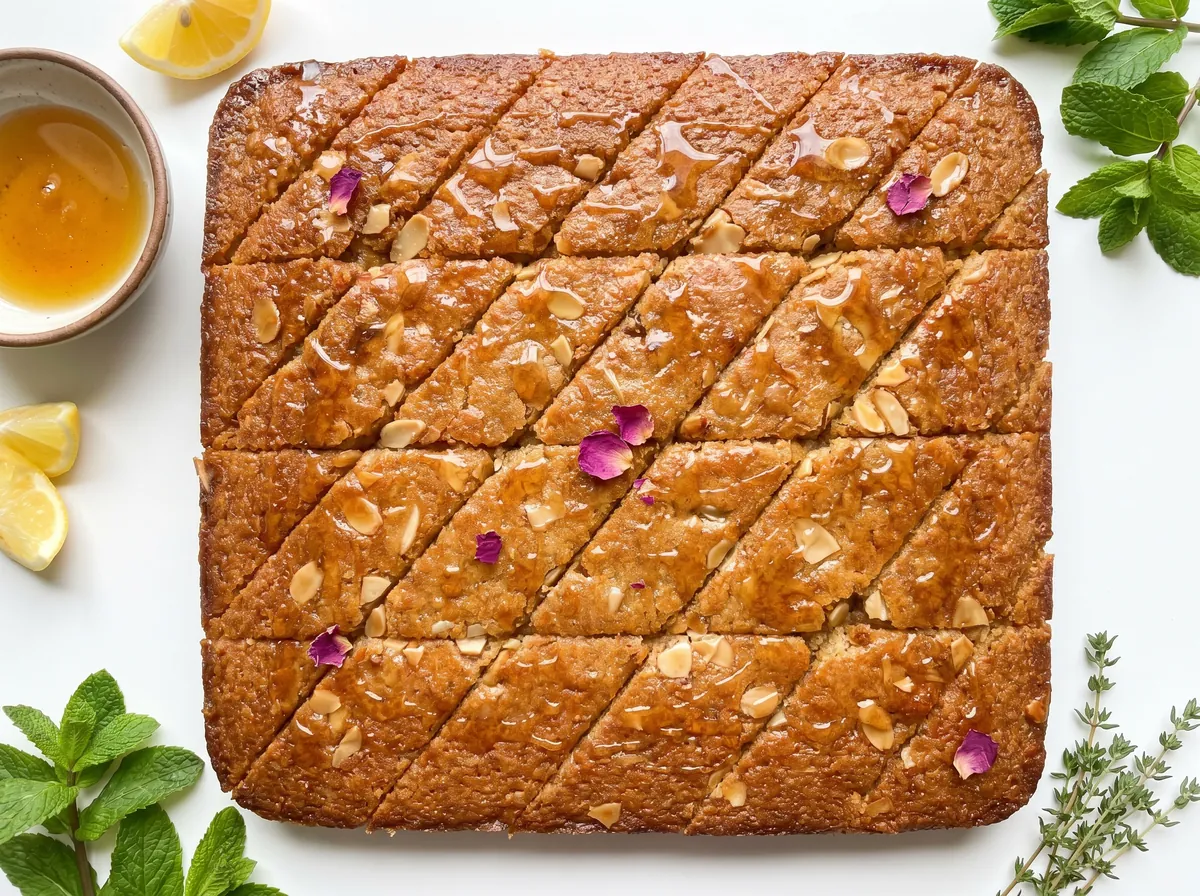
An Algerian Ramadan sweet — a coarse semolina cake with an almond layer, baked and soaked in orange blossom water syrup until it absorbs completely. Soft, fragrant and moist; medium glycemic load; contains gluten, tree nuts and dairy.
Kalb El Louz (qalb el luz) is a cherished Algerian Ramadan sweet whose name means the heart of the almond (for the almond layer in its center, like a heart). It is known as Shamiya in western Algeria and Harissa in the east.
It consists of a coarse semolina cake with a middle almond layer, baked then soaked in orange blossom water syrup until it absorbs and becomes soft, moist and fragrant. It is a star of the Ramadan Iftar table in Algeria, made in abundance throughout the month and served with tea. The coarse semolina soaking up the fragrant syrup with the almond heart and orange blossom water notes made it a beloved Algerian Ramadan icon — a symbol of the holy month and hospitality.
Preparation Steps
Make the semolina dough
Rub the coarse semolina with the sugar and melted butter thoroughly, then add orange blossom water and a little water. Let it rest for at least one hour (or overnight) so the semolina absorbs the fat and liquid. Long resting is the secret to Kalb El Louz's texture.
Make the almond filling
Mix the ground almonds with sugar and orange blossom water into a soft almond paste. The almond filling is the heart of this sweet (hence the name: Kalb El Louz — heart of the almond) — a middle layer of almonds between two semolina layers.
Layer in the tray
Spread half the semolina dough in a greased tray, then spread the almond filling on top in an even layer, then cover with the remaining half of the semolina dough and press down. Three layers: semolina, almonds, semolina — with the almonds as a hidden heart in the center.
Decorate and bake
Smooth the top, cut into diamond shapes (before baking), and place a whole almond in the center of each diamond. Bake in a moderate oven until cooked through and the top is golden, about forty minutes. Coarse semolina gives the distinctive texture.
Pour the syrup
Remove the Kalb El Louz hot from the oven and pour cold syrup over it while hot (the rule: hot sweet with cold syrup) until it is submerged and absorbs it. Leave for several hours or overnight for the syrup to be fully absorbed and for it to become soft, moist and fragrant. This slow absorption is the secret of Kalb El Louz.
Serve
After the syrup has been absorbed, cut along the marked lines and serve Kalb El Louz with tea or coffee. It is a cherished Algerian Ramadan sweet (also known as Shamiya or Harissa in some regions) — a star of the Ramadan Iftar table. The coarse semolina that soaks up the fragrant syrup with its almond heart is a delight, a symbol of Algerian Ramadan and hospitality.
Blood Sugar Impact
The glycemic index (GI) measures how quickly a food raises blood sugar, while the glycemic load (GL) measures how much a full serving raises it. Together they give the complete picture.
Glycemic Index
GI
64Medium
Low0–55Medium56–69High70+
A low value (≤55) means a gradual rise in blood sugar — the most suitable range for diabetes and insulin resistance.
Glycemic Load
GL
47High
Low0–10Medium11–19High20+
Glycemic load reflects the impact of the full serving. To lower it: take half a serving, or pair the recipe with a source of protein and fiber.
Nutritional Information
Per ServingMakes 12 servings · one serving is about 150 g of raw ingredients
Calories452 kcal23%of Daily Value*
Protein8 g16%of Daily Value*
Carbohydrates76 g28%of Daily Value*
Fat14 g18%of Daily Value*
Fiber3 g11%of Daily Value*
Sodium2 mg0%of Daily Value*
Potassium173 mg4%of Daily Value*
Phosphorus118 mg9%of Daily Value*
* Percent Daily Values are based on a 2,000-calorie diet per FDA food-label reference values — your daily needs may be higher or lower. Values are derived from the recipe's ingredients via the USDA database.
Troubleshooting
The most common problems when preparing Kalb El Louz (Algerian Semolina and Almond Cake), and how to fix them:
Kalb El Louz is dry and didn't absorb the syrup
Too little syrup or not left long enough. Pour generous cold syrup over the hot sweet until it is submerged, then leave for several hours or overnight to absorb completely. Coarse semolina needs time and enough syrup to soften.
Kalb El Louz is too wet (pasty)
Too much syrup or not baked enough. Bake until fully cooked and golden first, then pour a moderate amount of syrup (enough to cover it, not drown it). The balance between baking and syrup gives the soft-moist, not pasty, texture.
The dough didn't come together
Not enough resting or liquid. Rest the semolina dough for at least one hour (or overnight) so the coarse semolina absorbs the fat and liquid and firms up — coarse semolina needs time to soften. Resting is essential.
The syrup crystallized (grained)
Not enough lemon. Add lemon juice to the syrup while cooking it (prevents crystallization) and don't stir it too much after it comes to a boil. Lemon gives a smooth, non-grainy syrup.
The top burned before the inside was cooked
Oven too hot from the top. Bake in the center of the oven at moderate heat, and cover with foil if the top browns quickly, until the coarse semolina inside is cooked without the top burning.
Storage and Make-Ahead
Room temperature
Kalb El Louz keeps in an airtight container at room temperature for one week (like syrup-soaked sweets, sugar acts as a preservative). It stays soft and moist. Ideal to make ahead during Ramadan — prepare and serve over days.
Refrigerator (4°C)
Keeps longer refrigerated (two weeks) — take it out a little before serving (softer at room temperature). Practical for preparing a large batch at the start of Ramadan and serving gradually.
Freezer
Freeze Kalb El Louz (with or without syrup) for two to three months in an airtight container. Thaw at room temperature and add syrup if frozen without it. Practical for preparing Ramadan batches in advance.
Food safety
Kalb El Louz is a syrup-soaked sweet (semolina, almonds and syrup) that keeps well thanks to the sugar. Bake until fully cooked and store sealed. It contains butter and almonds — keep away from high heat and moisture.
Tested Ingredient Substitutions
Original Ingredient
Tested Substitute
Ratio
Flavor Difference
Sugar in the syrup and dough
Reduce the amount
To taste
Lowers the high glycemic load — reduce the syrup sugar especially (the main source of sugar); almonds give sweetness and richness
Butter
Ghee or oil
Same amount
Ghee has a traditional flavor (contains dairy); oil makes it dairy-free with a lighter flavor
Almonds
Ground walnuts or pistachios
Same amount
Almonds are authentic (and the name reflects this); walnuts and pistachios are alternatives (still tree nuts) — avoid for those with nut allergies
How Much Does It Make? Scaling Guide
Number of pieces
Semolina
Ground almonds
Syrup
6 (half recipe)
1.5 cups
1/2 cup
1 cup
12 (base)
3 cups
1 cup
2 cups
24 (Ramadan)
6 cups
2 cups
4 cups
EEINA Nutrition Tip
Kalb El Louz is a rich syrup-soaked Ramadan sweet. On the positive side, the almonds add protein, healthy fats, fiber and vitamin E, and coarse semolina is slower to digest than white flour. But it remains a sweet concentrated in sugar (from the syrup) and butter, with a medium-high glycemic load. To lighten it: reduce the sugar in the syrup and the soaking intensity, use moderate butter and increase the almonds. Enjoy one small piece at Iftar — it is an occasional sweet, not for excess, especially for people with diabetes.
Add This Recipe to Your Plan
The EEINA app saves your favorite recipes, calculates them from their real ingredients, and shows your daily numbers toward your goal. Try it free now.
An Algerian Ramadan sweet made from a coarse semolina cake with a middle almond layer (the heart of the almond), baked then soaked in orange blossom water syrup until it absorbs and becomes soft and fragrant. Also known as Shamiya or Harissa in some regions — a star of the Algerian Ramadan Iftar table.
Why is it called Kalb El Louz?
Because it has an almond filling layer in the middle (between the two semolina layers) as if it were the heart of the sweet. The name describes its structure: semolina, then almonds, then semolina — with the almonds as a hidden heart discovered upon biting, which is its distinctive flavor.
Is Kalb El Louz healthy?
A rich syrup-soaked Ramadan sweet — on the positive side, almonds (protein, healthy fats, fiber) and coarse semolina (slower than white flour). But it is concentrated in sugar (syrup) and butter with a medium-high glycemic load. Reduce the syrup, increase the almonds and enjoy one small piece. An occasional sweet, not for excess.
What is the secret to the soft, absorbed texture?
Three factors: resting the coarse semolina dough (an hour or overnight to absorb the fat), baking until fully cooked, and pouring cold syrup over the hot sweet and leaving it for several hours to absorb completely. Patience with the slow absorption gives the soft, moist texture.