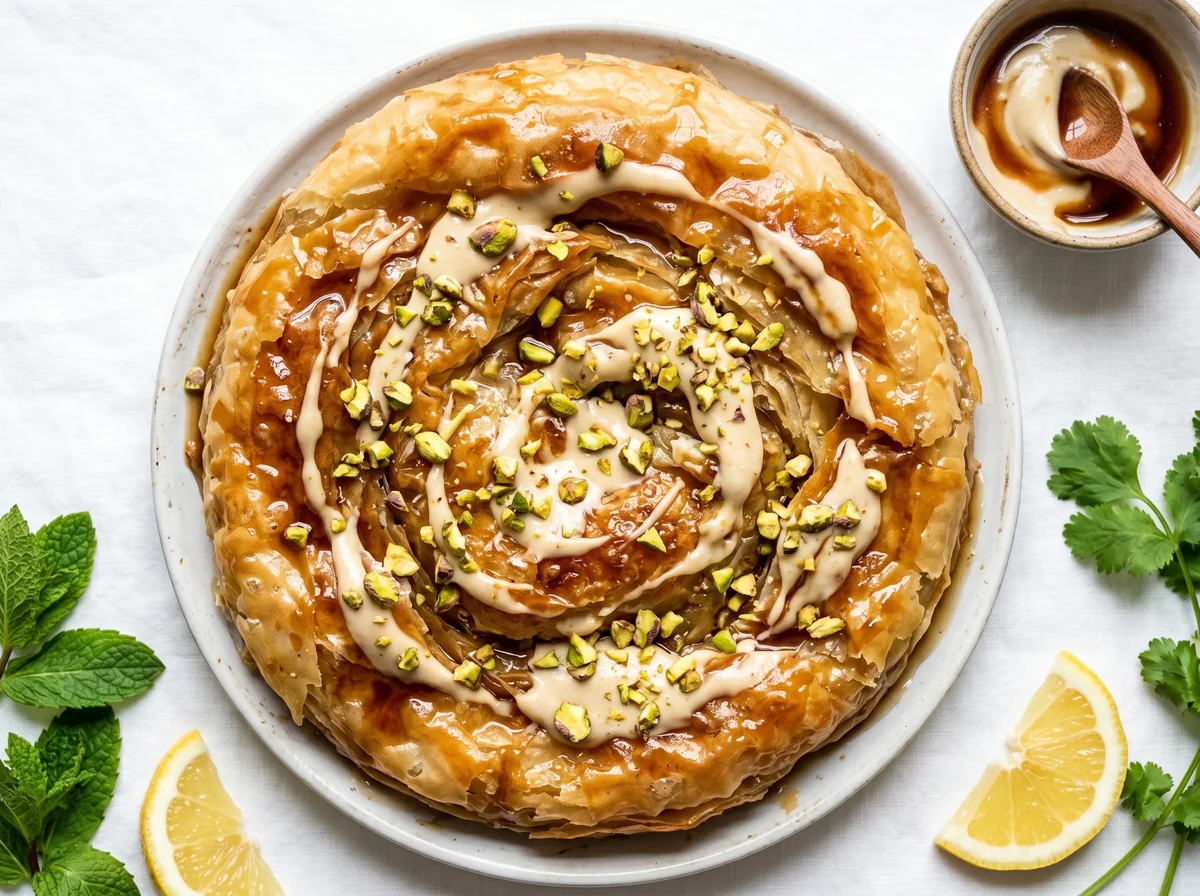
A luxurious Iraqi breakfast pastry — paper-thin layers of dough baked in ghee until shatteringly crisp, then drizzled with light sugar syrup and served with gaymar (thick cream). A famous Baghdadi breakfast sweet, meant to be enjoyed in moderation, containing gluten and dairy.
Kahi is a famous, luxurious Baghdadi Iraqi breakfast pastry — one of the most storied Iraqi breakfast dishes (especially for Friday mornings and special occasions). It consists of paper-thin dough layers (like phyllo) brushed with ghee, folded, and baked until shatteringly crisp and golden, then drizzled with a light sugar syrup. It is traditionally served with gaymar (thick cream) and honey or date molasses and Iraqi tea, forming a complete, luxurious breakfast.
Kahi resembles baklava in its layering technique but is simpler and less sweet (a light syrup, not a heavy soak) and is eaten as a breakfast rather than a dessert. Baghdad is famous for its kahi-and-gaymar shops, which people visit in the morning. Its shatteringly crisp layers drizzled with syrup alongside rich creamy gaymar are a classic morning luxury — a symbol of the authentic Baghdadi breakfast and its generous morning hospitality.
Preparation Steps
Prepare the syrup and dough
Make the light syrup (sugar, water, lemon, and rose water) and let it cool. Knead the flour with water and salt into a soft, pliable dough and let it rest. Kahi is a Baghdadi breakfast pastry (paper-thin crisp dough layers), served with gaymar (the cream), a classic Iraqi luxury breakfast.
Roll the dough paper thin
Roll the dough out paper thin (until it is nearly translucent, like phyllo) and brush it generously with melted ghee. Rolling paper thin and brushing with ghee is the secret to kahi's shatteringly crisp layers (like baklava but simpler) — the ghee separates and crisps the layers.
Fold the layers
Fold the buttered dough into multiple layers on top of each other (or roll it and press), creating many thin layers saturated with ghee. Folding into buttered layers gives kahi its signature flaky, crisp, laminated texture when baked.
Shape
Shape the folded dough into squares or rectangles, brush the tops with ghee, and arrange on a baking tray. Square pieces from the layered dough are ready for the oven. Brush generously with ghee (it crisps and browns the layers).
Bake
Bake the kahi in a medium-to-hot oven until the layers turn golden, puff up, and crisp (about twenty minutes). Baking until golden and crisp is what gives kahi its flakiness. The thin buttered layers puff, crisp, and turn golden.
Drizzle the syrup and serve
Remove the hot kahi and drizzle the cooled light syrup over it (a moderate drizzle — do not soak it, it should stay crisp), then serve immediately with gaymar (cream), honey or date molasses, and tea. This is a famous, luxurious Baghdadi breakfast pastry (a Friday and special-occasion favorite), and its shatteringly crisp layers drizzled with syrup alongside rich creamy gaymar are a classic morning indulgence — a symbol of the authentic Baghdadi breakfast and its generous hospitality.
Blood Sugar Impact
The glycemic index (GI) measures how quickly a food raises blood sugar, while the glycemic load (GL) measures how much a full serving raises it. Together they give the complete picture.
Glycemic Index
GI
65Medium
Low0–55Medium56–69High70+
A low value (≤55) means a gradual rise in blood sugar — the most suitable range for diabetes and insulin resistance.
Glycemic Load
GL
16Medium
Low0–10Medium11–19High20+
Glycemic load reflects the impact of the full serving. To lower it: take half a serving, or pair the recipe with a source of protein and fiber.
Nutritional Information
Per ServingMakes 8 servings · one serving is about 70 g of raw ingredients
Calories368 kcal18%of Daily Value*
Protein0 g0%of Daily Value*
Carbohydrates25 g9%of Daily Value*
Fat30 g38%of Daily Value*
Fiber0 g0%of Daily Value*
Sodium1 mg0%of Daily Value*
* Percent Daily Values are based on a 2,000-calorie diet per FDA food-label reference values — your daily needs may be higher or lower. Values are derived from the recipe's ingredients via the USDA database.
Troubleshooting
The most common problems when preparing Iraqi Kahi, and how to fix them:
The kahi is soft, not crisp
Not enough ghee, insufficient baking, or too much syrup. Brush the layers generously with ghee, bake until the layers color and crisp, and drizzle a moderate amount of cooled light syrup. Ghee, adequate baking, and moderate syrup maintain the crispness.
The layers do not separate
Not enough butter or the dough was rolled too thick. Roll the dough paper thin and brush it with ghee between the layers (it separates and crisps them) — too little ghee or thick rolling yields a block instead of layers. Thinness and ghee are the secret to the layers.
The kahi is soggy from the syrup
Too much syrup or hot syrup poured on hot kahi. Drizzle a moderate amount of cooled syrup on the hot kahi (kahi takes much less syrup than baklava) — over-soaking makes it soggy. A moderate drizzle sweetens while keeping the crispness.
It burned before cooking through
The temperature was too high. Bake at medium-to-high heat with close attention (thin layers color quickly) until golden and crisp without burning. Watch it carefully in the final minutes.
The dough is stiff
Over-kneaded or did not rest. Knead gently and let the dough rest (it relaxes and rolls paper thin) — over-kneading toughens it and makes it hard to roll thin. Resting makes it supple and easy to roll into crisp, flaky layers.
Storage and Make-Ahead
Serve fresh
Kahi is best eaten hot and fresh right after baking and drizzling (layers are crisp) — it softens over time. Prepare and drizzle it fresh before breakfast, and serve the gaymar fresh. Fresh and hot is the best experience.
Room temperature (one day)
Drizzled kahi keeps at room temperature for one day (covered) and loses some crispness (warm it briefly in the oven to restore it). Do not refrigerate it (the refrigerator makes it tough). The gaymar should be stored refrigerated separately.
Freezer (before syrup)
Bake the kahi without the syrup and freeze it, then reheat and drizzle fresh. Or prepare unbaked pieces and freeze them to bake fresh. This keeps it crispier than freezing it already drizzled.
Food safety
Gaymar is a sensitive dairy product — keep it refrigerated and serve it fresh. Plain kahi (without gaymar) can be stored at room temperature briefly. Bake the kahi thoroughly and use fresh ingredients.
Tested Ingredient Substitutions
Original Ingredient
Tested Substitute
Ratio
Flavor Difference
Gaymar
Qishta (clotted cream), labneh (strained yogurt), or skip the cream
as desired
Gaymar (thick cream) is the traditional luxury option; qishta is a substitute; labneh is a lighter, tangier option; or serve with just honey
Generous ghee
Less ghee or butter
less
Reduces saturated fat; some ghee is essential for the crisp layers, but the amount can be slightly reduced
Heavy syrup drizzle
Light moderate syrup or honey
less
Kahi is already lighter on syrup than baklava; a light drizzle or serving honey or date molasses on the side reduces sugar and preserves crispness
How Much Does It Make? Scaling Guide
Pieces
Dough
Ghee
Syrup
4 (small)
Half the recipe
1/2 cup
1/2 cup
8 (base)
Full recipe
1 cup
1 cup
16 (gathering)
Double
2 cups
2 cups
EEINA Nutrition Tip
Kahi with gaymar is a luxurious, energy-rich breakfast: the dough layers provide carbohydrates, the ghee and gaymar are high in fat, and the syrup adds sugar. It is a high-calorie, high-fat, high-sugar breakfast — suitable for a special occasion or an active morning, not for heavy daily routines. To lighten it: use slightly less ghee, drizzle a moderate light syrup (kahi is already lighter than baklava in syrup), serve gaymar in a moderate portion with a little honey, and balance it with protein (eggs) and fruit for a more complete breakfast. Those with diabetes and heart disease should be moderate. A luxurious breakfast pastry for special occasions — in moderation.
Add This Recipe to Your Plan
The EEINA app saves your favorite recipes, calculates them from their real ingredients, and shows your daily numbers toward your goal. Try it free now.
A famous, luxurious Baghdadi Iraqi breakfast pastry: paper-thin dough layers brushed with ghee, folded, and baked until shatteringly crisp and golden, then drizzled with a light sugar syrup. Served with gaymar (thick cream) and honey or date molasses and tea. The go-to Friday and special-occasion breakfast — its shatteringly crisp layers with rich creamy gaymar are a classic Baghdadi morning pleasure.
What is the difference between kahi and baklava?
Both are thin dough layers brushed with ghee and drizzled with syrup, but kahi is simpler and less sweet (a light drizzle, not a heavy soak, and no nut filling) and is eaten as a breakfast with gaymar. Baklava is filled with nuts, heavily soaked with syrup, and eaten as a dessert. Kahi is a light, crisp breakfast pastry; baklava is a rich dessert.
Why is it served with gaymar?
Gaymar (thick, rich cream) is the classic companion to kahi: the contrast between the crisp, sweet kahi and the rich, creamy, soft gaymar is a luxurious pleasure (like a croissant with clotted cream). Together they make a rich, complete breakfast. Baghdad's shops are famous for serving kahi and gaymar together in the morning — a beloved, long-standing Baghdadi breakfast tradition.
Is kahi healthy?
It is a luxurious, energy-rich breakfast (dough, ghee, gaymar, and syrup) — high in calories, fat, and sugar — suitable for a special occasion or active morning, not for daily routines. Use less ghee, drizzle the syrup lightly, serve a moderate amount of gaymar, and balance with protein and fruit. Those with diabetes and heart disease should be moderate. A luxury breakfast pastry for special occasions — to be enjoyed in moderation.
Sources: University of Sydney · Gulf GSO · Our methodology · Updated on