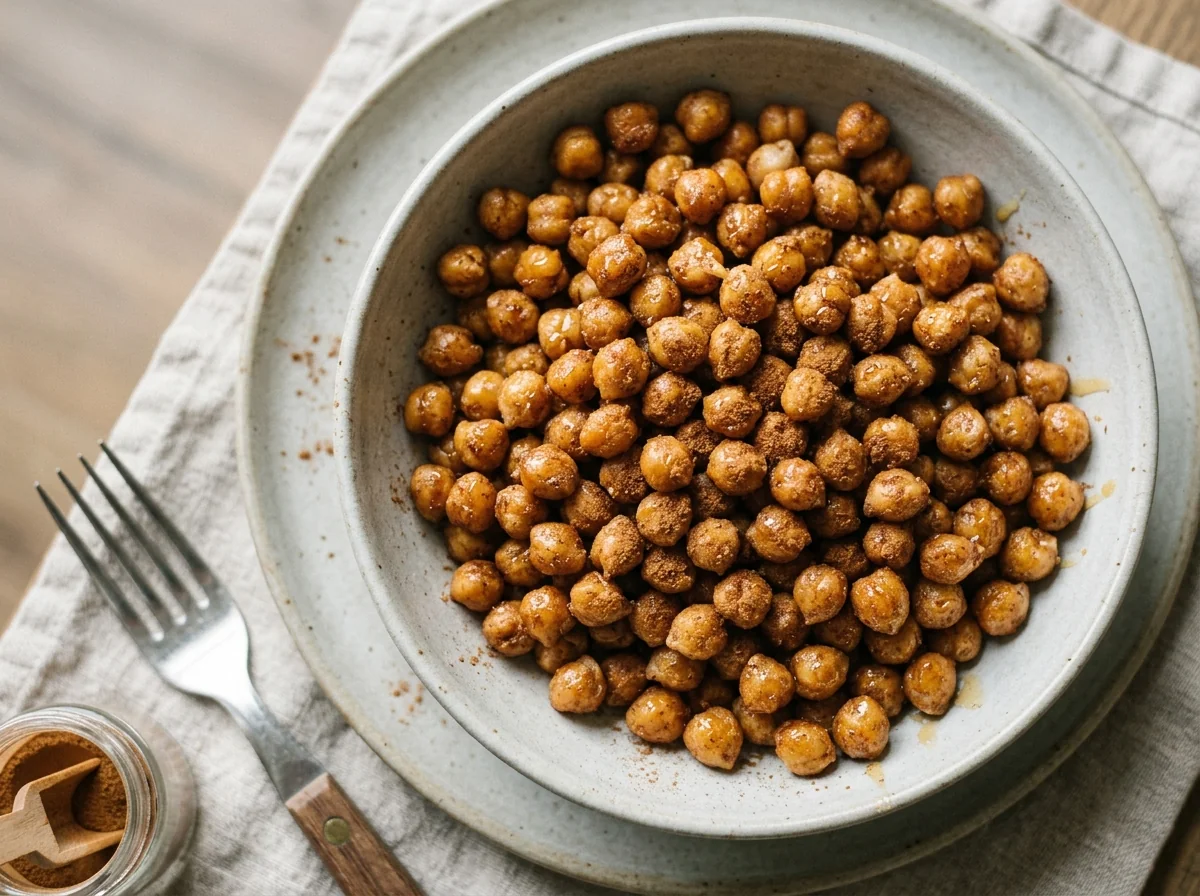
Chickpeas dried, tossed with oil, cinnamon, and a little sugar, then roasted in the oven until crunchy and coated hot with honey — a sweet, crunchy snack reminiscent of cinnamon roasted nuts. The sweet take on our spiced roasted chickpeas, for anyone craving dessert with a whole legume instead of processed sweets.
The sweet take on our spiced roasted chickpeas: the original goes the cumin and smoked paprika route as an alternative to salty chips, while this variation from the Two Peas and Their Pod blog goes the cinnamon and honey route, recalling cinnamon roasted nuts.
The method flips with the direction: the original roasts first and seasons after so the spices do not burn, while here the cinnamon and sugar go in from the start because they tolerate the bake, and the honey alone waits for the end so it does not burn. We reduced the source's sugar from a tablespoon (12 g) to two teaspoons (8 g); the honey after roasting covers the sweetness needed, and we kept it at the source's amount (21 g).
Preparation Steps
Preheat the oven and dry the chickpeas
Preheat the oven to 190°C and set the rack in the middle. Drain the chickpeas and rinse them under cold water until the starch residue is gone, then dry them with a clean kitchen towel, rubbing gently a full minute until the towel comes away dry and some thin skins flake off; complete dryness is the condition for crunch.
Coat with cinnamon and sugar
In a medium bowl, mix the canola oil, cinnamon, and sugar into a uniform sandy brown blend, then add the dried chickpeas and toss a minute until every chickpea wears a thin coat with no clumping.
Roast until crunchy
Spread the chickpeas on a parchment-lined baking sheet in a single layer without crowding, and roast 35 to 40 minutes, shaking the sheet once at the halfway point, until they turn a deep golden color, rattle when the sheet is shaken, and no chickpea tastes soft at the center.
Coat with honey while hot
Transfer the chickpeas to a bowl the moment they come out, pour the honey over them, and toss half a minute until every chickpea shines; the heat of the chickpeas thins the honey so the smallest amount spreads. The honey goes on after roasting, not before, so it does not burn over the long bake.
Dry and cool
Spread the chickpeas back on the same sheet and leave them 15 to 20 minutes until they cool and the honey coating dries and firms; the final crunch completes with the cooling, and tasting before that gives the false impression they never crisped.
Blood Sugar Impact
The glycemic index (GI) measures how quickly a food raises blood sugar, while the glycemic load (GL) measures how much a full serving raises it. Together they give the complete picture.
Glycemic Index
GI
40Low
Low0–55Medium56–69High70+
A low value (≤55) means a gradual rise in blood sugar — the most suitable range for diabetes and insulin resistance.
Glycemic Load
GL
13Medium
Low0–10Medium11–19High20+
Glycemic load reflects the impact of the full serving. To lower it: take half a serving, or pair the recipe with a source of protein and fiber.
Nutritional Information
Per ServingMakes 2 servings · one serving is about 140 g of raw ingredients
Calories259 kcal13%of Daily Value*
Protein9 g18%of Daily Value*
Carbohydrates41 g15%of Daily Value*
Fat8 g10%of Daily Value*
Fiber8 g29%of Daily Value*
Sodium296 mg13%of Daily Value*
* Percent Daily Values are based on a 2,000-calorie diet per FDA food-label reference values — your daily needs may be higher or lower. Values are derived from the recipe's ingredients via the USDA database.
Troubleshooting
The most common problems when preparing Honey Cinnamon Roasted Chickpeas, and how to fix them:
The chickpeas came out soft, not crunchy
Moisture left after rinsing, or crowding on the sheet. Dry the chickpeas until the towel comes away dry, spread in a single spaced-out layer, and extend the roast until you hear the rattle when shaking.
The coating burned and turned bitter
The honey went in before roasting, or the oven ran above 190°C. Add the honey only after the chickpeas leave the oven, and watch the color in the last ten minutes.
The chickpeas are sticky and will not firm up
They were not left to dry after the honey coating. Spread them back on the sheet a full 20 minutes until they cool and the coating hardens; if still sticky, return them to the turned-off warm oven 5 minutes.
Some chickpeas burned while others stayed raw
Uneven sizes or an irregular layer. Pick chickpeas of similar size, spread them evenly, and shake the sheet at the halfway point to even out the roast.
They lost their crunch after a day
The honey coating draws ambient moisture faster than a dry seasoning. Store in a not-fully-sealed container with an absorbent paper towel, and eat within two days at their best.
Storage and Make-Ahead
Room temperature
Store once fully cooled in a not-fully-sealed container with an absorbent paper towel, up to two days; the crunch is at its best the first day.
Not refrigerator-friendly
Refrigerator humidity liquefies the honey coating and softens the chickpeas within hours.
Re-crisping
Warm in the oven at 160°C for 4 to 5 minutes, then let cool completely — the crunch returns.
Tested Ingredient Substitutions
Original Ingredient
Tested Substitute
Ratio
Flavor Difference
Canned chickpeas
Dry chickpeas soaked overnight then boiled
120 g dry ≈ 240 g cooked
A sturdier crunch and less sodium without the canning brine, at the cost of extra soaking and boiling time.
Canola oil
Light olive oil
1:1
Handles roasting heat well; its flavor shows faintly behind the cinnamon.
Granulated sugar
Omit it entirely
Zero
The honey after roasting covers the sweetness; the most useful cut for anyone watching sugars.
Cinnamon alone
Cinnamon with ground cardamom
3 g → 2 g cinnamon + 1 g cardamom
An aromatic Gulf touch with no notable nutritional effect.
How Much Does It Make? Scaling Guide
Ingredient
2 servings (the recipe)
4 servings
8 servings
Cooked chickpeas, drained
240 g
480 g
960 g
Canola oil
10 ml
20 ml
40 ml
Cinnamon and sugar
3 g + 8 g
6 g + 16 g
12 g + 32 g
Honey
21 g
42 g
84 g
EEINA Nutrition Tip
Add the honey while the chickpeas are hot, straight from the oven; their heat thins it so a single spoon coats the whole batch. And to cut the sugars further, drop the granulated sugar entirely and rely on the honey alone — the sweetness stays clear and the crunch is unchanged.
Add This Recipe to Your Plan
The EEINA app saves your favorite recipes, calculates them from their real ingredients, and shows your daily numbers toward your goal. Try it free now.
How does it differ from our spiced roasted chickpeas?
Direction and order: the original is salty and spicy with cumin and paprika, its spices added after roasting so they do not burn; this one is sweet with cinnamon and honey, its cinnamon and sugar going in from the start because they tolerate the bake, with the honey saved for the end. The original replaces salty chips; this one replaces sweets.
Why did we cut the sugar from the source?
The source combines a full tablespoon of sugar with a tablespoon of honey. Tasting proves two teaspoons of sugar are enough as long as the honey coats the chickpeas at the end — clear sweetness with fewer sugars.
Is it a good snack for children?
Among the best sweet alternatives: a whole legume with fiber and plant protein instead of starch-and-sugar sweets, with a crunch children love. Serve only past age one, since it contains honey.
Can it be made in the air fryer?
Yes — 190°C for 12 to 15 minutes, shaking the basket every 5 minutes, then the honey coating outside the fryer as with the oven. Fryers vary, so watch the color, not just the clock.