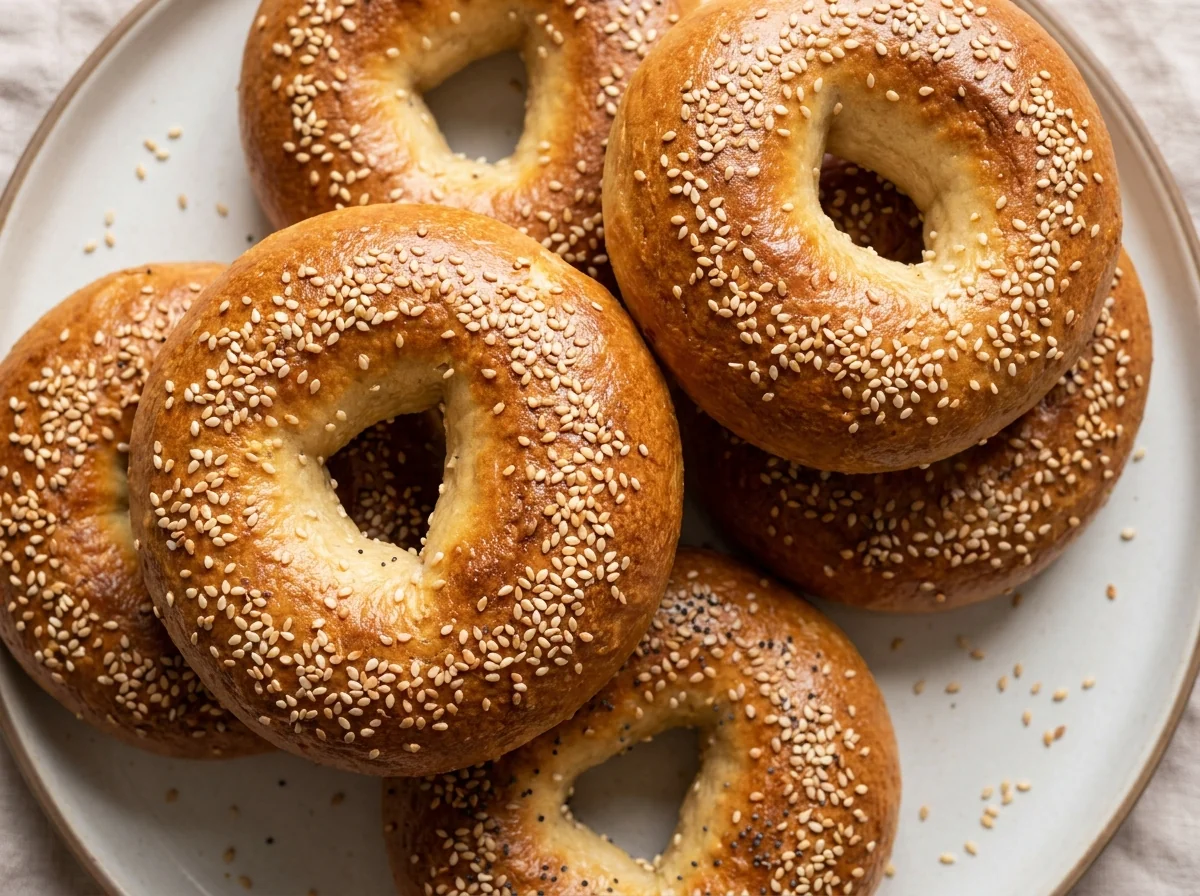
Ring bread is one of the oldest breads of Eastern European communities, carried by immigrants to America where it became a daily breakfast that is split in half and filled.
Its secret that distinguishes it from any other bread is the boiling step before baking.
Preparation Steps
Activate the yeast
Dissolve the yeast and sugar in the warm water and leave the mixture for five minutes until its surface foams, as the foam is proof that the yeast is alive and will ferment the dough.
Knead a stiff dough
Mix the flour and salt, then add the yeast water, and knead for ten minutes until the dough becomes smooth and slightly firm and does not stick to the hand, as the stiff low-water dough is the secret to the chewy crumb.
Ferment the dough
Put the dough in a greased bowl and cover it for an hour and a half until it doubles in size, as fermentation builds the flavor and the holes.
Shape the rings
Divide the dough into eight balls, and pierce each ball from its center with a finger, then widen the hole until its diameter is about four centimeters, as the wide hole stays visible after rising.
Rest the rings
Leave the rings on a flour-dusted tray for twenty minutes until they puff slightly, as the second rest gives them lightness before boiling.
Boil the rings
Bring a wide pot of water to a boil and dissolve the honey in it, then lower the rings in a little at a time and boil each side for one minute. Boiling gelatinizes the starch on the surface so the crust gains its distinctive shine and the crumb sets before baking.
Garnish and bake
Lift the rings with a strainer and sprinkle them with sesame while they are wet so it sticks, then bake them in a preheated oven at 220 degrees Celsius for about 20 to 25 minutes until they turn golden brown and make a hollow sound when their bottom is tapped.
Blood Sugar Impact
The glycemic index (GI) measures how quickly a food raises blood sugar, while the glycemic load (GL) measures how much a full serving raises it. Together they give the complete picture.
Glycemic Index
GI
73High
Low0–55Medium56–69High70+
A low value (≤55) means a gradual rise in blood sugar — the most suitable range for diabetes and insulin resistance.
Glycemic Load
GL
38High
Low0–10Medium11–19High20+
Glycemic load reflects the impact of the full serving. To lower it: take half a serving, or pair the recipe with a source of protein and fiber.
Nutritional Information
Per ServingMakes 8 servings · one serving is about 110 g of raw ingredients
Calories266 kcal13%of Daily Value*
Protein7 g14%of Daily Value*
Carbohydrates54 g20%of Daily Value*
Fat2 g3%of Daily Value*
Fiber2 g7%of Daily Value*
Sodium439 mg19%of Daily Value*
Potassium89 mg2%of Daily Value*
Phosphorus89 mg7%of Daily Value*
* Percent Daily Values are based on a 2,000-calorie diet per FDA food-label reference values — your daily needs may be higher or lower. Values are derived from the recipe's ingredients via the USDA database.
Troubleshooting
The most common problems when preparing Boiled Ring Bread (Bagel), and how to fix them:
The rings have no shine
The boiling time was probably too short; make sure to give a full minute per side in vigorously boiling, not simmering, water.
The crumb is dense, not chewy
The dough was soft and watery; reduce the water a little next time and knead longer until the gluten strengthens.
The hole closed up after baking
We widen the hole a little more when shaping because it shrinks with rising and boiling.
The crust is too hard
We left them in the oven longer than needed; take them out as soon as the bottom turns golden and makes a hollow sound.
Storage and Make-Ahead
Room temperature
Stays fresh for one day in a sealed bag; after that its surface dries out.
Freezing
Freeze it split in half in an airtight bag for up to three months, and toast it directly from the freezer.
Reheating
Toast it in the toaster or a hot oven for two minutes to restore the crispness of the crust.
Tested Ingredient Substitutions
Original Ingredient
Tested Substitute
Ratio
Flavor Difference
Bread flour
All-purpose flour
1 to 1
The result is less chewy because its protein is lower; acceptable but not ideal.
Honey in the boiling water
White sugar or molasses
Same amount
Gives the crust a similar color and shine.
Sesame
Nigella seeds or flax seeds
Same amount
Choose the garnish as desired, and add it at the same wet stage.
Instant yeast
Active dry yeast
Same weight
Dissolve it in the warm water and leave it for ten minutes before kneading.
How Much Does It Make? Scaling Guide
Ingredient
2 servings
4 servings (base)
8 servings
Bread flour
125 g
250 g
500 g
Warm water
70 ml
140 ml
280 ml
Instant yeast
2 g
4 g
7 g
Salt
2 g
5 g
9 g
EEINA Nutrition Tip
The brief boiling before baking is what makes the difference between ring bread and any ordinary bread: the boiling water cooks the outer layer, which sets the shape and gives the crust its shine and the crumb a chewy, cohesive texture.
Add This Recipe to Your Plan
The EEINA app saves your favorite recipes, calculates them from their real ingredients, and shows your daily numbers toward your goal. Try it free now.
If we skip it the result is no longer ring bread but ordinary bread; boiling is what gives it its distinctive crust and crumb, so it is an essential step, not optional.
Why do we add honey or sugar to the boiling water?
It helps brown the crust and gives it a beautiful shine and a lightly sweet edge flavor.
How do I know the dough has fermented enough?
When it nearly doubles in size, and when we press it with a wet finger it springs back slowly and does not return immediately.