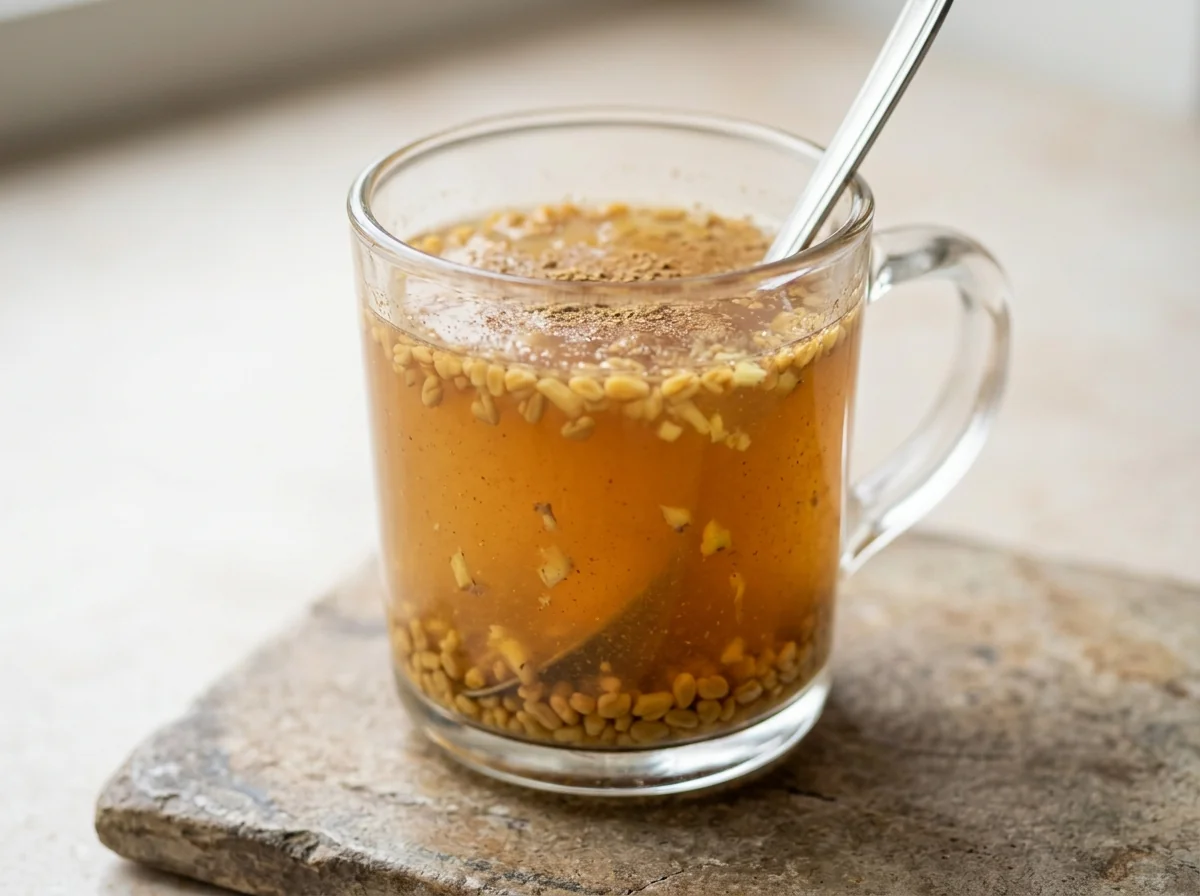
A warming fenugreek drink simmered with ginger, cardamom, and cumin, then sweetened with white honey. A soothing suhoor drink that aids digestion and supports insulin sensitivity.
Fenugreek is one of the oldest medicinal plants in pharaonic Egypt, used to stimulate labor and ease stomach pain.
During Ramadan, fenugreek with honey is a popular suhoor drink that soothes the stomach and fights hunger. Roasted sweet fenugreek loses its bitterness but also loses some of its benefits.
Preparation Steps
Soak the fenugreek
Wash the fenugreek seeds and soak them in cold water for 6 hours or overnight. Soaking reduces the bitterness and speeds up the cooking. Drain the seeds and discard the soaking water.
Boil the fenugreek
Place the soaked seeds in a pot with fresh water and heat over medium heat. Leave for 10 minutes until they soften and release their viscous liquid.
Add the spices
Add the ginger, cardamom, and cumin and leave for another 3 minutes. The cumin reduces the bloating that comes with fenugreek. The ginger adds a complementary warmth.
Strain
Strain the mixture through a fine sieve into two cups. Press the seeds with the back of a spoon to extract as much of the viscous liquid as possible.
Sweeten with honey
Add the white honey and stir. Serve warm immediately. White honey differs from sidr (red) honey in its lighter, gentler flavor.
Blood Sugar Impact
The glycemic index (GI) measures how quickly a food raises blood sugar, while the glycemic load (GL) measures how much a full serving raises it. Together they give the complete picture.
Glycemic Index
GI
44Low
Low0–55Medium56–69High70+
A low value (≤55) means a gradual rise in blood sugar — the most suitable range for diabetes and insulin resistance.
Glycemic Load
GL
7Low
Low0–10Medium11–19High20+
Glycemic load reflects the impact of the full serving. To lower it: take half a serving, or pair the recipe with a source of protein and fiber.
Nutritional Information
Per ServingMakes 2 servings · one serving is about 280 g of raw ingredients
Calories82 kcal4%of Daily Value*
Protein2 g4%of Daily Value*
Carbohydrates19 g7%of Daily Value*
Fat1 g1%of Daily Value*
Fiber3 g11%of Daily Value*
Sodium8 mg0%of Daily Value*
* Percent Daily Values are based on a 2,000-calorie diet per FDA food-label reference values — your daily needs may be higher or lower. Values are derived from the recipe's ingredients via the USDA database.
Troubleshooting
The most common problems when preparing Fenugreek with White Honey, and how to fix them:
The fenugreek is bitter
Double the soaking time and add an extra spoonful of honey. The bitterness comes from the saponins that break down with long soaking.
The texture is too thin
Cook for 5 more minutes uncovered. Evaporation thickens the texture and gives a fuller feeling.
Bloating after drinking
Add the cumin and reduce the amount. Fenugreek contains fermentable fibers that cause bloating.
The smell is strong
Add a pinch of cardamom. Cardamom covers the strong fenugreek smell and makes it more palatable.
Storage and Make-Ahead
In the refrigerator
3 days in a bottle. Reheat on low heat with a spoonful of water.
In the freezer
Two weeks in ice bags. Thaw the bag in warm water before drinking.
Tested Ingredient Substitutions
Original Ingredient
Tested Substitute
Ratio
Flavor Difference
white honey
date molasses (ajwa)
1:1
An authentic Gulf flavor with fewer calories.
fenugreek seeds
ground fenugreek
10 g whole = 7 g ground
Faster but less deep.
cumin
anise
1:1
A similar effect on bloating.
How Much Does It Make? Scaling Guide
Ingredient
2 people
4 people
6 people
Fenugreek
20 g
40 g
60 g
Water
500 ml
1000 ml
1500 ml
Honey
30 g
60 g
90 g
Cardamom
2 g
4 g
6 g
EEINA Nutrition Tip
Soak the fenugreek for at least 6 hours. Long soaking breaks down the bitter saponins and makes it easier to digest. Choose a natural white honey (such as summan or wildflower) because it is gentler on the stomach.
Add This Recipe to Your Plan
The EEINA app saves your favorite recipes, calculates them from their real ingredients, and shows your daily numbers toward your goal. Try it free now.
Yes, several studies have shown an increase in milk production. Fenugreek is one of the most well-known natural galactagogues. Consult a doctor before using it.
How many calories per cup?
Around 80 calories. The calories come from the honey and the soaked seeds.
Is it suitable during pregnancy?
Consult your doctor. Fenugreek stimulates the uterus, and excess use in the third trimester may increase the risk of contractions.
Does it lower blood sugar?
Fenugreek contains soluble fibers (galactomannan) that slow sugar absorption. Useful for people with type 2 diabetes.