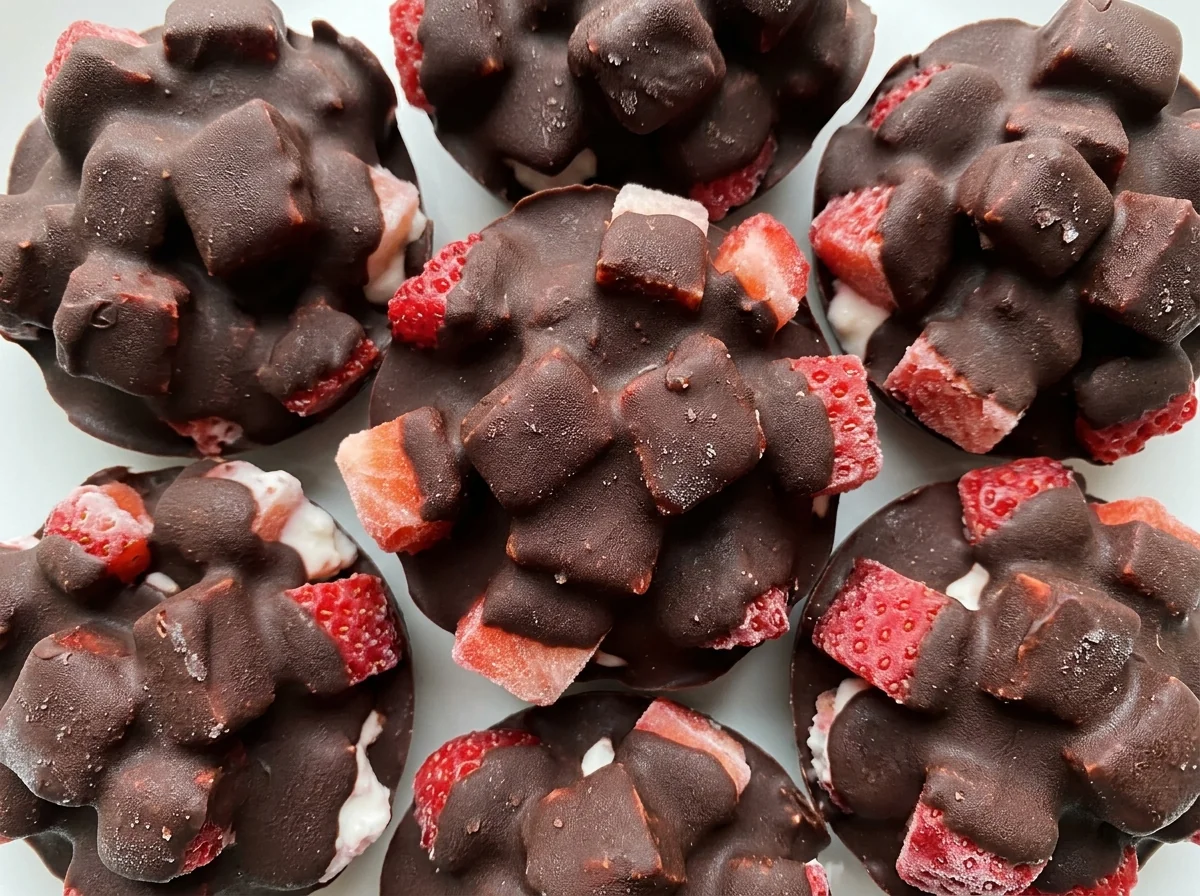
Strawberry pieces tossed in Greek yogurt, scooped into small mounds and frozen, then dipped in melted chocolate that sets into a shell that cracks at the first bite. The single-serve variation on frozen yogurt bark: the same idea in one-bite form, grabbed from the freezer whenever you like.
Frozen yogurt clusters swept TikTok as the ice cream alternative made with five ingredients, and in our library they are the single-serve variation on frozen yogurt bark: the bark is spread as one sheet and broken into shards, while a cluster is scooped as its own mound and dipped whole in chocolate, coming out as a coated bite eaten with no knife and no cutting.
The original is from Canadian dietitian Carly Walder, and we carried her quantities over as is, choosing dark chocolate as the first option instead of semi-sweet to lower the sugar a little.
Preparation Steps
Toss the strawberries in the yogurt
Line a small freezer-safe tray with parchment paper, then toss the strawberry cubes — dried well with a towel — in a bowl with the yogurt and vanilla until every piece wears an even white coat. Drying the strawberries before tossing matters: excess moisture thins the mixture and forms ice crystals.
Scoop into clusters and freeze
Scoop the mixture two tablespoons per cluster onto the paper, spaced apart — you get about 8 small mounds. Freeze the tray 30 to 45 minutes until the clusters firm up and feel solid to the touch without turning rock hard; a rock-hard cluster cracks its chocolate shell when bitten.
Melt the chocolate near the end of freezing
Ten minutes before the freezing time is up, put the chocolate and coconut oil in a small, deep bowl and melt in the microwave in 30-second bursts, stirring between them, until it flows smooth and glossy, then let it cool down 5 minutes. A deep bowl makes dipping easier, and lukewarm chocolate will not melt the yogurt on contact.
Dip the clusters quickly
Take out the clusters and dip each one in the chocolate with a spoon, rolling it quickly until fully coated, then return it to the paper. Work lightly, piece by piece — the cold clusters set the chocolate within seconds, and the mark of success is a continuous shell with no gaps.
Let the shell set and serve
Leave the clusters a few minutes until the shell fully hardens and loses its liquid shine, then serve straight away or pack for the freezer. The right bite is a shell that cracks open onto a cold yogurt center like ice cream.
Blood Sugar Impact
The glycemic index (GI) measures how quickly a food raises blood sugar, while the glycemic load (GL) measures how much a full serving raises it. Together they give the complete picture.
Glycemic Index
GI
24Low
Low0–55Medium56–69High70+
A low value (≤55) means a gradual rise in blood sugar — the most suitable range for diabetes and insulin resistance.
Glycemic Load
GL
2Low
Low0–10Medium11–19High20+
Glycemic load reflects the impact of the full serving. To lower it: take half a serving, or pair the recipe with a source of protein and fiber.
Nutritional Information
Per ServingMakes 8 servings · one serving is about 55 g of raw ingredients
Calories159 kcal8%of Daily Value*
Protein3 g6%of Daily Value*
Carbohydrates12 g4%of Daily Value*
Fat11 g14%of Daily Value*
Fiber3 g11%of Daily Value*
Sodium11 mg0%of Daily Value*
* Percent Daily Values are based on a 2,000-calorie diet per FDA food-label reference values — your daily needs may be higher or lower. Values are derived from the recipe's ingredients via the USDA database.
Troubleshooting
The most common problems when preparing Chocolate-Covered Frozen Yogurt Berry Clusters, and how to fix them:
The mixture is runny and will not hold in mounds
Thin yogurt or wet strawberries. Use thick Greek yogurt only and dry the strawberries well after washing; if it stays thin, add a spoonful of yogurt.
The chocolate stiffened in the bowl during dipping
The bowl chilled from the succession of cold clusters. Melt it 10 to 15 extra seconds in the microwave and continue, or dip in two batches from the start.
The shell cracked after long freezing
Partly natural, since the two layers contract differently. Reduce the gaps by dipping the clusters while firm, not rock hard, and with a medium — not too thin — chocolate layer.
The clusters stuck together in the storage container
They were packed before the shell fully set. Leave them until the shell hardens and separate the layers with parchment paper.
Storage and Make-Ahead
Freezer
Store in an airtight container with parchment paper between the layers up to a month, and leave them two minutes out of the freezer before eating so the center softens slightly.
Refrigerator (4°C)
They hold up to a week in an airtight container, as in the original recipe — the center comes out softer and the shell less crisp than freezer-kept ones.
Avoid
Do not refreeze melted clusters — the yogurt crystallizes and its texture is ruined.
Tested Ingredient Substitutions
Original Ingredient
Tested Substitute
Ratio
Flavor Difference
Strawberries
Blueberries or small-cut mango
150 g, same weight
Any firm, low-juice fruit does the job; avoid watermelon and the very watery ones.
Dark chocolate
Dark chocolate, 70% or higher
1:1
Cuts the sugar further and adds a little bitterness — the choice for anyone strict about their sugar.
Coconut oil
Omit it entirely
Omit 10 ml
Its job is thinning the chocolate and glossing the shell; without it the shell comes out thicker and less shiny, but it does the job.
Greek yogurt
Thick plant-based coconut yogurt
1:1
A dairy-free version for those who avoid it; choose a milk-free dark chocolate to complete it.
How Much Does It Make? Scaling Guide
Clusters
Strawberries
Greek yogurt
Dark chocolate
8 clusters (recipe)
150 g (1 cup)
120 g (1/2 cup)
170 g (1 cup)
16 clusters
300 g (2 cups)
240 g (1 cup)
340 g (2 cups)
24 clusters
450 g (3 cups)
360 g (1 1/2 cups)
510 g (3 cups)
EEINA Nutrition Tip
Stick to the 30 to 45 minute freezing window and do not stretch it: the cluster you want is firm outside and soft at the core. Frozen rock hard, it becomes tiring to bite and its shell cracks; under-frozen, it melts into the chocolate at dipping.
Add This Recipe to Your Plan
The EEINA app saves your favorite recipes, calculates them from their real ingredients, and shows your daily numbers toward your goal. Try it free now.
How do they differ from the frozen yogurt bark in our library?
The bark is one layer spread and frozen, then broken into sharp-edged shards with the yogurt left exposed. A cluster is an individual mound scooped by spoon and dipped whole in chocolate, so a shell seals the yogurt, slows its melting, and makes a clean one-bite snack.
Do they work with frozen strawberries?
Fresh is better; frozen ones release a lot of water as they thaw, thinning the mixture and crystallizing the clusters. If you must, thaw, drain, and towel-dry them rigorously.
Why do they melt quickly outside the freezer?
Because the core is yogurt, not stabilized ice cream. The chocolate shell slows the melting a little; even so, take out only the number you need and return the rest immediately.
Are they a good snack for children?
Yes, as an alternative to ice cream and packaged sweets: real fruit, yogurt, and a measured chocolate shell. For very young children, make smaller one-spoon clusters that are easier to bite.