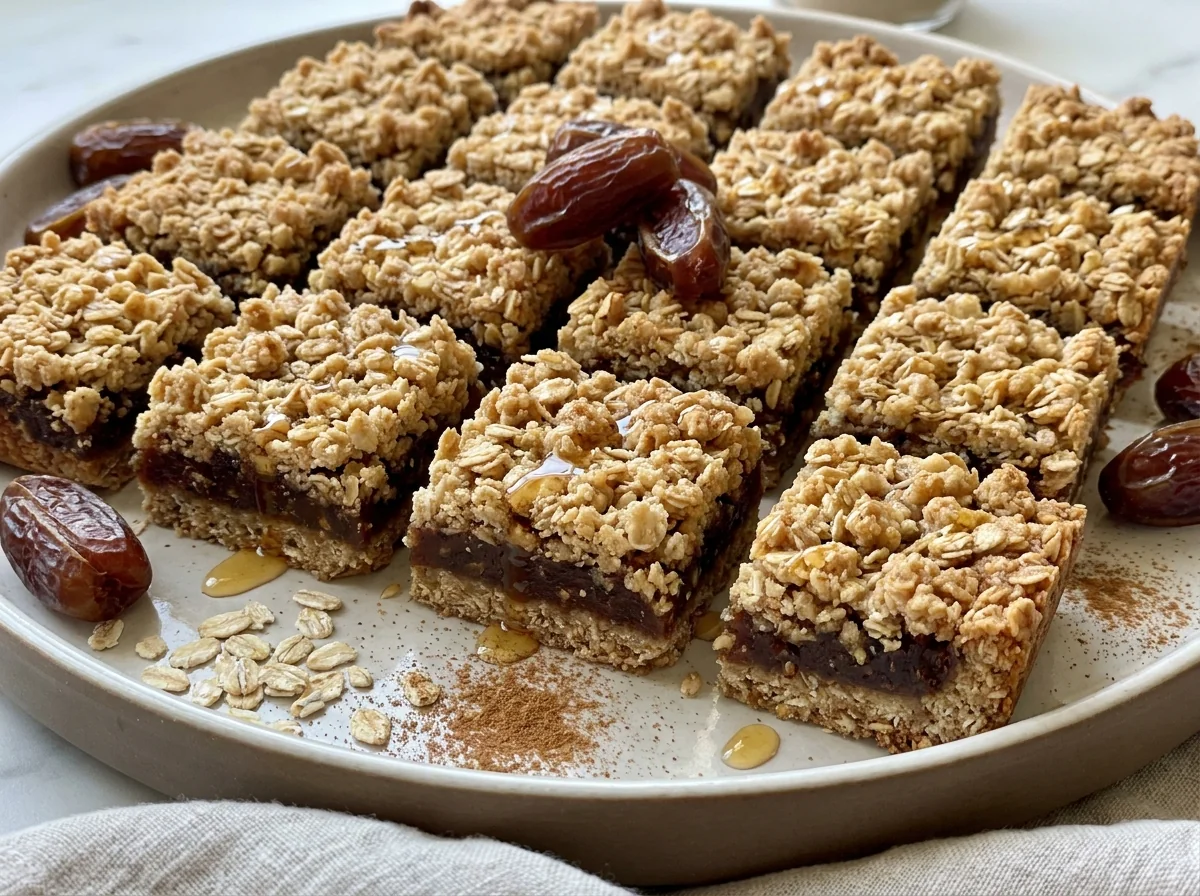
Date oat squares are a sweet of historic homes in Canada and Britain, where they are known as date crumble bars, and in the land of dates we adopt them by right of priority: date paste between two layers of rubbed oats makes tea squares that combine nature's caramel with the crunch of crumble.
Preparation Steps
Cook the date filling into a paste
The dates, water, and cinnamon over low heat for ten minutes, stirring and mashing until a smooth, glossy paste forms, with the vanilla after the heat: a true date-caramel filling is the heart of the squares.
Rub a single oat dough
Rub the oats, whole wheat flour, baking soda, salt, and honey with the cold butter using your fingertips into a moist, clumping crumble. A single dough will be both the base and the topping: the recipe's lovely economy.
Press two-thirds as a packed base
In a lined 20x20 pan, press two-thirds of the crumble down with the bottom of a cup into a firm layer. Firm pressing here is what prevents crumbling when cut.
Spread the paste and scatter the rest loosely
Spread the date filling with a wet spoon, and scatter the remaining third over it as a loose crumble with no pressing. The scattered topping crisps as a crumble while the pressed layer bakes into a firm biscuit.
Bake and cool with full patience
Thirty minutes at 180 until the top is golden, then full cooling for two hours in the pan before cutting into sixteen squares: a tea sweet that crosses generations with three honest layers.
Blood Sugar Impact
The glycemic index (GI) measures how quickly a food raises blood sugar, while the glycemic load (GL) measures how much a full serving raises it. Together they give the complete picture.
Glycemic Index
GI
52Low
Low0–55Medium56–69High70+
A low value (≤55) means a gradual rise in blood sugar — the most suitable range for diabetes and insulin resistance.
Glycemic Load
GL
16Medium
Low0–10Medium11–19High20+
Glycemic load reflects the impact of the full serving. To lower it: take half a serving, or pair the recipe with a source of protein and fiber.
Nutritional Information
Per ServingMakes 16 servings · one serving is about 65 g of raw ingredients
Calories226 kcal11%of Daily Value*
Protein4 g8%of Daily Value*
Carbohydrates35 g13%of Daily Value*
Fat9 g12%of Daily Value*
Fiber4 g14%of Daily Value*
Sodium302 mg13%of Daily Value*
Potassium267 mg6%of Daily Value*
Phosphorus116 mg9%of Daily Value*
* Percent Daily Values are based on a 2,000-calorie diet per FDA food-label reference values — your daily needs may be higher or lower. Values are derived from the recipe's ingredients via the USDA database.
Troubleshooting
The most common problems when preparing Date Oat Squares, and how to fix them:
They crumbled when cut
A loose base or hot cutting. Firm packing and the two hours of cooling, and a sharp knife wiped between cuts.
The filling ran from the sides
A thin paste with too much water. Ten minutes until thick glossiness. A paste that stands on the spoon.
The topping was pale with no crunch
A cool oven or a pressed scatter. The true golden and the loose scatter.
Overpowering sweetness
Premium dates with generous honey. Omit all the honey for diabetics and Majdool dates. The dates alone are usually enough.
Storage and Make-Ahead
At room temperature
Four days in an airtight container. The constant companion to tea.
In the refrigerator
Two weeks, and their cold texture is denser and firmer.
In the freezer
Two months separated by paper, thawing in half an hour: a hospitality reserve.
Tested Ingredient Substitutions
Original Ingredient
Tested Substitute
Ratio
Flavor Difference
Butter
Coconut oil, cold and solid
1:1
A fully plant-based version
Date filling
Ready date paste from our jar
400 g
A smart pantry shortcut
Whole wheat flour
Ground oat flour
1:1
A pure oat version
A nutty touch
A handful of crushed walnuts in the topping
40 g
A deeper crunch
How Much Does It Make? Scaling Guide
Ingredient
16 squares
8 squares
32 squares
Dates
400 g
200 g
800 g
Oats
200 g
100 g
400 g
Butter
150 g
75 g
300 g
EEINA Nutrition Tip
Press the base firmly and scatter the topping freely. The two layers come from one dough but their roles are opposite: the base is a foundation that holds, so it is packed down hard with the bottom of a cup, and the topping is a crumble that crisps, so it is sprinkled with light fingers; whoever presses both gets a solid biscuit, and whoever loosens both has squares that collapse into crumbs.
Add This Recipe to Your Plan
The EEINA app saves your favorite recipes, calculates them from their real ingredients, and shows your daily numbers toward your goal. Try it free now.
How are they different from our Batheetha and Tamriya?
Batheetha is toasted flour kneaded with dates into one mass; these are separate baked layers with Western crumble engineering. Dates are the bridge between the two kitchens.
A daily tea sweet, how is it counted?
The square is ~226 calories with the fiber of oats, whole wheat, and dates. One square with tea is a measured treat, and the whole pan is another story.
Are they fit for Eid hospitality?
One of the loveliest alternatives to Ma'amoul in terms of effort. No kneading, no engraving, no individual filling: one pan and sixteen elegant pieces.
Cheap hard dates, do they work for the filling?
They are the most economical choice. Cooking with water turns the hardest dates into a premium paste: save the soft premium ones for individual hospitality.