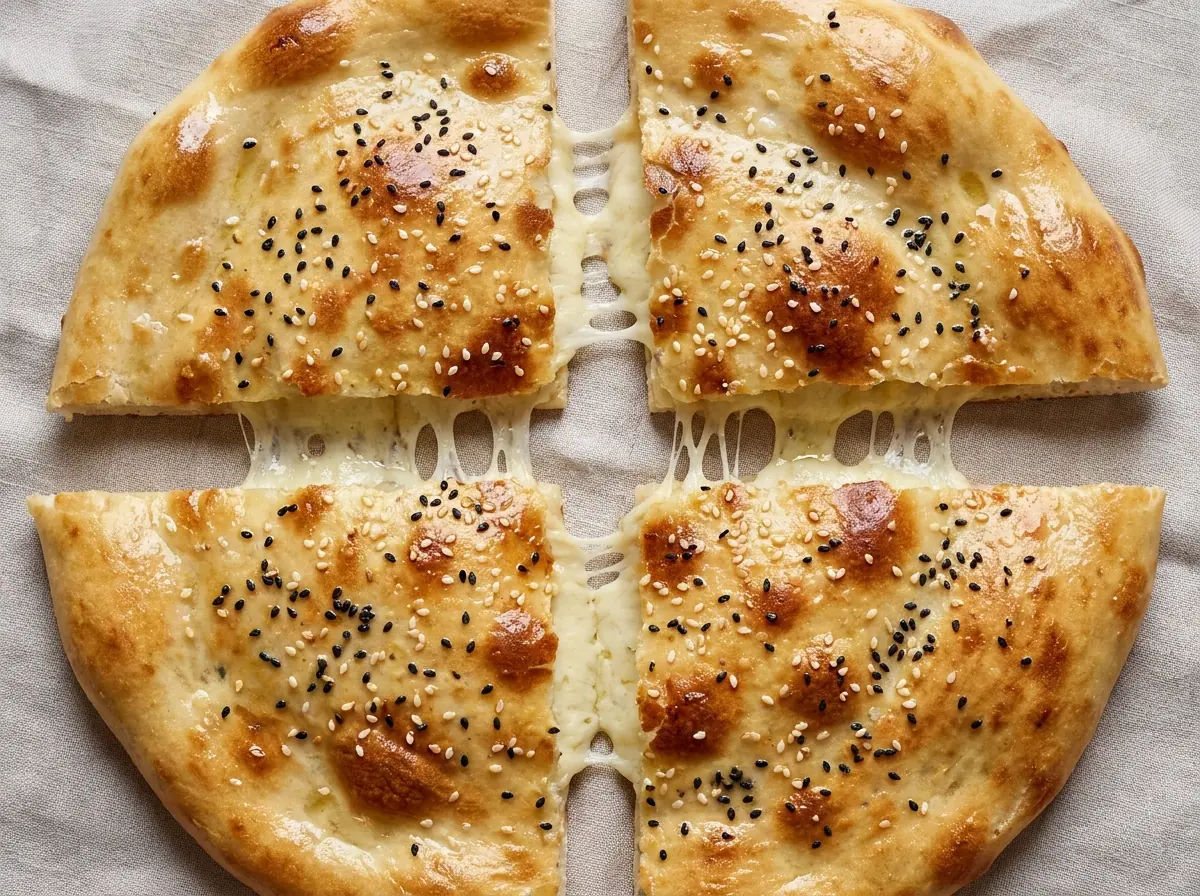
Tamees is the bread of Afghan ovens that Saudi mornings adopted, until the dawn queue in front of its shops became a familiar sight, and the cheese-stuffed version is one of its most beloved.
The home version saves the queue and makes the ingredients clear in your own hands.
Preparation Steps
Knead the soft Tamees dough
Mix the flour, yeast, sugar, and salt, add the warm water and oil, and knead for ten minutes until you have a soft, tender dough softer than ordinary bread dough. This softness is the cause of the Tamees bread's bubbles and lightness. Cover it for an hour until it doubles in size.
Divide the dough and stuff it with cheese
With an oiled hand, divide the dough into four balls. Flatten each ball in your palm and place a quarter of the grated cheese in its center, then close the dough around it into a tight ball with no cheese showing.
Flatten each ball into a wide disc
On an oiled surface, press each stuffed ball and flatten it with your fingertips into a wide disc half a finger thick, so the cheese spreads as a hidden layer between the two faces of the dough.
Bake at the highest heat
Heat the oven to its maximum (250) with an inverted tray or a baking stone inside. Brush the surface of the Tamees with water and scatter the nigella seeds, then transfer it to the hot surface to bake for six to eight minutes until it puffs and its surface browns with golden spots and the cheese melts inside. Maximum heat is the basis of Tamees ovens.
Serve it hot
Cut it into quarters so the cheese strands stretch when separated, and eat it hot with tea or with honey and chili in the style of Tamees shops.
Blood Sugar Impact
The glycemic index (GI) measures how quickly a food raises blood sugar, while the glycemic load (GL) measures how much a full serving raises it. Together they give the complete picture.
Glycemic Index
GI
73High
Low0–55Medium56–69High70+
A low value (≤55) means a gradual rise in blood sugar — the most suitable range for diabetes and insulin resistance.
Glycemic Load
GL
55High
Low0–10Medium11–19High20+
Glycemic load reflects the impact of the full serving. To lower it: take half a serving, or pair the recipe with a source of protein and fiber.
Nutritional Information
Per ServingMakes 4 servings · one serving is about 225 g of raw ingredients
Calories572 kcal29%of Daily Value*
Protein22 g44%of Daily Value*
Carbohydrates80 g29%of Daily Value*
Fat17 g22%of Daily Value*
Fiber4 g14%of Daily Value*
Sodium828 mg36%of Daily Value*
* Percent Daily Values are based on a 2,000-calorie diet per FDA food-label reference values — your daily needs may be higher or lower. Values are derived from the recipe's ingredients via the USDA database.
Troubleshooting
The most common problems when preparing Cheese-Stuffed Tamees Bread, and how to fix them:
The cheese came out of the edges
The ball was not sealed tightly, or it was flattened too hard over the filling. Seal the dough with a firm pinch and flatten from the center gently.
The Tamees came out pale on its surface
The oven was not hot enough, or it was baked on a cold tray. Maximum heat and a preheated tray are two essential conditions.
The dough is sticky and hard to flatten
This is its required soft nature. Oil your hand and the surface instead of adding flour, because excess flour robs it of its lightness.
It came out thick like a flatbread
It was not flattened enough. Flatten it wide to half a finger's thickness, and it will puff in the oven and return to its correct thickness.
Storage and Make-Ahead
Right away
It is served hot with the cheese strands stretching, so it is at its best the moment it comes out of the oven.
At room temperature
It holds for a few hours wrapped in a cotton towel, and is reheated on a hot griddle for a minute before eating.
In the freezer
Keeps baked for a month, and is reheated straight from frozen in a hot oven for four minutes so the cheese turns soft again.
Tested Ingredient Substitutions
Original Ingredient
Tested Substitute
Ratio
Flavor Difference
The cheese filling
No filling
same amount
It returns to a plain Tamees like the version in our library
Mozzarella with white cheese
Kiri cheese with za'atar
150 g
The known creamy shop version
Half the white flour
Whole-wheat flour
1:1 for the half
Brown whole-wheat Tamees as many ovens serve it
The home oven
A well-heated thick skillet with a lid
same amount
Less browning and a good result
How Much Does It Make? Scaling Guide
Ingredient
4 loaves
2 loaves
8 loaves
Flour
400 g
200 g
800 g
Cheese
200 g
100 g
400 g
Water
260 ml
130 ml
520 ml
EEINA Nutrition Tip
Heat the oven to its highest setting with an inverted tray inside for a full fifteen minutes before baking. Tamees needs strong heat from beneath to puff and brown its surface in minutes as in wood-fired ovens, while a lukewarm oven yields a pale flatbread, not Tamees.
Add This Recipe to Your Plan
The EEINA app saves your favorite recipes, calculates them from their real ingredients, and shows your daily numbers toward your goal. Try it free now.
What is the difference between it and ordinary Tamees?
Ordinary Tamees is plain and eaten with Ful and honey, while this one has a layer of melted cheese inside, so it is enough for a meal by itself. The dough is the same and the difference is in the filling.
How do I get closer to the wood-fired oven flavor?
A baking stone or a preheated inverted tray at maximum heat is half the way, and the short baking time is the other half. Do not over-bake it.
Does it hold up in a morning lunchbox?
Wrap it in paper then in a towel while warm, and it arrives soft, but it is best to reheat it for a minute in the work microwave so the cheese turns soft again.
A whole loaf or half for breakfast?
Half a stuffed loaf with tea and vegetables is enough, because the cheese filling increases fullness clearly more than plain Tamees.