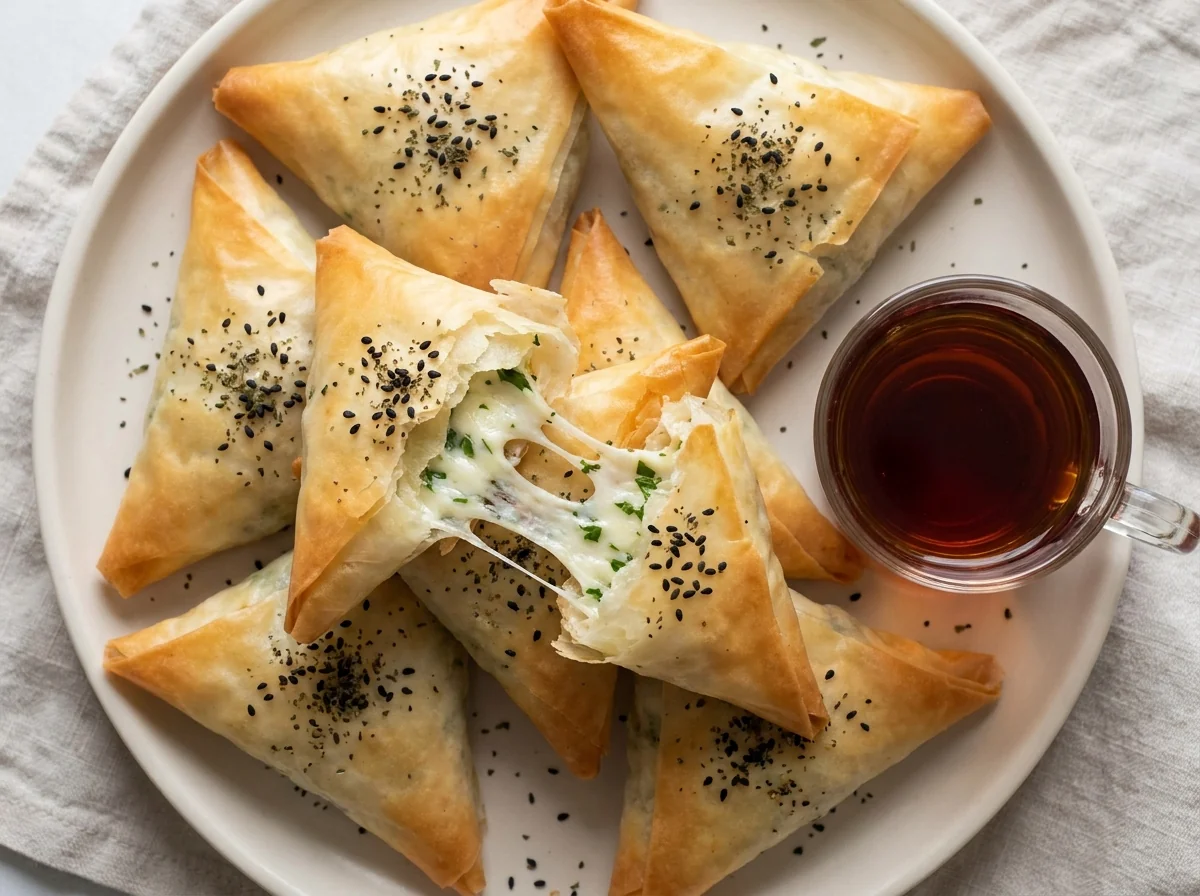
Cheese samosa is the third common type of Ramadan samosa alongside meat and vegetable, and children love it before adults for the molten cheese strings.
Nigella seeds and mint are its old Arab touch.
Preparation Steps
Prepare the cheese and parsley filling
Wash the parsley and chop it finely. In a bowl, mix the grated cheese with the parsley, dried mint, nigella seeds, and egg until a cohesive filling forms in which the aroma of mint shows. If the cheese is very salty, soak it beforehand for half an hour in cold water and squeeze it.
Fill generous triangles
Place a spoonful of cheese filling at the end of each wrapper and fold triangle over triangle to the end, sealing the edge with the flour paste. Tight sealing here is more important than for any other samosa, because the melted cheese leaks from any small opening.
Bake quickly at high heat
Brush the triangles with a swipe of oil and bake them in a preheated oven at 200 degrees for twelve to fifteen minutes only, with a turn halfway. The cheese needs less time than meat, and lift them as soon as they brown, before the cheese boils and seeps out.
Serve while the cheese is molten
They are eaten hot, where the cheese stretches into strings at the first bite. The best time for them is the first ten minutes out of the oven, and they are served alongside a glass of tea.
Blood Sugar Impact
The glycemic index (GI) measures how quickly a food raises blood sugar, while the glycemic load (GL) measures how much a full serving raises it. Together they give the complete picture.
Glycemic Index
GI
65Medium
Low0–55Medium56–69High70+
A low value (≤55) means a gradual rise in blood sugar — the most suitable range for diabetes and insulin resistance.
Glycemic Load
GL
21High
Low0–10Medium11–19High20+
Glycemic load reflects the impact of the full serving. To lower it: take half a serving, or pair the recipe with a source of protein and fiber.
Nutritional Information
Per ServingMakes 6 servings · one serving is about 110 g of raw ingredients
Calories316 kcal16%of Daily Value*
Protein13 g26%of Daily Value*
Carbohydrates33 g12%of Daily Value*
Fat15 g19%of Daily Value*
Fiber1 g4%of Daily Value*
Sodium808 mg35%of Daily Value*
* Percent Daily Values are based on a 2,000-calorie diet per FDA food-label reference values — your daily needs may be higher or lower. Values are derived from the recipe's ingredients via the USDA database.
Troubleshooting
The most common problems when preparing Baked Cheese and Parsley Samosa, and how to fix them:
The cheese leaked in the oven
The sealing is weak or the baking is longer than needed. Seal tightly and lift them as soon as they brown.
The filling is dry after baking
The cause is entirely low-fat cheese or too little filling. Make the mozzarella at least half the mixture and place a generous spoonful in each wrapper.
The taste is too salty
The cheese was not soaked. Soak the Akkawi and feta for half an hour and change the water once, so the excess salt comes out and the taste remains.
The wrappers cracked while folding
They dried from the air. Cover the wrappers with a wrung-out damp towel throughout the work, and only take out the wrapper you are working on.
Storage and Make-Ahead
Immediately
Eaten immediately while the cheese is molten and stretches into strings.
In the fridge
The filling alone for two days, and the wrappers are filled fresh.
In the freezer
Filled raw for two months, and baked frozen with three extra minutes.
Tested Ingredient Substitutions
Original Ingredient
Tested Substitute
Ratio
Flavor Difference
The soaked Akkawi
Cottage cheese with mozzarella
1:1
Higher protein and less salt
Nigella seeds
Toasted sesame
1:1
A different crunch and aroma (those with allergies, beware of sesame)
The parsley
Fresh dill
1:1
A softer green flavor
The samosa wrappers
Spring roll pastry
1:1
A finer crunch
How Much Does It Make? Scaling Guide
Ingredient
24 pieces
12 pieces
48 pieces
Wrappers
24
12
48
Cheese
300 g
150 g
600 g
Parsley
20 g
10 g
40 g
EEINA Nutrition Tip
Blend two cheeses: a salty one for flavor (Akkawi or feta) and a melting one for the strings (mozzarella). A single cheese gives either the flavor or the stretch, and the blend gives both together.
Add This Recipe to Your Plan
The EEINA app saves your favorite recipes, calculates them from their real ingredients, and shows your daily numbers toward your goal. Try it free now.
Which cheese holds up in the oven without melting away completely?
A blend of feta or Akkawi with mozzarella: the first holds firm and the second stretches, and grated halloumi is a third option that holds together well.
Why the egg in the filling?
It binds the crumbled cheese so it does not collapse when bitten and does not leak when baked, and it adds no taste of its own.
Is it suitable for children?
It is among the gentlest appetizers for them: cheese and parsley with no spicy seasoning. Wait until it cools a little, since its molten center is hot.
How many pieces are reasonable at iftar?
Two to three, since the cheese filling is more filling than its size suggests.