A warm, beloved Arab comfort sweet — flour cooked in water to a smooth, dense porridge served with a well of ghee and honey or date molasses. Filling, energising, medium glycemic load, contains gluten and dairy.
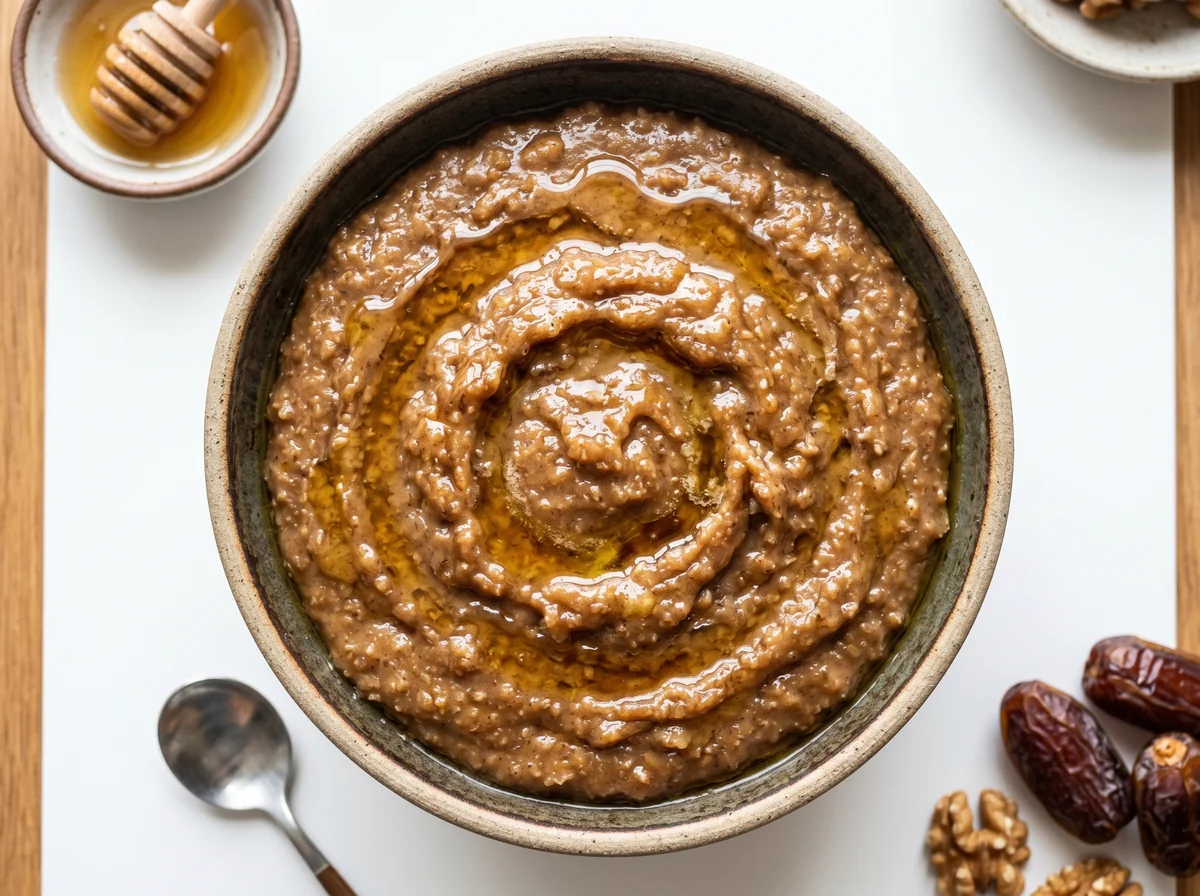
Asida is one of the oldest and simplest foods in the Arab world, found in similar forms across the Gulf, Libya, Sudan, and the Maghreb. It is nothing more than flour (or semolina) cooked in water to a smooth porridge, served with a hollow in the centre filled with ghee and honey or date molasses.
It holds a cherished place at celebrations: the Prophet's birthday, Ramadan, and the arrival of a newborn (where it is given to the mother to restore her strength). Asida embodies the genius of folk cooking — a satisfying, energy-giving dish made from the simplest ingredients. It carries warmth, generosity, and the taste of authentic Arab heritage.
Preparation Steps
Boil the water
Bring the water and salt to a boil in a pot. The boiling water is what will cook the flour. Add a pinch of cardamom to the water if you like a fragrant Asida.
Add the flour
Lower the heat, add the flour all at once to the boiling water, and immediately begin stirring vigorously with a strong wooden spoon. Adding the flour in one go and stirring straight away prevents lumps — flour clumps easily in hot water.
Cook and stir
Keep stirring and kneading inside the pot over low heat until the flour is cooked through and forms a smooth, firm dough that pulls away from the sides — about ten minutes. Asida takes muscle: constant, vigorous stirring gives a smooth, properly cooked texture.
Check doneness
Cook until the flour has completely lost its raw taste and the texture is smooth, glossy, and firm (not grainy or undercooked). If it is too dry, add a splash of hot water; if too loose, keep it on the heat.
Shape in the dish
Pour the Asida onto a serving plate, spread it out, and press a well (a hollow) in the centre with the back of a wet spoon. The well in the centre is the traditional serving style — fill it with ghee and honey so they pool together and you can dip each piece in.
Serve
Fill the well with melted ghee and honey (or date molasses) so they run down the sides of the Asida. Serve warm — eat by pulling off a piece and dipping it into the ghee and honey. Asida is a time-honoured Arab comfort food (found across the Gulf, Libya, Sudan, and North Africa), served at celebrations, the Prophet's birthday, Ramadan, and after childbirth. It is a symbol of generosity, simplicity, and nourishing folk cooking.
Blood Sugar Impact
The glycemic index (GI) measures how quickly a food raises blood sugar, while the glycemic load (GL) measures how much a full serving raises it. Together they give the complete picture.
Glycemic Index
GI
75High
Low0–55Medium56–69High70+
A low value (≤55) means a gradual rise in blood sugar — the most suitable range for diabetes and insulin resistance.
Glycemic Load
GL
26High
Low0–10Medium11–19High20+
Glycemic load reflects the impact of the full serving. To lower it: take half a serving, or pair the recipe with a source of protein and fiber.
Nutritional Information
Per ServingMakes 5 servings · one serving is about 190 g of raw ingredients
Calories175 kcal9%of Daily Value*
Protein5 g10%of Daily Value*
Carbohydrates36 g13%of Daily Value*
Fat0 g0%of Daily Value*
Fiber1 g4%of Daily Value*
Sodium1 mg0%of Daily Value*
Potassium51 mg1%of Daily Value*
Phosphorus52 mg4%of Daily Value*
* Percent Daily Values are based on a 2,000-calorie diet per FDA food-label reference values — your daily needs may be higher or lower. Values are derived from the recipe's ingredients via the USDA database.
Troubleshooting
The most common problems when preparing Asida (wheat porridge), and how to fix them:
Asida is lumpy
The flour was added too slowly or not stirred immediately. Add the flour all at once to boiling water and stir vigorously right away — adding it gradually without stirring creates lumps. Keep kneading hard until smooth.
Tastes raw or floury
Not cooked long enough. Keep cooking with constant stirring until the flour has completely lost its raw taste and the texture is smooth and glossy (about ten minutes). Undercooked flour gives an unpleasant starchy taste.
Asida is too hard
Too much flour, too little water, or overcooked. Add a splash of hot water and knead it in — Asida firms up more as it cools. The right texture is firm and smooth, not solid like a rock.
Asida is too loose and sticky
Too much water or not cooked long enough. Keep cooking with stirring until it firms up and pulls away from the sides of the pot. Successful Asida is a smooth, cohesive mass, not a runny paste.
Hard to stir
This is normal — Asida is dense and requires effort. Use a strong wooden spoon and a heavy, stable pot, and lower the heat. Constant vigorous stirring is essential for a smooth, cooked texture. It is part of the traditional process.
Storage and Make-Ahead
Refrigerator (4°C)
Store in an airtight container in the fridge for up to two days, but Asida firms up and hardens when chilled. Reheat with a splash of water and stirring (or microwave) to soften. It is best eaten warm and freshly made.
Make-ahead
Best made fresh and warm — the ideal approach is to cook it just before serving (25 minutes). Prepare the ghee and honey in advance, and cook the Asida fresh right before serving for the best texture.
Freezer
Not recommended (cooked flour dough changes texture when thawed and becomes hard). Make it fresh — it is simple and quick.
Food safety
Asida is a cooked flour dough — keep it chilled. Honey should not be given to children under one year old. Use clean utensils and serve warm and fresh for the best taste and texture.
Tested Ingredient Substitutions
Original Ingredient
Tested Substitute
Ratio
Flavor Difference
White flour
Wholemeal flour, semolina, or cornmeal
same amount
Wholemeal and semolina increase fibre and lower the glycemic load. Cornmeal gives a gluten-free version with a different texture.
Honey
Date molasses or carob molasses
to taste
Date molasses is common in the Gulf (and keeps it vegan). Both are natural local sweeteners with more minerals than refined sugar — pour into the well.
Ghee
Butter or less ghee
as desired
Butter is an alternative (contains dairy). Reducing the ghee lowers saturated fat. Asida is delicious with a moderate amount of ghee and honey.
How Much Does It Make? Scaling Guide
Servings
Flour
Water
3 (half recipe)
1 cup
1.5 cups
5 (base)
2 cups
3 cups
10 (celebration)
4 cups
6 cups
EEINA Nutrition Tip
Asida is a traditional energy food with real positives: it is sweetened with natural honey or date molasses (better than refined sugar, both contain minerals) and it is not fried. The challenge is the white flour base (fast-digesting starch), the ghee (saturated fat), and the medium-to-high glycemic load. To lighten it: use wholemeal flour or semolina (more fibre), reduce the ghee, moderate the honey, and keep portions small. Think of it as a celebration or postpartum energy food, with awareness of quantity if you are watching blood sugar.
Add This Recipe to Your Plan
The EEINA app saves your favorite recipes, calculates them from their real ingredients, and shows your daily numbers toward your goal. Try it free now.
Asida (wheat porridge) is a time-honoured Arab comfort food made from flour (or semolina) cooked in water to a smooth porridge, served with a hollow in the centre filled with ghee and honey or date molasses. It is found across the Gulf, Libya, and Sudan, and is served at the Prophet's birthday celebrations, Ramadan, and after childbirth.
Why is a well made in the centre?
The well (hollow) in the centre of the Asida is a serving tradition — the ghee and honey (or molasses) pool inside it and run down the sides, so you dip each piece of Asida into them as you eat. It is a beautiful, practical way to distribute the sweetness and fat across the porridge.
Is Asida healthy?
It is a traditional energy food with natural sweeteners (honey or date molasses, better than refined sugar) and no frying. The challenge is the white flour base and ghee with its medium-to-high glycemic load. Use wholemeal flour or semolina, reduce the ghee, moderate the honey, and keep portions small. Enjoy it as a celebration or postpartum energy food, with mindful quantities if monitoring blood sugar.
How do I avoid lumps?
Add the flour all at once to the boiling water and immediately begin stirring vigorously with a strong wooden spoon. Flour clumps easily in hot water, so adding it in one go with instant, continuous stirring is the secret to a smooth texture.