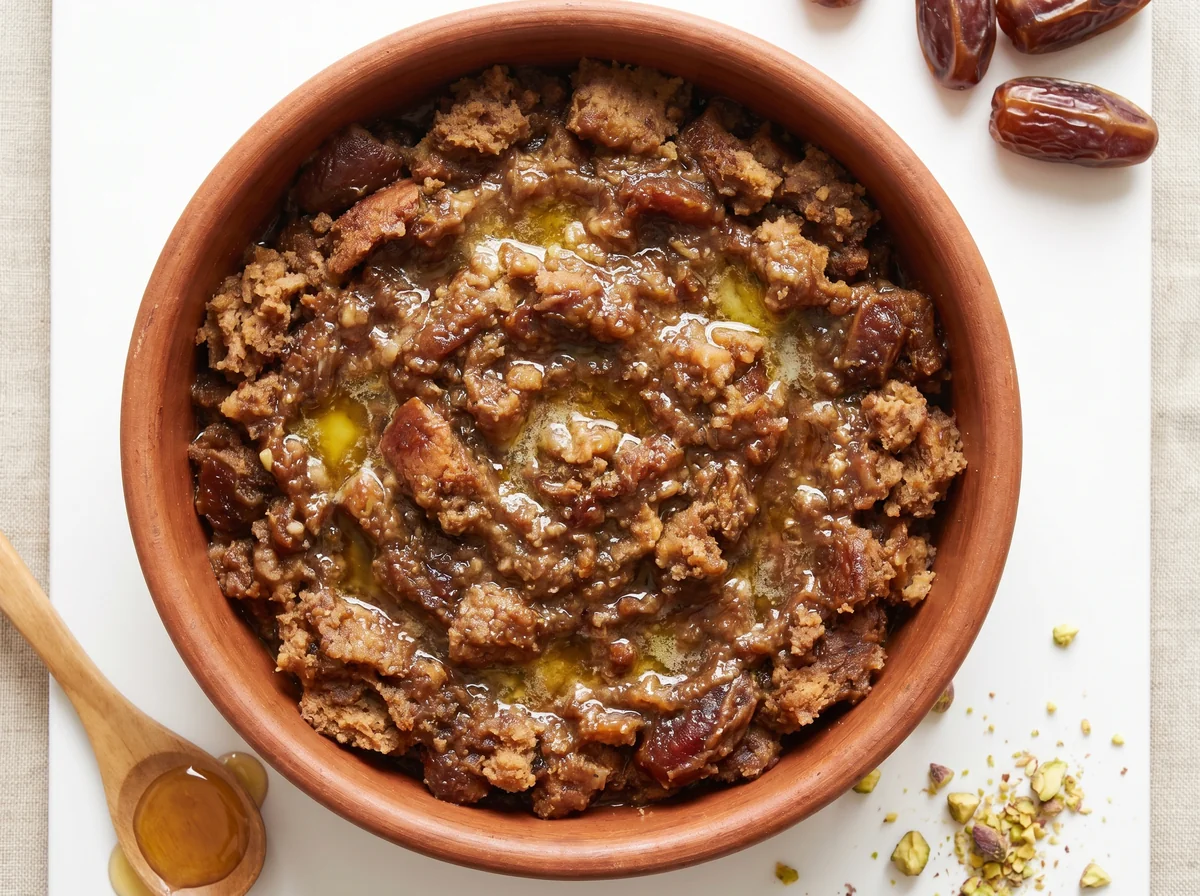
A warm Yemeni dessert of torn flatbread soaked in ghee, honey, and condensed milk, then topped with date paste and a fragrant cardamom finish — rich, comforting, and deeply traditional.
Areeka is one of Yemen's most beloved communal desserts — a humble dish that transforms everyday bread into something extraordinary with little more than ghee, honey, and dates.
It appears at celebrations, family gatherings, and the suhoor table during Ramadan.
Preparation Steps
Warm the ghee
Melt the ghee in a wide, heavy-bottomed pan over low heat until just liquid and fragrant. Ghee is the aromatic foundation of areeka.
Tear the bread
Tear the flatbread into rough pieces and add them to the pan. Stir to coat all pieces in the ghee and let them absorb it for 2–3 minutes over low heat.
Add the sweeteners
Drizzle in the honey and condensed milk. Stir gently until the bread soaks up the sweetness and the mixture begins to come together into a soft, sticky mass.
Fold in the dates
Add the mashed date paste and stir through the bread mixture. The dates add natural sweetness and a jammy, caramel depth.
Finish with cardamom
Sprinkle the ground cardamom over the top, give one last gentle stir, and remove from the heat. Cardamom is the aromatic signature of this dessert.
Serve
Spoon into shallow bowls and serve immediately while warm. Drizzle extra honey on top if desired. Areeka is a dessert best enjoyed the moment it is made.
Blood Sugar Impact
The glycemic index (GI) measures how quickly a food raises blood sugar, while the glycemic load (GL) measures how much a full serving raises it. Together they give the complete picture.
Glycemic Index
GI
56Medium
Low0–55Medium56–69High70+
A low value (≤55) means a gradual rise in blood sugar — the most suitable range for diabetes and insulin resistance.
Glycemic Load
GL
32High
Low0–10Medium11–19High20+
Glycemic load reflects the impact of the full serving. To lower it: take half a serving, or pair the recipe with a source of protein and fiber.
Nutritional Information
Per ServingMakes 5 servings · one serving is about 180 g of raw ingredients
Calories473 kcal24%of Daily Value*
Protein4 g8%of Daily Value*
Carbohydrates62 g23%of Daily Value*
Fat25 g32%of Daily Value*
Fiber5 g18%of Daily Value*
Sodium165 mg7%of Daily Value*
Potassium467 mg10%of Daily Value*
Phosphorus80 mg6%of Daily Value*
* Percent Daily Values are based on a 2,000-calorie diet per FDA food-label reference values — your daily needs may be higher or lower. Values are derived from the recipe's ingredients via the USDA database.
Troubleshooting
The most common problems when preparing Areeka (Yemeni Date and Bread Dessert), and how to fix them:
Bread is too dry and does not absorb
The bread may be too thick or too dry. Tear it into smaller pieces and add a tablespoon of warm water alongside the honey to help it hydrate.
Mixture is too sticky and clumps together
Stir more frequently over very low heat and add an extra half tablespoon of ghee to loosen the texture.
Dates are lumpy and not blending in
Mash the dates thoroughly into a smooth paste before adding, or warm them briefly in the microwave to soften.
Storage and Make-Ahead
Refrigerator (4°C)
Up to 2 days in a sealed container. Reheat gently with a drop of ghee to restore the texture.
Freezer (-18°C)
Not recommended — the bread texture becomes unpleasant after freezing.
Advance prep
Prepare the date paste and measure all ingredients in advance. The final cooking takes only minutes.
Reheating
Warm gently in the pan over low heat with a small knob of ghee, stirring until soft again. Do not leave outside the refrigerator for more than 2 hours [2].
Tested Ingredient Substitutions
Original Ingredient
Tested Substitute
Ratio
Flavor Difference
ghee
unsalted butter
same amount
Butter works but lacks the nutty, concentrated aroma of ghee
flatbread (lahoh)
thin white bread or pita
same amount
Any soft, thin bread absorbs well; avoid thick sourdough
condensed milk
evaporated milk + 1 teaspoon sugar
same volume
Reduces sweetness slightly for a less rich version
How Much Does It Make? Scaling Guide
Servings
Dates
Bread
Ghee
3 (half recipe)
1 cup
1 cup
1/4 cup
5 (base)
2 cups
2 cups
1/2 cup
10 (occasion)
4 cups
4 cups
1 cup
EEINA Nutrition Tip
Areeka is calorie-dense and high in sugar, so enjoy it in small portions on special occasions. Use high-quality dates (Medjool if available) for natural sweetness, and reduce the condensed milk to cut down on added sugar without losing much flavor.
Add This Recipe to Your Plan
The EEINA app saves your favorite recipes, calculates them from their real ingredients, and shows your daily numbers toward your goal. Try it free now.
Areeka is high in sugar and refined carbohydrates and is best reserved for occasional enjoyment in very small portions. People with diabetes should balance it carefully within their daily carbohydrate budget.
Can I make it gluten-free?
Yes — use certified gluten-free bread. The texture will differ but the flavors will hold.
What makes areeka different from a bread pudding?
Areeka is cooked on the stovetop rather than baked, uses ghee as the fat base rather than eggs or custard, and its flavor profile is purely Arabian — dates, honey, and cardamom.