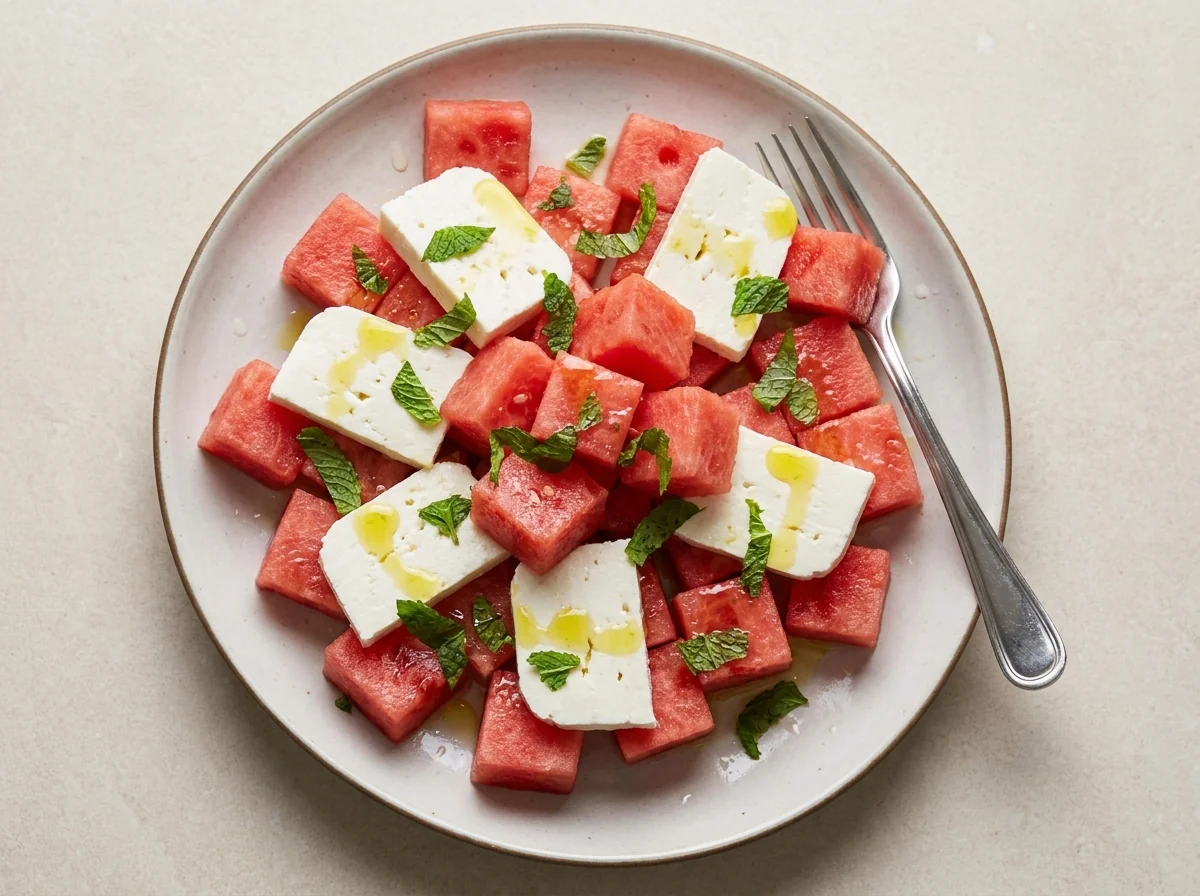
Cheese and watermelon are a summer pairing of the Levant and the Gulf that needs no introduction.
Cold sweetness meets rich saltiness. And in summer Ramadans it steps forward as a light Suhoor (pre-dawn Ramadan meal) that quenches and satisfies without weighing you down.
Preparation Steps
Chill the watermelon hard
At least two hours in the fridge before cutting. The watermelon's chill is half its pleasure, and a warm one betrays the whole plate.
Cut both elements evenly
Cut the watermelon into bite-sized cubes and the cheese into slightly smaller cubes. Balanced sizing ensures every fork carries sweet and salty together.
Arrange, don't toss
On a wide plate, spread out the watermelon and scatter the cheese among the cubes. Tossing and stirring break the watermelon and melt the cheese.
Finish with mint
Tear mint leaves by hand over the top, with a thread of olive oil for anyone who wants the full Levantine touch. Serve immediately with small forks.
Blood Sugar Impact
The glycemic index (GI) measures how quickly a food raises blood sugar, while the glycemic load (GL) measures how much a full serving raises it. Together they give the complete picture.
Glycemic Index
GI
64Medium
Low0–55Medium56–69High70+
A low value (≤55) means a gradual rise in blood sugar — the most suitable range for diabetes and insulin resistance.
Glycemic Load
GL
8Low
Low0–10Medium11–19High20+
Glycemic load reflects the impact of the full serving. To lower it: take half a serving, or pair the recipe with a source of protein and fiber.
Nutritional Information
Per ServingMakes 4 servings · one serving is about 205 g of raw ingredients
Calories198 kcal10%of Daily Value*
Protein8 g16%of Daily Value*
Carbohydrates13 g5%of Daily Value*
Fat13 g17%of Daily Value*
Fiber1 g4%of Daily Value*
Sodium571 mg25%of Daily Value*
Potassium199 mg4%of Daily Value*
Phosphorus185 mg15%of Daily Value*
* Percent Daily Values are based on a 2,000-calorie diet per FDA food-label reference values — your daily needs may be higher or lower. Values are derived from the recipe's ingredients via the USDA database.
Troubleshooting
The most common problems when preparing White Cheese with Watermelon, and how to fix them:
Watery, bland watermelon
Luck of the fruit. Seek the one that feels heavy for its size and rings when tapped; the bland one belongs in juice, not the plate.
The cheese is too salty
A quarter hour soaking in cold water returns it to balance.
The plate leaked water
You cut the watermelon too early so it wept. Cut only just before serving.
Wilted, blackened mint
You tore it too early. Mint is torn the moment the plate hits the table.
Storage and Make-Ahead
Immediately
A plate of the moment. Ten minutes and its first showing is over.
Kept apart
Cut watermelon in a sealed container for two days, and the cheese in its brine for a week, then they meet fresh.
Not suitable for freezing
Frozen watermelon is humiliated water.
Tested Ingredient Substitutions
Original Ingredient
Tested Substitute
Ratio
Flavor Difference
Red watermelon
Yellow cantaloupe
1:1
The second famous summer pairing
Nabulsi cheese
Grilled halloumi, warm cubes
1:1
An elegant hot-cold contrast
Mint
Fresh basil
1:1
A Mediterranean turn
Olive oil
Nothing at all
to taste
The simplest, most common original
How Much Does It Make? Scaling Guide
Ingredient
4 servings
2 servings
8 servings
Watermelon
600 g
300 g
1.2 kg
Cheese
200 g
100 g
400 g
EEINA Nutrition Tip
The plate's balance lies in the cheese's saltiness: an over-salty cheese (like unsoaked Akkawi) swallows the watermelon's sweetness. Soak it in cold water for a quarter hour and it mellows.
Add This Recipe to Your Plan
The EEINA app saves your favorite recipes, calculates them from their real ingredients, and shows your daily numbers toward your goal. Try it free now.
In summer Ramadan it is a fully legitimate light Suhoor: the watermelon's water hydrates while the cheese's protein and salt hold onto fluids and fullness. A lightness that won't weigh down your post-dawn sleep.
Why do sweet and salty go together at all?
Contrast wakes the palate. An old rule in kitchens around the world, long before books explained it.
Is it good for someone counting calories?
One of the kindest plates: low-calorie watermelon and portion-controlled cheese, with the balance in the hand of whoever does the cutting.
Seeds or no seeds?
Seedless is more gracious to a guest, while the seeded country variety has truer flavor, so pick your battle.