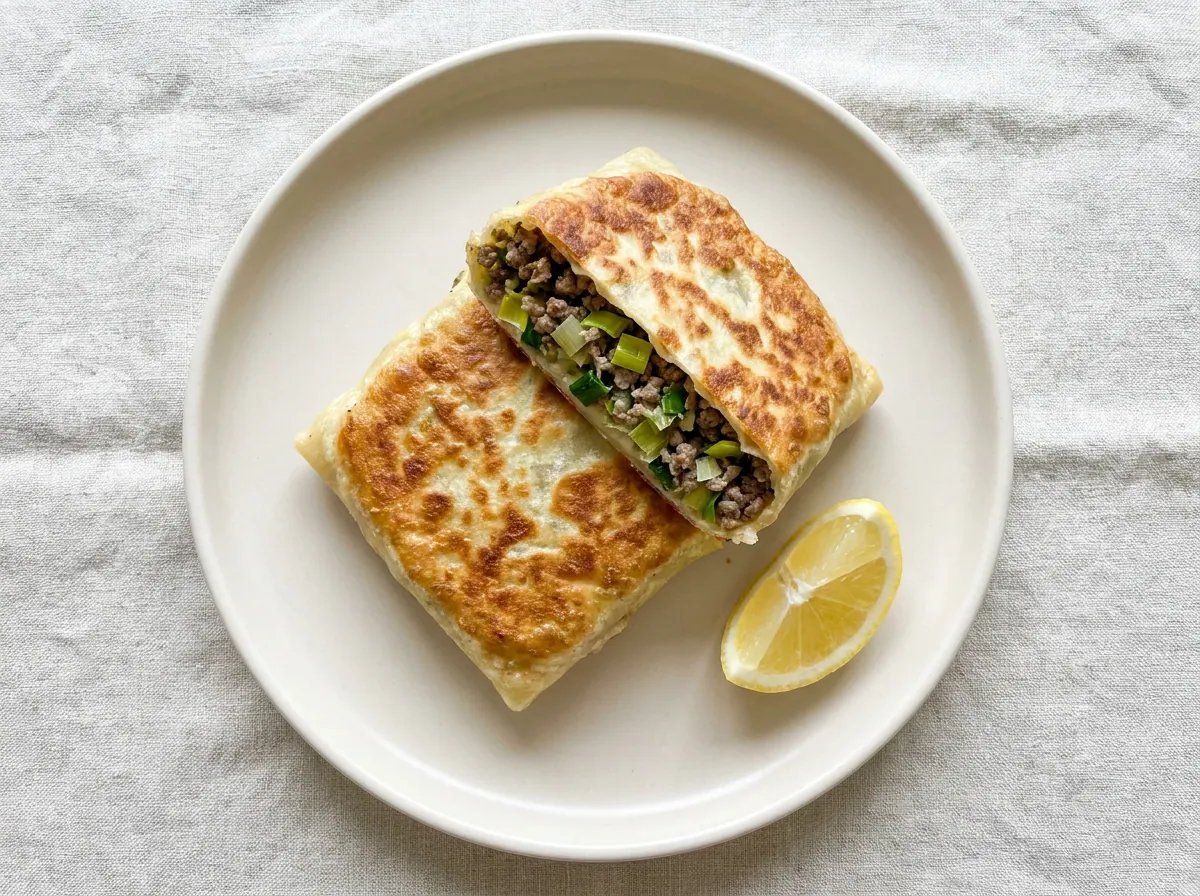
A lighter Hejazi mutabbaq made with whole wheat dough and a filling of lean minced meat, vegetables, and egg, cooked on a griddle with minimal oil instead of deep-frying. GI 58, 330 calories per serving.
Mutabbaq is one of the most famous Hejazi street foods: a thin sheet of dough rolled almost translucent, filled with meat, eggs, and vegetables, then folded into a square and cooked on a hot griddle. The name comes from the verb meaning 'to fold something over itself' — an apt description of how the filling is wrapped inside the dough.
The common version is sometimes deep-fried in generous oil, raising its fat content considerably. In this lighter version we kept the spirit of the dish and changed only two things: whole wheat dough instead of refined white flour, adding fibre and slowing the rise in blood sugar; and cooking on a griddle with a little oil instead of deep-frying. The filling stays exactly as it should be: lean minced meat, leeks, spring onion, tomato, and egg to bind it all together.
Preparation Steps
Knead the dough
Knead the whole wheat flour with salt and warm water until a soft, smooth dough forms. Cover and leave to rest for 30 minutes.
Brown the meat
For the filling, brown the lean minced meat over medium heat until it loses its pink colour, then add the spices (cumin, turmeric, and black pepper).
Add the vegetables
Add the leeks, spring onion, and drained tomato. Stir until the vegetables wilt and the liquid evaporates, then remove from heat and leave to cool. For a vegetarian version, replace the meat with extra vegetables.
Bind the filling with egg
Mix the cooled filling with the beaten eggs so the filling holds together during cooking.
Roll out the dough
Divide the dough into four balls and roll each one out very thinly on a lightly oiled surface until almost translucent.
Shape the mutabbaq
Place a portion of filling in the centre, then fold all four sides over it to form a closed square.
Cook on the griddle
Heat a griddle or flat pan with just one teaspoon of olive oil per piece, and cook the mutabbaq on both sides until golden and crisp — no deep-frying.
Serve
Serve hot, cut into pieces, alongside a green salad or labneh (strained yogurt) to lower the glycemic load of the meal.
Blood Sugar Impact
The glycemic index (GI) measures how quickly a food raises blood sugar, while the glycemic load (GL) measures how much a full serving raises it. Together they give the complete picture.
Glycemic Index
GI
51Low
Low0–55Medium56–69High70+
A low value (≤55) means a gradual rise in blood sugar — the most suitable range for diabetes and insulin resistance.
Glycemic Load
GL
21High
Low0–10Medium11–19High20+
Glycemic load reflects the impact of the full serving. To lower it: take half a serving, or pair the recipe with a source of protein and fiber.
Nutritional Information
Per ServingMakes 4 servings · one serving is about 210 g of raw ingredients
Calories477 kcal24%of Daily Value*
Protein25 g50%of Daily Value*
Carbohydrates48 g17%of Daily Value*
Fat21 g27%of Daily Value*
Fiber7 g25%of Daily Value*
Sodium86 mg4%of Daily Value*
* Percent Daily Values are based on a 2,000-calorie diet per FDA food-label reference values — your daily needs may be higher or lower. Values are derived from the recipe's ingredients via the USDA database.
Troubleshooting
The most common problems when preparing Light Saudi Mutabbaq with Whole Wheat, and how to fix them:
The dough tears when rolling
The dough is too dry or hasn't rested long enough — the gluten hasn't relaxed yet. Whole wheat absorbs more water than white flour and may need an extra two tablespoons of warm water to become pliable. Knead well, cover, and let it rest a full half hour — resting makes it rollable thin without tearing.
The filling leaks and opens the mutabbaq during cooking
The filling is hot or wet, or the binding egg was skipped. Drain the tomato well before adding it, and let the filling cool completely before mixing with the egg. The beaten egg binds the mixture so it holds together with heat — do not skip this step. Fold and press all four edges firmly.
The outside burns while the dough is raw inside
The griddle is too hot — the surface charred before the inner layer cooked through. Lower the heat to medium; the thin dough needs moderate, slightly longer heat to cook all the way through. Flip only once, when the first side turns golden — not before.
The mutabbaq is greasy and heavy even though it's cooked on a griddle
Too much oil was added to the griddle. The whole point of the lighter version is to cook, not fry — one teaspoon of olive oil per piece, brushed on or applied with a paper towel, is all you need. Excess oil is absorbed by the dough and makes it heavy.
The dough is thick and hard after cooking
It was not rolled thin enough. Hejazi mutabbaq is rolled until almost translucent — that is the secret to its light, crisp texture. Roll on a lightly oiled surface, using the heel of your hand or a rolling pin, until the sheet is nearly see-through before filling.
The flavour is flat with insufficient seasoning
Too few spices or added too late. Add the cumin, turmeric, and black pepper to the meat while it is browning — the heat draws out their aromatic oils. The leeks add a gentle onion depth, and a final light pinch of salt at the end balances the flavour. Taste the filling before wrapping and adjust.
Storage and Make-Ahead
Refrigerator (4°C)
Cooked mutabbaq: three days in an airtight container. Reheat on a griddle, not in the microwave, to restore crispness. The filling alone: two days in an airtight container — bind with egg at preparation time, not before.
Freezer (-18°C)
Shaped, uncooked pieces freeze on a tray lined with parchment, separated, then transfer to a sealed bag for up to one month. Cook directly from frozen on medium heat without thawing.
Advance preparation
Dough: knead and keep covered in the refrigerator for up to 24 hours; remove 30 minutes before rolling to soften. Filling: cook and cool the day before, bind with egg at shaping time. Shaping: shape pieces and freeze them; cook fresh as needed.
Serving
Serve hot, cut, with a green salad or labneh (strained yogurt). Do not leave out of the refrigerator for more than two hours after cooking, as it contains meat and eggs.
Tested Ingredient Substitutions
Original Ingredient
Tested Substitute
Ratio
Flavor Difference
Ground beef
Lean ground chicken breast
same weight
Lighter and lower in fat, milder flavour that needs a little extra seasoning
Meat filling
Vegetarian filling (extra leeks and mashed potato)
same volume
Meat-free, lower in protein, pleasant vegetable flavour
Whole wheat flour
Half whole wheat, half white flour
same amount
Easier to roll, less fibre, smoother texture
Leeks
Spring onion and extra chives
same amount
More pronounced onion flavour, more water — drain well
Olive oil for cooking
Canola oil spray
less amount
Neutral flavour, less fat per piece
How Much Does It Make? Scaling Guide
Number of servings
Whole wheat flour
Ground meat
Vegetables
Eggs
2 (individual × 2)
1 cup
125 g
0.5 cup
1 egg
4 (base)
2 cups
250 g
1 cup
2 eggs
8 (large family)
4 cups
500 g
2 cups
4 eggs
12 (entertaining)
6 cups
750 g
3 cups
6 eggs
EEINA Nutrition Tip
Whole wheat and the griddle are the secret to the lighter version: the change doesn't touch the soul of the mutabbaq — it merely shifts the carbohydrate source to whole wheat, richer in fibre, and the cooking method to a light griddle fry. Even so, it remains a pastry, so the glycemic load is moderate. The smarter approach is to pair it with a salad or labneh (strained yogurt) rather than eating it on its own in large quantities.
Add This Recipe to Your Plan
The EEINA app saves your favorite recipes, calculates them from their real ingredients, and shows your daily numbers toward your goal. Try it free now.
In moderation. The glycemic index is medium (58) and the glycemic load is 19 — at the upper end of moderate. Stick to one piece or half a piece, pair it with a green salad or unsweetened labneh (strained yogurt) to slow sugar absorption, and monitor your reading after the meal.
How do I make it lower in fat?
Use 90% lean mince or ground chicken, and brush the griddle with only one teaspoon of oil using a brush or paper towel instead of pouring. Cooking, not frying, is the idea.
Can I make it vegetarian?
Yes. Replace the meat with extra vegetables (leeks, mashed potato, and spring onion). The egg remains as a binder, or replace it with extra mashed potato for a fully plant-based version.
Why whole wheat instead of white flour?
Whole wheat retains the bran and germ, increasing fibre content and slowing the rise in blood sugar compared to refined white flour. The textural difference is minor; the nutritional benefit is clear.
Sources: USDA · University of Sydney · Gulf GSO · Our methodology · Updated on