Najdi Vegetable Margoog (vegetable stew with flatbread)
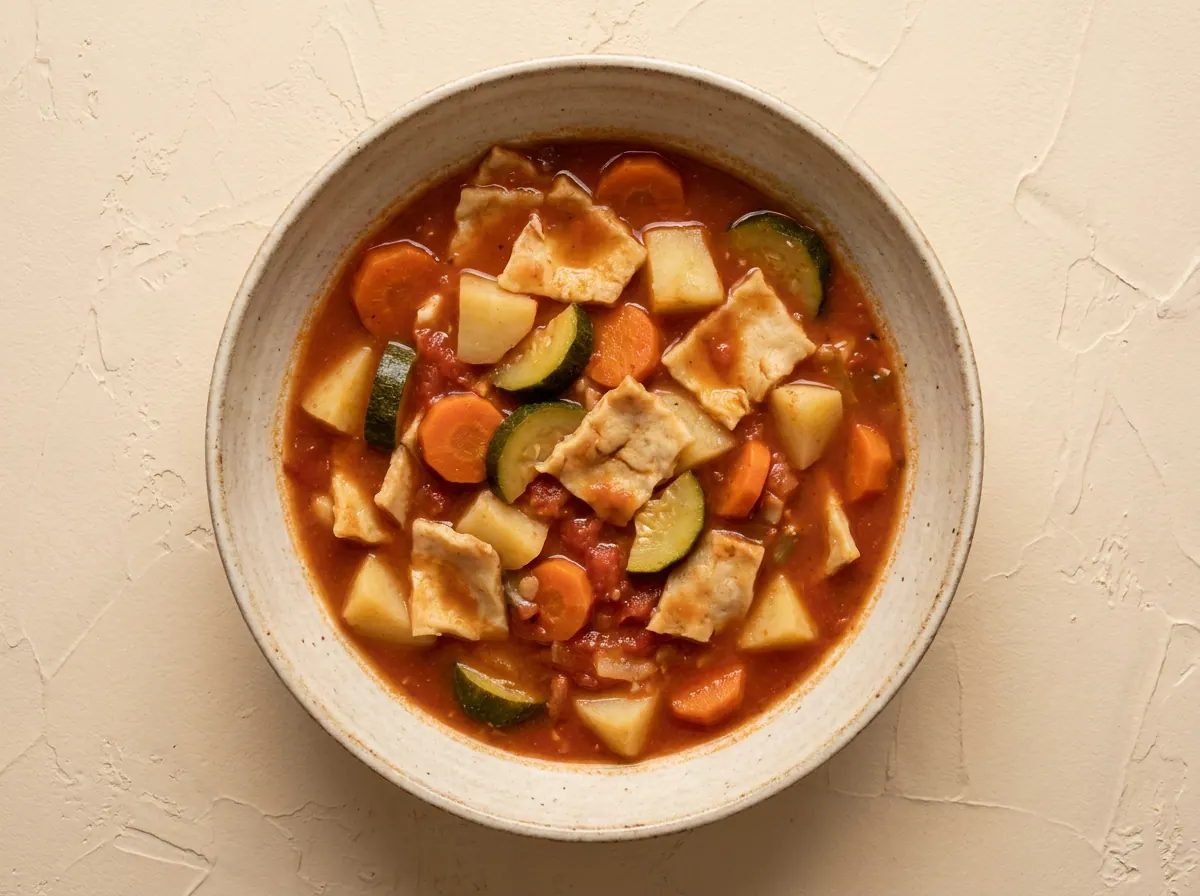
Najdi Margoog (vegetable stew with flatbread) with thin dough rounds cooked with vegetables — butternut squash, courgette, tomatoes, potatoes, and onion — in spiced tomato broth. A warming lunch dish, GI 55, rich in fibre from the vegetables.
Margoog (vegetable stew with flatbread) is a venerable Najdi dish built on thin dough rounds cooked in broth until they are soft and saturated with its flavour.
In Najdi homes it is typically cooked with lamb, but the vegetable version has its own place on the table — warming and light, relying on butternut squash, courgette, potatoes, and tomatoes in spiced tomato broth. This version uses whole-wheat flour for the dough instead of white, and generous vegetables, raising the fibre and moderating the effect on blood sugar compared with white dough alone.
Preparation Steps
Knead the dough and let it rest
Knead the flour with the lukewarm water, salt, and a tablespoon of oil until a soft, cohesive dough forms, then cover and let it rest for 30 minutes. Resting allows the gluten to relax, making the dough easier to roll out thin.
Sauté the onion and garlic
Heat the olive oil in a wide pot and add the onion, stirring until softened and translucent, then add the garlic and stir until fragrant. This aromatic base is the flavour foundation of the broth.
Build the broth
Add the grated tomatoes, tomato paste, turmeric, cumin, and the Najdi spice blend, and let the broth simmer for ten minutes until the colour is even and the spices are fragrant. The Najdi spice blend — cinnamon, cardamom, and loomi (dried black lime) — is the soul of the dish.
Cook the vegetables
Add the water or stock, then the potatoes and squash, and let them boil for ten minutes, then add the courgette. Add firm vegetables first and softer ones later, so everything cooks through without falling apart.
Roll out the dough rounds
Roll the dough out thin on a lightly floured surface and cut into palm-sized rounds, then leave them for two minutes until the surface dries slightly so they do not stick.
Add the rounds and cook through
Drop the rounds one by one into the simmering broth, gently, so they do not stick together, then cook for 15 minutes over a low flame until tender and saturated with the broth. Adjust the salt and serve hot.
Blood Sugar Impact
The glycemic index (GI) measures how quickly a food raises blood sugar, while the glycemic load (GL) measures how much a full serving raises it. Together they give the complete picture.
Glycemic Index
GI
53Low
Low0–55Medium56–69High70+
A low value (≤55) means a gradual rise in blood sugar — the most suitable range for diabetes and insulin resistance.
Glycemic Load
GL
21High
Low0–10Medium11–19High20+
Glycemic load reflects the impact of the full serving. To lower it: take half a serving, or pair the recipe with a source of protein and fiber.
Nutritional Information
Per ServingMakes 6 servings · one serving is about 530 g of raw ingredients
Calories296 kcal15%of Daily Value*
Protein9 g18%of Daily Value*
Carbohydrates48 g17%of Daily Value*
Fat8 g10%of Daily Value*
Fiber8 g29%of Daily Value*
Sodium17 mg1%of Daily Value*
Potassium859 mg18%of Daily Value*
Phosphorus237 mg19%of Daily Value*
* Percent Daily Values are based on a 2,000-calorie diet per FDA food-label reference values — your daily needs may be higher or lower. Values are derived from the recipe's ingredients via the USDA database.
Troubleshooting
The most common problems when preparing Najdi Vegetable Margoog (vegetable stew with flatbread), and how to fix them:
The dough rounds stuck together in the pot
All rounds were added at once, or the broth was not simmering. Drop the rounds one by one into gently simmering broth and stir the pot lightly after every few rounds. Dusting the rolled surface with a little flour before cutting also prevents sticking.
The dough stayed raw and doughy inside
The rounds were rolled too thick or not cooked long enough. Roll the dough as thin as possible and cook for 15 minutes over a low flame. If it still feels heavy: cook for a few extra minutes with a gentle stir — thin rounds cook through completely while thick ones remain doughy at the core.
The vegetables fell apart and became mushy
All vegetables were added at the same time, so the tender ones overcooked before the firm ones. The rule: firm first (potatoes and squash), then tender (courgette) after ten minutes. By the time the dough goes in, the vegetables should be nearly done, so they do not overcook further.
The broth is thin and watery with no body
Too much water, or too few tomatoes. The starch from the dough naturally thickens the broth during cooking, so do not add too much water at the start. If it stays thin: leave the pot uncovered for five minutes to let some evaporate, or add an extra tablespoon of tomato paste.
Bland flavour with no Najdi depth
The Najdi spice blend is absent or too little. The depth of Najdi Margoog comes from loomi (dried black lime), cinnamon, and cardamom with cumin and turmeric. Add a pierced loomi to simmer with the broth and remove it before serving — it gives the earthy acidity that defines Najdi cooking.
The rounds absorbed all the broth and the dish dried out
The dish was left on the heat too long after the dough was cooked — the dough keeps absorbing liquid. Serve the Margoog as soon as it is ready, and keep a cup of hot broth on the side to add at serving if needed. Always add a little water or broth when reheating.
Storage and Make-Ahead
Refrigerator (4°C)
Two to three days in a sealed container. The dough thickens further when cold — reheat with a splash of hot water. Raw dough: wrap and keep refrigerated for one day, then bring to room temperature before rolling.
Freezer (-18°C)
The broth and vegetables freeze well for up to a month, but the dough rounds change texture after thawing. Best practice: freeze the broth alone and cook fresh rounds at serving time.
Prep ahead
Knead the dough and rest it an hour ahead, covered at room temperature. Chop the vegetables and store them in the fridge from the morning. Prepare the broth two hours ahead and drop the fresh rounds only 30 minutes before serving.
Reheating
Over a low flame with a little hot water and a gentle stir. Do not leave cooked food outside the fridge for more than two hours, and reheat only once.
Tested Ingredient Substitutions
Original Ingredient
Tested Substitute
Ratio
Flavor Difference
Whole-wheat flour
Half whole-wheat, half white flour
Same quantity
Softer, lighter rounds; slightly less fibre and a marginally higher glycaemic load
Butternut squash
Pumpkin (kabocha or similar) [2]
Same quantity
Also low GI, with a slightly less sweet flavour
Potatoes
Diced carrot
Same quantity
Sweeter flavour, firmer texture, holds its shape without falling apart
Grated tomatoes
Canned crushed tomatoes
One medium can per 4 fresh tomatoes
Deeper colour and more intense flavour; adjust the salt carefully as canned tomatoes are salted
Water
Light chicken or vegetable stock
Same quantity
Richer depth and body in the broth; watch the sodium in ready-made stock
How Much Does It Make? Scaling Guide
Number of servings
Flour
Vegetables
Tomatoes
Water or broth
3 (small)
1 cup
Half the quantity
2
3 cups
6 (base)
2 cups
The full quantity
4
6 cups
9 (large family)
3 cups
1.5×
6
9 cups
12 (entertaining)
4 cups
Double the quantity
8
12 cups
EEINA Nutrition Tip
Vegetables before dough is the secret to balance: the more generous the low-GI vegetables relative to the dough, the more moderate the dish's effect on blood sugar and the higher its fibre. Make the dough a supporting element rather than the dominant base, and you will have a warm, balanced dish.
Add This Recipe to Your Plan
The EEINA app saves your favorite recipes, calculates them from their real ingredients, and shows your daily numbers toward your goal. Try it free now.
What is the difference between Margoog and Matazeez?
Both are Najdi dough-and-broth dishes. Margoog has thinner, wider dough rounds; Matazeez has smaller, thicker pieces. The flavour and method are very similar.
Is it suitable for diabetics?
The whole-wheat version with generous vegetables has a GI of 55, at the lower edge of medium. A moderate portion with extra vegetables alongside a protein source is a reasonable choice, with portion monitoring.
Is lamb required?
No. The vegetable version has its own place on the Najdi table and is light and satisfying. Anyone wanting protein can add chicken pieces or cooked chickpeas to the broth.
What is loomi and why is it added?
Loomi (dried black lime) is pierced and simmered in the broth, then removed before serving. It gives the earthy acidity that defines Najdi cooking. A splash of fresh lemon juice at serving is a simple substitute.