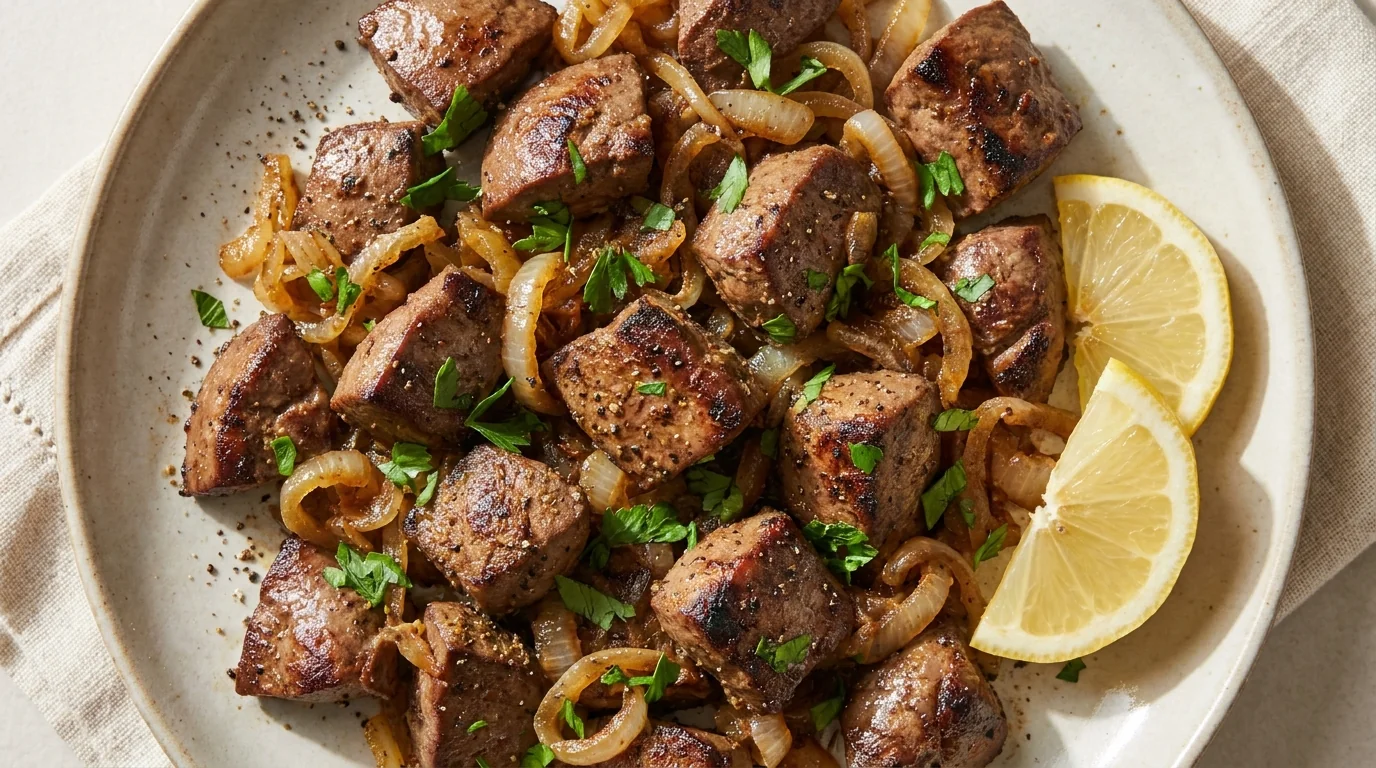
Free-range hashi (camel) liver with a comparison of three types (hashi, local lamb, and beef). The authentic method as served in restaurants, with an EEINA modification that cuts 464 calories. Rich in iron and protein.
Hashi liver has become a cultural phenomenon in Saudi Arabia — entire restaurants have opened dedicated to this single dish. The reason is simple: hashi (camel calf) meat is tender, mildly sweet, and easier to digest than beef, a fact many people don't know. But restaurants don't use authentic local ghee — it's expensive and inconsistent at scale. In reality, commercial versions are cooked in large quantities of hydrogenated vegetable shortening and refined oils (corn, sunflower, canola) to lock in flavour and reduce cost. The result is that an average restaurant serving of liver exceeds 450 calories, most of them from synthetic fats rather than the liver itself.
More concerning, hydrogenated shortening contains trans fats linked to heart disease. This recipe preserves the flavour and cuts the calories to just 290 with three simple adjustments. Common commercial ingredients (for 4 servings): 500 g hashi liver, 4 large onions, 5 garlic cloves, 70 ml hydrogenated shortening or refined corn oil (~7 tablespoons), cumin, black and red pepper, vinegar, and white bread for serving. The commercial method: heat the shortening in a wide skillet, fry the onion until it melts into the fat, add the whole liver pieces (some membranes intact), stir over high heat for 8 minutes, then serve with bread soaked in extra oil. Each serving carries roughly two tablespoons of absorbed hydrogenated fat. Each modification here keeps the flavour and lowers the number.
Preparation Steps
Prepare the liver
Wash the liver thoroughly, remove sinew and membranes, and cut into small pieces (2×2 cm). Pat dry with paper towels — dryness prevents oil splatter.
Sauté the onion
In a wide skillet, heat one tablespoon of oil. Add the onion and stir over medium heat until golden (7–8 minutes). Do not let it burn.
Add garlic and spices
Add the crushed garlic, cumin, black pepper, and red pepper if using. Stir over low heat for one minute.
Fry the liver over high heat
Raise the heat, add the remaining tablespoon of oil, then add all the liver at once. Stir continuously for 4–5 minutes only — healthy liver should be cooked briefly and never exceed 5 minutes.
Add vinegar and salt
Add the apple cider vinegar and salt in the final minute. Stir and immediately remove the skillet from the heat.
Serve
Place the liver on a serving plate, scatter the chopped parsley, and add lemon wedges on the side. Serve with wholemeal flatbread — each piece of bread counts as one portion.
Blood Sugar Impact
The glycemic index (GI) measures how quickly a food raises blood sugar, while the glycemic load (GL) measures how much a full serving raises it. Together they give the complete picture.
Glycemic Index
GI
49Low
Low0–55Medium56–69High70+
A low value (≤55) means a gradual rise in blood sugar — the most suitable range for diabetes and insulin resistance.
Glycemic Load
GL
23High
Low0–10Medium11–19High20+
Glycemic load reflects the impact of the full serving. To lower it: take half a serving, or pair the recipe with a source of protein and fiber.
Nutritional Information
Per ServingMakes 4 servings · one serving is about 355 g of raw ingredients
Calories464 kcal23%of Daily Value*
Protein33 g66%of Daily Value*
Carbohydrates53 g19%of Daily Value*
Fat14 g18%of Daily Value*
Fiber6 g21%of Daily Value*
Sodium488 mg21%of Daily Value*
* Percent Daily Values are based on a 2,000-calorie diet per FDA food-label reference values — your daily needs may be higher or lower. Values are derived from the recipe's ingredients via the USDA database.
Troubleshooting
The most common problems when preparing Saudi Hashi Liver, and how to fix them:
The liver came out tough and rubbery
It was overcooked. Liver should never exceed 5 minutes over high heat. The rule: remove the skillet the moment the red colour disappears from the surface — residual heat finishes the cooking. Next time, set a phone timer.
The oil splatters and makes a mess
The liver was wet when added. Patting dry with paper towels before frying is a step you cannot skip. To rescue the situation mid-cook: partially cover the skillet with a lid propped open on one side — this reduces splatter while letting steam escape.
The liver tastes strong and bitter
The thin membranes on the liver's surface were not fully removed — they cause bitterness. To fix it: soak the liver in a cup of milk for half an hour before cooking; the milk mellows the flavour and draws out residue. Next time, allow 15 minutes to clean sinew and membranes with a sharp knife.
The onion burned before it softened
The heat was too high. Onion needs medium heat and 7–8 minutes of patience to turn golden. Next time: medium heat, constant stirring, and a light pinch of salt on the onion helps draw out moisture and slow the browning.
The liver is swimming in water inside the skillet
Too much liver in too small a pan — the temperature dropped and couldn't sustain quick frying. Divide the liver into two batches or use a wider pan. Successfully fried liver develops a light golden crust.
The liver is dry and tough after reheating
It was reheated in the microwave, which dries it out completely. Never reheat cooked liver in the microwave. The best method: a dry skillet over very low heat with a splash of water, covered for 1–2 minutes just until warm — not re-cooked.
Storage and Make-Ahead
Refrigerator (4°C)
Cooked liver: 24 hours only in an airtight container. Liver is highly perishable. Raw liver (before cooking): maximum two days on the lowest shelf.
Freezer (-18°C)
Raw liver: one full month in a sealed freezer bag; thaw overnight in the refrigerator before cooking. Cooked liver: not recommended — the flavour deteriorates after freezing.
Advance preparation
Cleaning and removing sinew: can be done up to two hours ahead and kept in the refrigerator. Sautéing the onion: can be done an hour ahead, kept in the covered skillet. Frying: always at serving time — liver is a same-day dish.
Reheating
Dry skillet over very low heat with a splash of water, covered for 1–2 minutes. No microwave — it dries the liver out.
Tested Ingredient Substitutions
Original Ingredient
Tested Substitute
Ratio
Flavor Difference
Extra-virgin olive oil
Avocado oil
same amount
Neutral flavour, handles higher heat
Apple cider vinegar
Pomegranate vinegar or date molasses
half the amount
Deeper sweet-sour Levantine note
Wholemeal flatbread
Wholemeal saj bread
same amount
Thinner, roughly the same GI
Ground cumin
Saudi mixed baharat (Gulf spice blend)
same amount
More complex, classic Najdi flavour
Fresh parsley
Fresh coriander
same amount
More pungent, a Lebanese touch
How Much Does It Make? Scaling Guide
Number of servings
Liver
Onion
Olive oil
Frying time
2 (individual × 2)
250 g
2
1 tbsp
3–4 min
4 (base)
500 g
4
2 tbsp
4–5 min
8 (large family)
1 kg
8
4 tbsp
In 2 batches × 5 min
12 (entertaining)
1.5 kg
12
6 tbsp
In 3 batches × 5 min
EEINA Nutrition Tip
Liver is extremely rich in vitamin A and cholesterol — beneficial as a once-a-week meal, but unsuitable as a daily routine. Pregnant women benefit greatly from its high iron content, but in the first trimester it is advisable to limit vitamin A intake. Hashi (lower in vitamin A) is therefore more suitable for pregnant women than beef liver.
Add This Recipe to Your Plan
The EEINA app saves your favorite recipes, calculates them from their real ingredients, and shows your daily numbers toward your goal. Try it free now.
For a healthy adult: once a week is sufficient. Liver is very rich in vitamin A, which accumulates in the body — eating it daily could potentially lead to vitamin A toxicity (rare but possible). For pregnant women: twice a week is acceptable to replenish iron, but avoid beef liver (highest in vitamin A) in the first trimester.
Is hashi liver really better than local lamb liver?
To clarify: the word 'local' (baladi) refers to the source (domestic, from Saudi Arabia), not the animal type. Hashi (camel), lamb, and beef liver can all be local or imported. The correct comparison is by animal type. Nutritionally, hashi has a slight edge (about 15% fewer calories, 20% more iron, milder flavour). Price: local hashi is about 30–40% more expensive than local lamb at most Saudi stores. Conclusion: for pregnant and breastfeeding women, hashi is worth the difference due to their higher iron needs. For the average family, local lamb is an excellent choice balancing cost and value, with a flavour most children are familiar with.
How do I tell fresh liver from frozen at the supermarket?
Fresh liver is in the chilled meat section (open refrigerated display at 0–4°C), reddish-brown in colour, with a faint metallic smell, springy texture, and a sell-by of two to three days. Frozen liver is in the freezer section (below zero), packaged for months, slightly darker due to freezing, and needs slow overnight thawing in the refrigerator before cooking. Avoid liver that looks green or grey, or smells pungent. When in doubt, soak the liver in milk for half an hour before cooking — it mellows the flavour and draws out residue.
Is it suitable for people with diabetes?
Yes, excellently. GI is low (42 with wholemeal bread), protein is high to sustain satiety, and sodium is moderate. Recommended once a week with a large salad and a glass of water before eating.
Do I need to soak the liver in milk?
Not necessary, but it softens the strong flavour and adds tenderness. Optional for hashi (naturally mild), beneficial for beef (stronger flavour). Soak for 20–30 minutes only, then rinse and pat dry before cooking.
How do I store leftovers?
Cooked liver is highly perishable. Details: in the refrigerator (lowest shelf, 4°C): safe for 24 hours only. Store in an airtight container and reheat quickly over medium heat before eating (no microwave — it dries it out). In the freezer (below zero): up to two weeks maximum, but the flavour deteriorates after freezing, so freezing cooked liver is not recommended. Best practice: cook only what you will eat in one sitting — liver is a same-day dish.
Sources: USDA · University of Sydney · Gulf GSO · Our methodology · Updated on