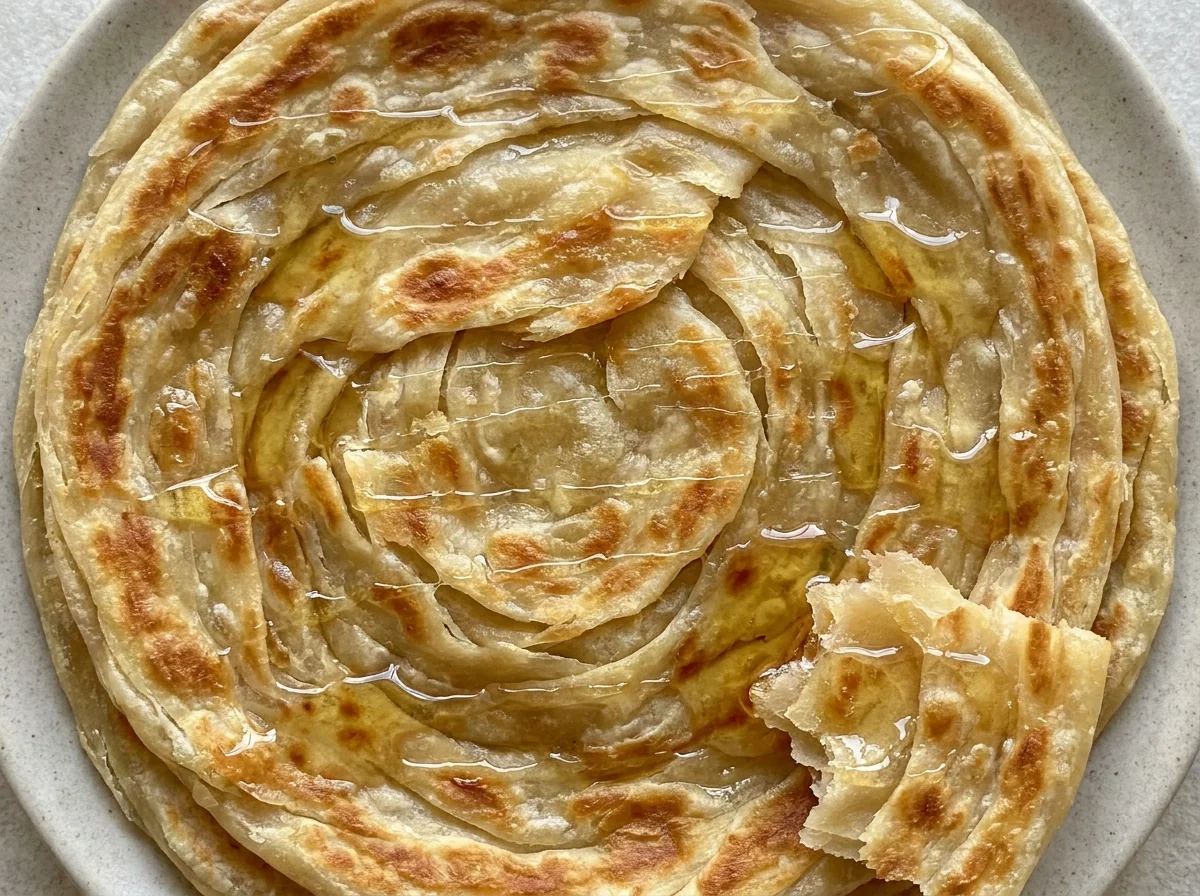
Paratha is the Indian layered bread that crossed over to Saudi tables through Indian restaurants and koshari until it became, with honey, one of the most ordered breakfast dishes.
Flaky pleats with crisp edges that soak up the honey between their leaves.
Preparation Steps
Knead a soft dough and rest it
Mix the flour, salt and sugar, and add the warm water and a spoonful of oil and knead for eight minutes into a soft, tender dough. Divide it into four oiled balls and rest them for half an hour. The rest relaxes their gluten so they roll out later without resistance.
Fold the layers. The secret of the flakiness
Roll each ball into a thin sheet on an oiled surface, brush its surface with oil or ghee, then fold it into a fan (parallel pleats like an accordion) and coil the folded strip into a spiral like a shell and rest it for ten minutes. This oiled spiral fold is what gives birth to the paratha's famous flaky layers.
Roll the spiral gently
Press each shell and roll it into a disc half a finger thick. Gently to preserve the layers and not weld them together.
Brown on the griddle until flaky
On a griddle or thick skillet over medium heat, put a swipe of ghee and bake the paratha for three minutes per side, pressing it with the spoon in gentle presses and turning it. Its layers puff, turn golden and its edges crisp, then clap each hot paratha between your palms, a clap that frees its leaves.
Serve it with honey our way
Served hot with honey drawn in threads between its folds or dipped into it bite by bite, the paratha breakfast that Saudi mornings adopted from Indian restaurants until it became one of their first orders, in your home's guaranteed version.
Blood Sugar Impact
The glycemic index (GI) measures how quickly a food raises blood sugar, while the glycemic load (GL) measures how much a full serving raises it. Together they give the complete picture.
Glycemic Index
GI
72High
Low0–55Medium56–69High70+
A low value (≤55) means a gradual rise in blood sugar — the most suitable range for diabetes and insulin resistance.
Glycemic Load
GL
56High
Low0–10Medium11–19High20+
Glycemic load reflects the impact of the full serving. To lower it: take half a serving, or pair the recipe with a source of protein and fiber.
Nutritional Information
Per ServingMakes 4 servings · one serving is about 175 g of raw ingredients
Calories541 kcal27%of Daily Value*
Protein9 g18%of Daily Value*
Carbohydrates81 g29%of Daily Value*
Fat20 g26%of Daily Value*
Fiber3 g11%of Daily Value*
Sodium390 mg17%of Daily Value*
Potassium102 mg2%of Daily Value*
Phosphorus95 mg8%of Daily Value*
* Percent Daily Values are based on a 2,000-calorie diet per FDA food-label reference values — your daily needs may be higher or lower. Values are derived from the recipe's ingredients via the USDA database.
Troubleshooting
The most common problems when preparing Saudi-Style Paratha with Honey, and how to fix them:
It came out hard like a biscuit
A dry dough or a low heat that dragged on. A soft, almost sticky dough and a decisive medium heat for three minutes per side.
The layers welded into a solid disc
We were stingy with the folding fat or rolled the spiral violently. Generous fat between the pleats and a gentle final rolling.
It soaked up fat and turned heavy
A lukewarm griddle that lets it absorb. Heat it well and use only a swipe of ghee per paratha.
It puffed into a balloon and did not flake
Thick rolling. Half a finger is its thickness. The thicker traps the steam into one balloon instead of leaves.
Storage and Make-Ahead
Right away
Hot with its leaves peeling. Its absolute peak.
At room temperature
Hours of its day under a towel. Revived on the griddle for half a minute.
In the freezer
As raw folded discs between parchment sheets for a month. Baked from frozen directly with an extra minute.
Tested Ingredient Substitutions
Original Ingredient
Tested Substitute
Ratio
Flavor Difference
Honey
Kiri cheese or labneh
~
The famous second savory face in our restaurants
Half the white flour
Whole-wheat flour
1:1 for the half
A browner paratha with higher fiber
Ghee in the folding
Vegetable oil
1:1
Lighter and the ghee makes more fragrant layers
The griddle
A thick non-stick skillet
~
It does the job efficiently
How Much Does It Make? Scaling Guide
Ingredient
4 discs
2 discs
8 discs
Flour
350 g
175 g
700 g
Folding oil
60 ml
30 ml
120 ml
Honey
60 g
30 g
120 g
EEINA Nutrition Tip
The clap between the palms as soon as it comes off the griddle is not a show. It is what frees the welded layers and releases their steam so they come out as peeling leaves; a paratha without a clap is half a paratha.
Add This Recipe to Your Plan
The EEINA app saves your favorite recipes, calculates them from their real ingredients, and shows your daily numbers toward your goal. Try it free now.
Chapati is a whole-wheat flatbread with no layers, and tamees is a yeasted bread puffed in the oven; paratha is a dough folded with fat into pleats so it flakes on the griddle. The layers are its passport.
Why does restaurant paratha come out with more layers?
Generous fat between the pleats, a scorching griddle and the experience of the clap, all of which are now in your hand, and the gap narrows with every attempt.
How many parathas make a reasonable breakfast?
One with honey and a glass of laban or milk tea. Its oiled layers are filling beyond their appearance.
Is it filled like in restaurants?
Yes, with beaten egg or cheese before folding, so it becomes a complete meal, and each filling has its own separate recipe.