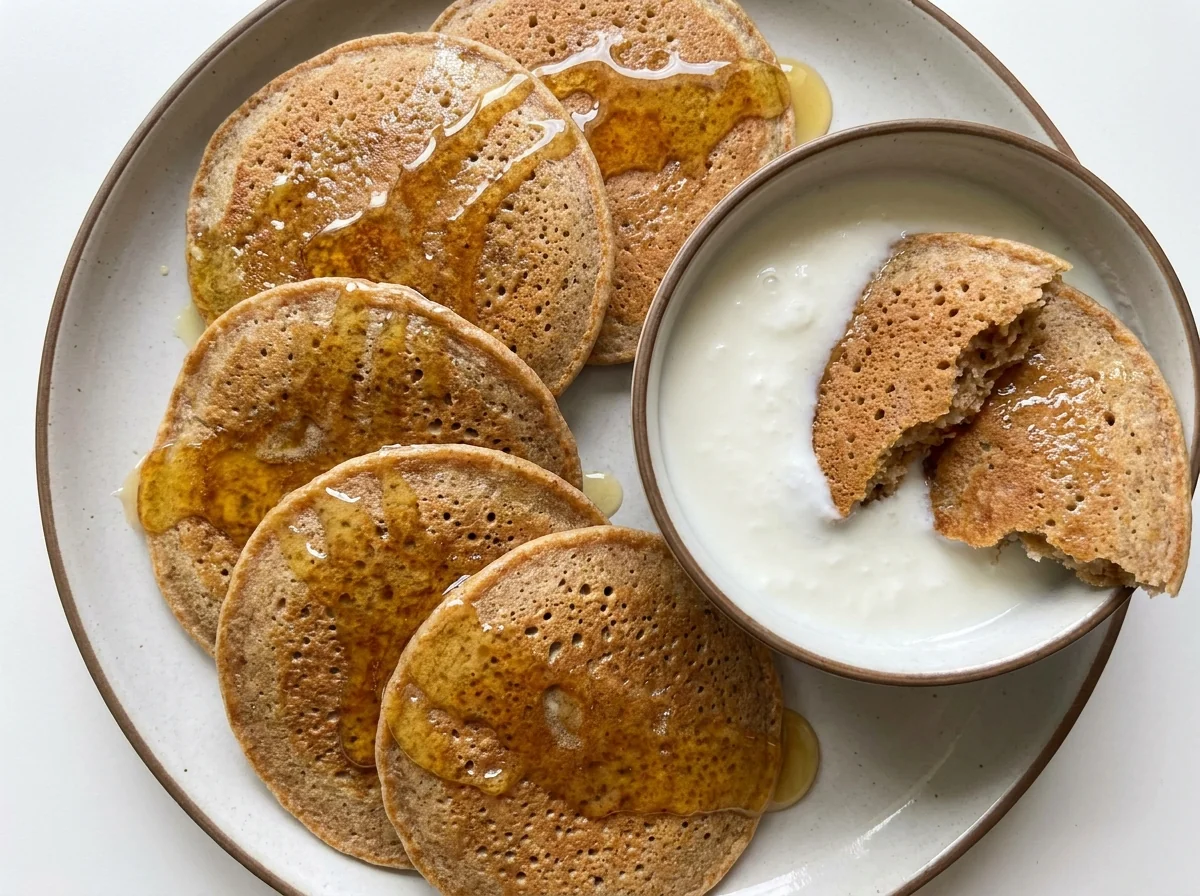
Masabib, called marasee in some areas, are southern poured pancakes of whole-wheat flour, a close relative of the aseeda and the khubza documented by Saudipedia in the Suhoor tables of Al-Baha and Aseer, eaten with laban or with honey and ghee.
Preparation Steps
Whisk a pourable batter
In a bowl, whisk the whole-wheat flour with the salt, yeast, and water into a pourable batter the consistency of thick laban that pours from the ladle in a continuous ribbon. Masabib comes from 'pouring,' and its batter is poured out.
Rest it until it comes alive
Cover it for twenty minutes until small breathing bubbles rise to its surface. The sign of awakened yeast and a ready batter.
Pour discs onto the saj
A hot saj or thick pan brushed with ghee. Pour the ladle from a close height so it spreads into a palm-sized disc, and small holes open across its surface like a honeycomb, which is the sign of the craft.
Flip with care
When the top dries and its holes set, two minutes, flip it for one minute only; masabib is blond and soft, not browned and dry.
Serve it the two ways
Hot, brushed with ghee and drenched in honey, or crumbled into cold cultured laban in the custom of the southern Suhoor (pre-dawn Ramadan meal), and both houses are full.
Blood Sugar Impact
The glycemic index (GI) measures how quickly a food raises blood sugar, while the glycemic load (GL) measures how much a full serving raises it. Together they give the complete picture.
Glycemic Index
GI
54Low
Low0–55Medium56–69High70+
A low value (≤55) means a gradual rise in blood sugar — the most suitable range for diabetes and insulin resistance.
Glycemic Load
GL
25High
Low0–10Medium11–19High20+
Glycemic load reflects the impact of the full serving. To lower it: take half a serving, or pair the recipe with a source of protein and fiber.
Nutritional Information
Per ServingMakes 4 servings · one serving is about 195 g of raw ingredients
Calories325 kcal16%of Daily Value*
Protein12 g24%of Daily Value*
Carbohydrates54 g20%of Daily Value*
Fat7 g9%of Daily Value*
Fiber8 g29%of Daily Value*
Sodium294 mg13%of Daily Value*
Potassium289 mg6%of Daily Value*
Phosphorus269 mg22%of Daily Value*
* Percent Daily Values are based on a 2,000-calorie diet per FDA food-label reference values — your daily needs may be higher or lower. Values are derived from the recipe's ingredients via the USDA database.
Troubleshooting
The most common problems when preparing Southern Masabib with Laban and Honey, and how to fix them:
No holes on the surface
A heavy batter or sleeping yeast. Thin it with a little water and give it a few more minutes.
It stuck to the saj
A lukewarm saj or a stingy ghee brush. Full heat and a brush before each pour.
It dried out and snapped
We flipped it several times or browned it like bread. Two minutes and one minute and a single flip, and its blondness, not its browning.
Its core is raw batter
The disc is thick and the heat is high. A nimbler ladle and a more patient medium heat.
Storage and Make-Ahead
Hot right after pouring
Its softness is a child of its hour.
In a cloth bag then sealed
A day at room temperature, and revived on the saj for moments.
In the freezer
A month with separating sheets, and from the freezer straight to the hot saj.
Tested Ingredient Substitutions
Original Ingredient
Tested Substitute
Ratio
Flavor Difference
The whole-wheat flour
Half of it white
1:1 for the half
Lighter discs for anyone not used to pure whole wheat
Water alone
Half of it cultured laban
1:1 for the half
A deeper southern acidity and longer softness
The honey and ghee
Date molasses
1:1
The sweetness of neighboring Wadi al-Dawasir
The yeast
A full night's proof in the fridge with a quarter of the yeast
~
An aged flavor for anyone who planned from the night before
How Much Does It Make? Scaling Guide
Ingredient
4 servings (~8 discs)
2 servings
8 servings
Whole-wheat flour (burr)
300 g
150 g
600 g
Water
450 ml
225 ml
900 ml
EEINA Nutrition Tip
The batter's consistency is the whole recipe: thicker than needed gives thick, raw discs, and thinner gives a slack one that tears. The consistency of thick laban pouring in a ribbon is the inherited measure.
Add This Recipe to Your Plan
The EEINA app saves your favorite recipes, calculates them from their real ingredients, and shows your daily numbers toward your goal. Try it free now.
Masabib and marasee are two southern names for the same poured family with regional differences, while lahooh is a thinner, more fermented Yemeni one. Relatives, not twins.
Why whole-wheat flour specifically?
It is the inherited wheat of the south. Its whole fiber slows digestion so its satiety accompanies the fasting person, and its flavor is the dish's memory.
Which of the two ways suits Suhoor better: laban or honey?
Cultured laban is lighter and more quenching for the fasting night, and honey with ghee is the farmer's energy for a day of toil, and each has its Suhoor.
Eggs in the batter?
Not from the origin of masabib. The simplicity of flour and water is its identity, and anyone who adds eggs has made another pancake.