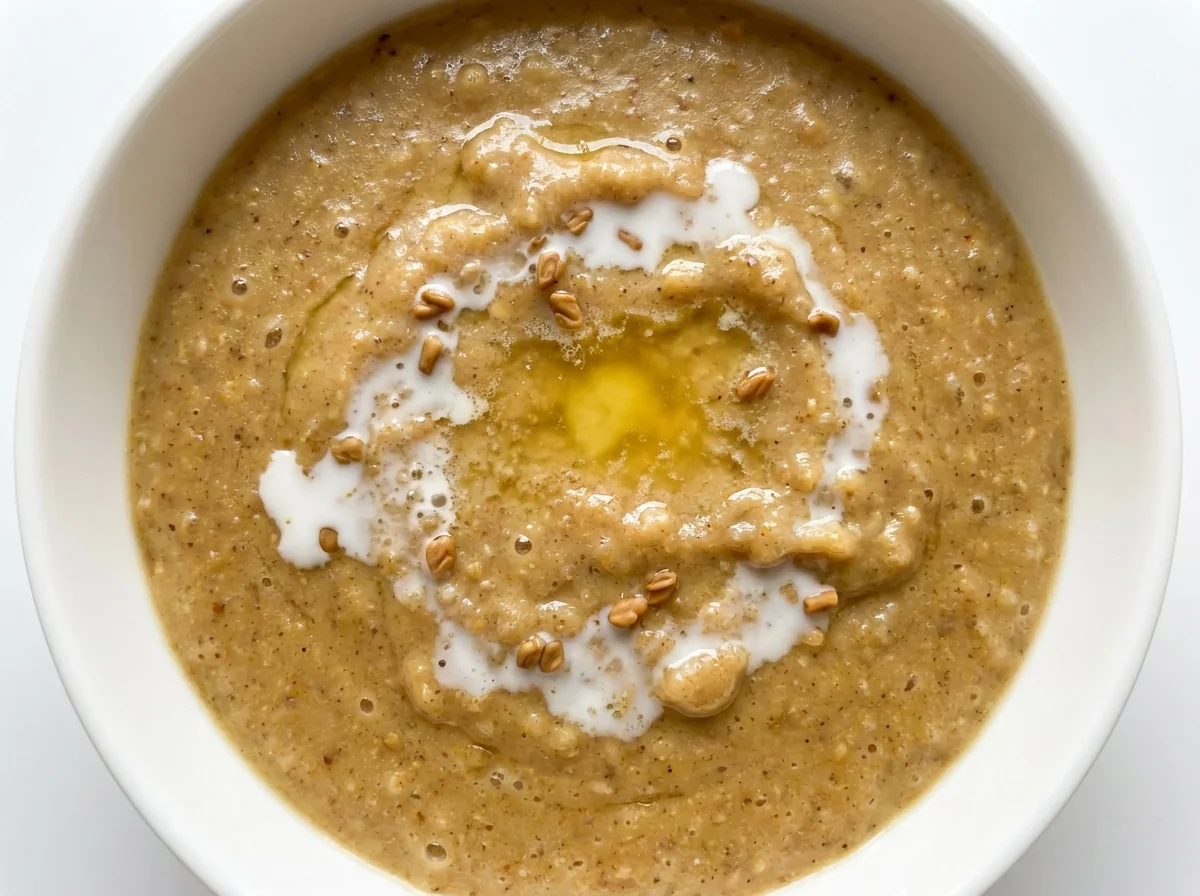
Madida helba is a warm Sudanese porridge often served to new mothers and in winter for its nourishing value and warmth.
It combines toasted fenugreek seeds with milk and flour, and the atroun gives it its distinctive yellow color and special flavor.
Preparation Steps
Toasting the fenugreek
Toast the fenugreek seeds in the ghee over low heat, stirring, until they turn golden and become fragrant, and stop before they brown, because over-toasting gives them a sharp bitterness.
Simmering the fenugreek
Add the water gradually and let it boil until the fenugreek seeds are fully cooked and softened, as sufficient boiling breaks the bitterness of the fenugreek and prepares it for the rest of the mixture.
Adding the milk and atroun
Add the milk, then the sodium bicarbonate (atroun), and stir until it boils, as the atroun gives the madida its warm yellowish color and distinctive flavor; add it in a small amount because too much overpowers the taste.
Adding the flour
Dissolve the flour in a little cold water and add it gradually to the boiling mixture while stirring vigorously and without stopping, because continuous stirring is what prevents the flour from lumping and gives a smooth texture.
Sweetening and finishing
Add the sugar and salt and keep stirring over low heat until the texture thickens and becomes dense, warm, and cohesive, then remove it and serve it hot with a drizzle of ghee on top.
Blood Sugar Impact
The glycemic index (GI) measures how quickly a food raises blood sugar, while the glycemic load (GL) measures how much a full serving raises it. Together they give the complete picture.
Glycemic Index
GI
61Medium
Low0–55Medium56–69High70+
A low value (≤55) means a gradual rise in blood sugar — the most suitable range for diabetes and insulin resistance.
Glycemic Load
GL
22High
Low0–10Medium11–19High20+
Glycemic load reflects the impact of the full serving. To lower it: take half a serving, or pair the recipe with a source of protein and fiber.
Nutritional Information
Per ServingMakes 6 servings · one serving is about 255 g of raw ingredients
Calories266 kcal13%of Daily Value*
Protein5 g10%of Daily Value*
Carbohydrates38 g14%of Daily Value*
Fat11 g14%of Daily Value*
Fiber2 g7%of Daily Value*
Sodium261 mg11%of Daily Value*
* Percent Daily Values are based on a 2,000-calorie diet per FDA food-label reference values — your daily needs may be higher or lower. Values are derived from the recipe's ingredients via the USDA database.
Troubleshooting
The most common problems when preparing Sudanese Fenugreek Pudding (Madida Helba), and how to fix them:
A dominant bitter taste
The fenugreek was toasted too much; lower the heat and stop as soon as it turns golden, and long boiling of the seeds also reduces the bitterness.
The flour lumps
Strain the mixture or beat it with a hand whisk, and next time dissolve the flour well in cold water and add it gradually with continuous stirring.
The texture is too runny
Let it boil over low heat while stirring until it thickens, or dissolve an extra spoon of flour in cold water and add it gradually.
Storage and Make-Ahead
Refrigerator
Chill it in an airtight container for up to two days, and reheat it over low heat with a little milk or water because it thickens as it cools.
Reheating
Reheat it over low heat with constant stirring and a little added liquid until the texture returns smooth.
Tested Ingredient Substitutions
Original Ingredient
Tested Substitute
Ratio
Flavor Difference
flour
cornstarch
half the amount, 40 g
A gluten-free alternative that gives a dense glossy texture, so start with a smaller amount.
clarified butter (ghee)
butter
same amount, 45 g
An available alternative that gives a similar flavor with a slight difference in depth.
milk
diluted evaporated milk
same amount, 500 ml
Gives a richer texture and a denser taste for those who prefer the madida creamy.
sugar
date molasses
100 g
A natural sweetener that gives a darker color and a caramel flavor.
How Much Does It Make? Scaling Guide
Ingredient
1/2 (3 servings)
Base (6 servings)
Double (12 servings)
Fenugreek seeds
20 g
40 g
80 g
Local ghee (samn)
22 g
45 g
90 g
Water
375 ml
750 ml
1500 ml
Milk
250 ml
500 ml
1000 ml
Flour
40 g
80 g
160 g
Sugar
60 g
120 g
240 g
Sodium bicarbonate (atroun)
1 g
2 g
4 g
EEINA Nutrition Tip
Dissolve the flour in cold water before adding it rather than sprinkling it dry over the hot mixture, as pre-mixing along with continuous stirring is what prevents lumping entirely.
Add This Recipe to Your Plan
The EEINA app saves your favorite recipes, calculates them from their real ingredients, and shows your daily numbers toward your goal. Try it free now.
Sodium bicarbonate (atroun) gives the madida its warm yellow color and distinctive flavor and helps soften the texture, and it is added in a small amount so its taste does not dominate.
Can the bitterness of the fenugreek be reduced?
Yes, with a light toasting that stops at the golden stage and with sufficient boiling of the fenugreek seeds until fully cooked, as both reduce the natural bitterness.