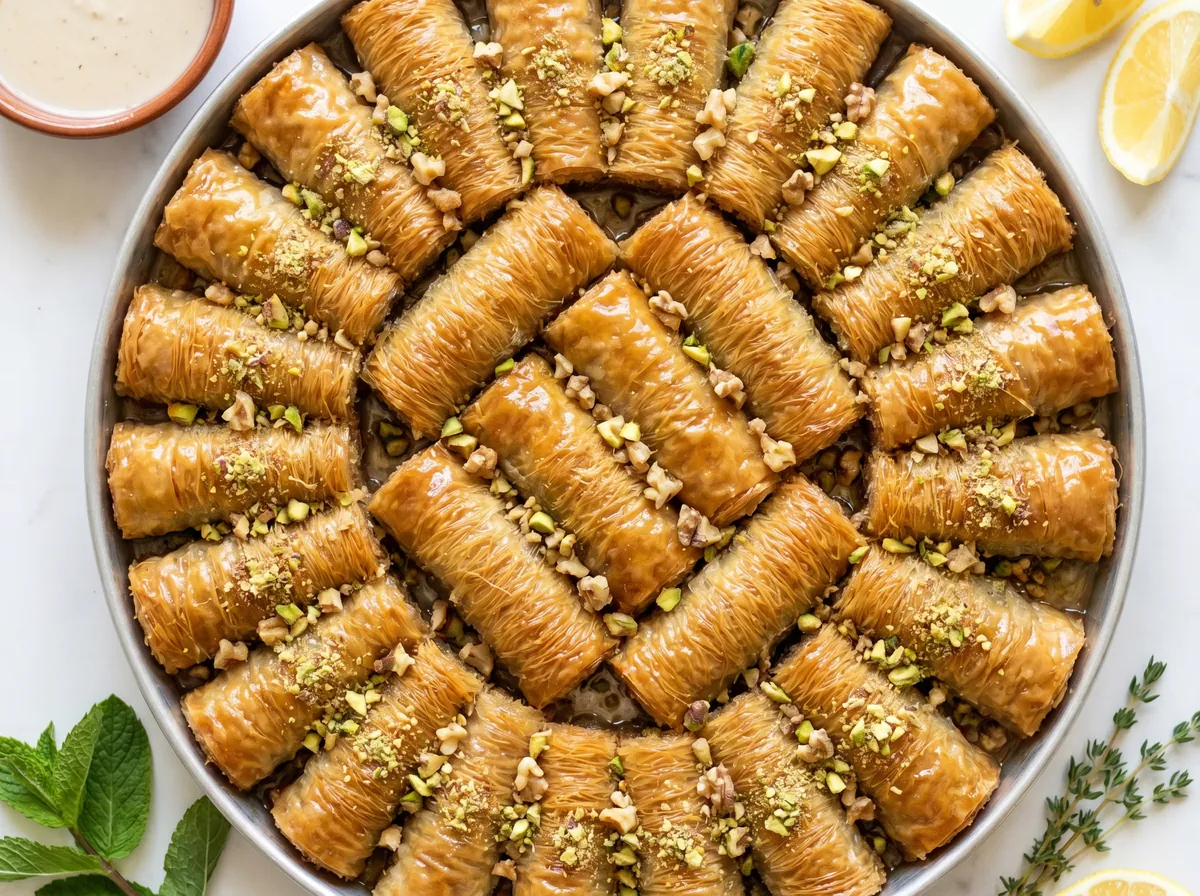
Mabroumeh with Pistachios (Levantine Rolled Baklava)
A Levantine rolled sweet — fine pastry threads rolled around pistachios, baked in ghee, soaked in syrup, then cut into fingers. A premium type of baklava, a high-sugar sweet to be enjoyed in moderation. Contains gluten, tree nuts, and dairy.
Mabroumeh is a premium Levantine sweet, a refined type of baklava celebrated in Levantine cities (Damascus, Aleppo, and Tripoli in Lebanon). Its name comes from the Arabic for rolling/twisting: fine pastry threads (kataifi) are rolled tightly around a pistachio filling into cylinders, baked in ghee until crisp, soaked in syrup, and cut into fingers.
Mabroumeh is one of the most prized occasion sweets (weddings, Eid, Ramadan, and hospitality tables), and the abundance of pistachios is a mark of quality and generosity. Its rolled crisp pistachio-filled fingers soaked in fragrant syrup are a luxurious pleasure, combining the crunch of threads, the richness of pistachios, and the sweetness of syrup. Mabroumeh is a symbol of the finest Levantine sweets and the mastery of its confectioners.
Preparation Steps
Prepare the syrup
Boil the sugar and water with a few drops of lemon until a medium syrup forms. Add the orange blossom water and leave to cool completely. Cold syrup on hot pastry is the golden rule (it keeps the mabroumeh crisp). Prepare it first so it is completely cold.
Prepare the pastry threads
Spread out the kataifi (shredded pastry threads) or baklava sheets and brush generously with melted ghee. Mabroumeh is rolled from fine threads (its name comes from the Arabic for rolling/twisting), so the threads give it its distinctive rolled appearance and luxurious crisp texture.
Spread the pistachios and roll
Arrange a row of pastry threads and spread the chopped pistachios along one edge, then roll them tightly around the pistachios (around a thin dowel or by hand) into a long filled cylinder. Tight rolling around the pistachios creates the distinctive cylinder — the heart of mabroumeh — and its characteristic rolled layers appear.
Arrange, press, and score
Arrange the rolled cylinders side by side in a greased tray, brush the tops generously with ghee, and score into finger-length pieces before baking. Scoring before baking makes final separation easier and allows the syrup to penetrate. Brush generously with ghee (it crisps and browns).
Bake
Bake the mabroumeh in a moderate oven until golden and crisp (about thirty minutes), patiently letting the threads cook through without burning. Baking to full golden colour delivers the crunch. Cover with foil if the top browns before the inside is cooked.
Soak and serve
Remove the hot mabroumeh and immediately pour the cold syrup over it (it sizzles, absorbs the syrup, and stays crisp). Scatter with finely ground pistachios. Allow to set after the syrup is absorbed. This is a premium Levantine sweet — a luxurious type of baklava famous in Damascus, Aleppo, and Tripoli — its rolled crisp pistachio-filled fingers soaked in fragrant syrup are pure indulgence, a symbol of the finest Levantine sweets and the generosity of its tables.
Blood Sugar Impact
The glycemic index (GI) measures how quickly a food raises blood sugar, while the glycemic load (GL) measures how much a full serving raises it. Together they give the complete picture.
Glycemic Index
GI
61Medium
Low0–55Medium56–69High70+
A low value (≤55) means a gradual rise in blood sugar — the most suitable range for diabetes and insulin resistance.
Glycemic Load
GL
13Medium
Low0–10Medium11–19High20+
Glycemic load reflects the impact of the full serving. To lower it: take half a serving, or pair the recipe with a source of protein and fiber.
Nutritional Information
Per ServingMakes 24 servings · one serving is about 50 g of raw ingredients
Calories234 kcal12%of Daily Value*
Protein3 g6%of Daily Value*
Carbohydrates22 g8%of Daily Value*
Fat15 g19%of Daily Value*
Fiber1 g4%of Daily Value*
Sodium60 mg3%of Daily Value*
* Percent Daily Values are based on a 2,000-calorie diet per FDA food-label reference values — your daily needs may be higher or lower. Values are derived from the recipe's ingredients via the USDA database.
Troubleshooting
The most common problems when preparing Mabroumeh with Pistachios (Levantine Rolled Baklava), and how to fix them:
Mabroumeh is soft and not crisp
Not enough ghee, not baked long enough, or hot syrup on hot pastry. Brush generously with ghee, bake until coloured and crisp, and pour cold syrup on the hot pastry. Generous ghee, sufficient baking, and cold syrup maintain the crunch.
Soggy and sticky from too much syrup
Too much syrup or hot on hot. Pour a moderate amount of cold syrup on the hot mabroumeh (no flooding) — too much or too hot syrup will make it soggy. The rule: one cold, one hot, moderate quantity.
Top burned, inside undercooked
Oven too hot. Bake at moderate heat and cover with foil if the top colours before the inner threads are cooked. Fine threads burn quickly — moderate heat cooks them through without burning.
Fell apart (did not hold its roll)
Rolled too loosely or pastry dried out. Roll the threads around the pistachios tightly and brush with ghee (it acts as a binder). Do not let the pastry dry out (keep covered). Tight rolling and ghee keep the cylinders intact.
Too sweet
Too much syrup. Soak with a moderate amount (serve some on the side), reduce the sugar in the syrup slightly, and increase the pistachios (they balance the sweetness). Controlling the syrup quantity controls sweetness.
Storage and Make-Ahead
Room temperature
Keep in an airtight container at room temperature for 3 to 5 days (the syrup preserves it). It stays delicious but gradually loses some of its crunch. Do not refrigerate (the fridge makes it rubbery and tough) — keep at room temperature.
Freezer (before syrup)
Bake the mabroumeh without syrup, freeze for two months, then reheat and soak in fresh syrup. This keeps it crispier than freezing after soaking. Practical for preparing occasion quantities in advance.
Meal prep
A good make-ahead sweet (keeps for days) — prepare one or two days before the occasion and keep sealed at room temperature. Or roll, bake, and soak fresh just before serving for maximum crunch.
Food safety
Use fresh pistachios and ghee, bake the mabroumeh thoroughly, and keep in a sealed, dry container at room temperature (moisture and the fridge ruin the texture). The syrup is a natural preservative, so it keeps safely for days.
Tested Ingredient Substitutions
Original Ingredient
Tested Substitute
Ratio
Flavor Difference
Pistachios
Walnuts, almonds, or cashews
same amount
Pistachios are the classic premium choice (and the green is beautiful); walnuts, almonds, and cashews are alternative nuts with different flavours, all adding value
Generous ghee
Less ghee or butter
less
Reduces saturated fat and calories; some ghee is essential for crunch and Levantine flavour, but it can be reduced
Flooding with syrup
Moderate soaking
less
Reduces sugar; moderate syrup (no flooding) lowers sweetness and calories while maintaining crunch
How Much Does It Make? Scaling Guide
Fingers
Dough
Pistachios
Syrup
12 (small)
half amount
1 cup
3/4 cup
24 (base)
full amount
2 cups
1.5 cups
48 (for an occasion)
double
4 cups
3 cups
EEINA Nutrition Tip
Mabroumeh is a premium occasion sweet combining pastry, ghee, and syrup (sugar) — high in sugar, calories, and fat. The pistachios add real value (healthy fats, protein, vitamin E, and antioxidants), so an abundance of pistachios improves it relatively. Even so, it remains a sweet. Best enjoyed in moderation on occasions (one or two pieces) as part of a varied table. To lighten it slightly: reduce the syrup (moderate soaking), increase the pistachios, and reduce the ghee. People with diabetes and those on diets should be cautious. A luxury sweet to be savoured in moderation, and the pistachios add genuine value.
Add This Recipe to Your Plan
The EEINA app saves your favorite recipes, calculates them from their real ingredients, and shows your daily numbers toward your goal. Try it free now.
A premium Levantine sweet — a refined type of baklava: fine pastry threads are rolled tightly around pistachio filling into cylinders, baked in ghee until crisp, soaked in syrup, and cut into fingers. Its name comes from the Arabic for rolling/twisting. A premium occasion sweet — its rolled crisp pistachio-filled fingers soaked in fragrant syrup are a luxurious pleasure.
What is the difference between mabroumeh and baklava?
Both belong to the Levantine pastry-nut-syrup family, but mabroumeh is rolled from fine pastry threads (kataifi) around pistachios into cylinders (a rolled, thread-like appearance), while baklava is flat layered phyllo sheets with filling. Mabroumeh typically has more pistachios and is generally considered more premium and expensive; baklava is flat and layered.
Why are there so many pistachios in mabroumeh?
An abundance of pistachios is the hallmark of quality mabroumeh and a sign of generosity (and its premium price) — it is a luxury sweet that showcases pistachio generosity. Pistachios add flavour and value (healthy fats, protein, vitamin E, and antioxidants) and a beautiful green colour. Good mabroumeh is generously filled with pistachios — a sign of refinement and Levantine hospitality.
Is mabroumeh healthy?
A premium occasion sweet, high in sugar (syrup), calories, and fat (ghee). The pistachios add real value (healthy fats, protein, vitamin E), so their abundance improves it relatively — but it remains a sweet. Enjoy in moderation on occasions (one or two pieces), reduce the syrup and ghee, and increase the pistachios. People with diabetes should be cautious. To be savoured in moderation.
Sources: University of Sydney · Gulf GSO · Our methodology · Updated on