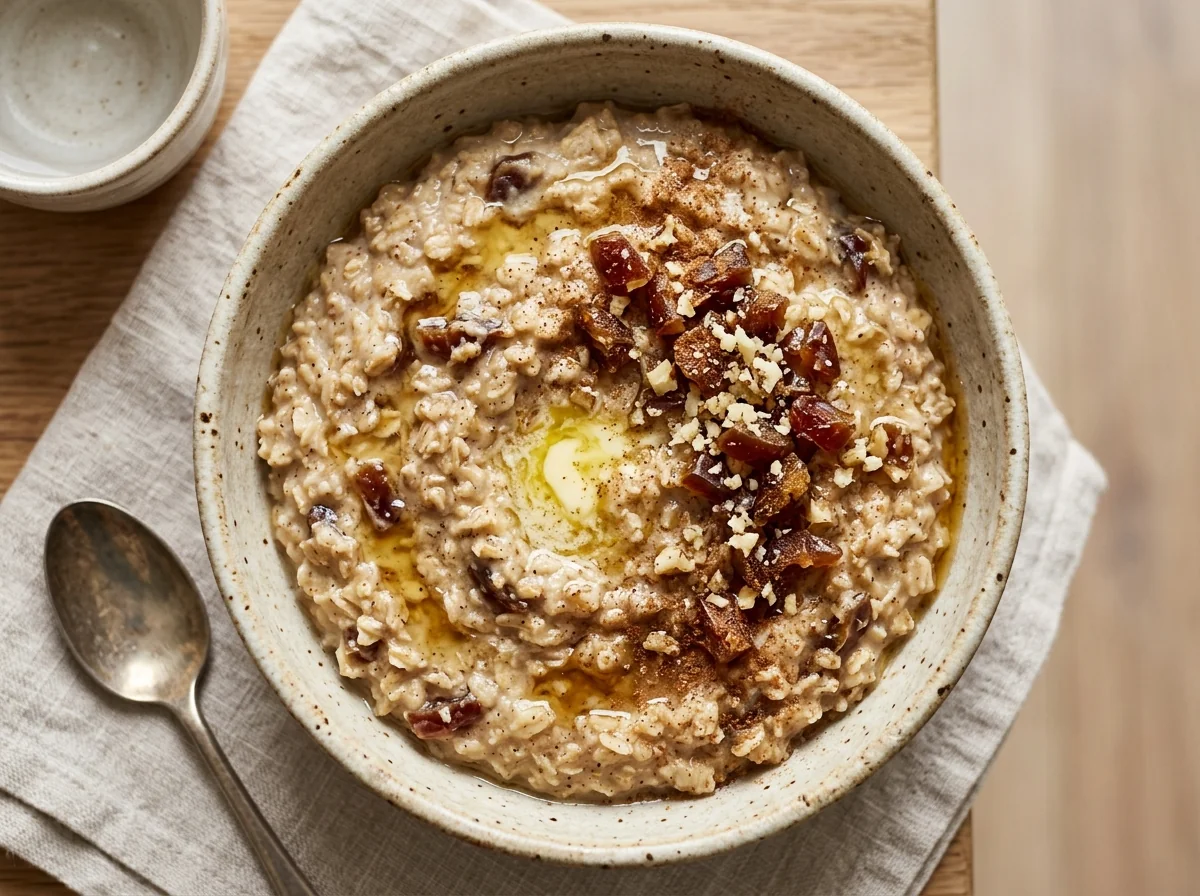
A Gulf sweet porridge made from wheat flour or semolina cooked with date molasses, ghee and cardamom into a warm, spoonable dessert. A traditional celebration dish and Ramadan sweet; medium-high glycemic load; contains gluten and dairy.
Khabeesa is one of the most ancient and cherished sweets in Gulf culinary heritage — a simple, warming sweet porridge of toasted flour (or semolina) cooked with ghee and date molasses (dibs al-tamr), flavored with cardamom and saffron. Its name in Arabic means 'a mixture' or 'a blend', reflecting its simple but perfect combination of humble Gulf pantry staples. Khabeesa is deeply embedded in Gulf social occasions: it is served at celebrations, births, weddings, and as a welcoming sweet for guests.
During Ramadan it appears on Iftar tables across Bahrain, Kuwait, Qatar, UAE and eastern Saudi Arabia. Date molasses — the thick, dark syrup made from boiled and strained dates — is a defining ingredient of Gulf cuisine and Khabeesa's heart, giving it its deep, caramel-fruity sweetness. A dish that tells the story of the Gulf's date-palm heritage in every spoonful.
Preparation Steps
Toast the flour
Toast the flour in a dry pan over medium heat, stirring constantly, until it turns a light golden-tan color and smells nutty (about five to seven minutes). This step is the secret to Khabeesa's distinctive flavor — toasted flour gives a deep, roasted note that raw flour cannot achieve. Do not skip it and do not let it burn.
Add the ghee
Add the ghee to the toasted flour and stir well over medium heat for two minutes until the flour absorbs the ghee and the mixture becomes a smooth, uniform paste (like a roux). Ghee is essential — it gives Khabeesa its richness and the characteristic flavor of Gulf sweets. The ghee-toasted flour base is the foundation.
Add water
Gradually pour in the warm water while stirring continuously to prevent lumps. Add the water slowly and stir constantly — adding it all at once causes lumps. Keep stirring over medium heat until the mixture thickens and begins to pull away from the sides of the pan (five to eight minutes).
Add date molasses and spices
Add the date molasses (dibs al-tamr), cardamom and saffron water and stir well to fully incorporate. Date molasses is the defining ingredient of Khabeesa — its deep, dark, caramel-fruity sweetness made from concentrated date syrup is irreplaceable. Cardamom adds warmth, saffron adds fragrance and color.
Cook to consistency
Continue cooking and stirring over low heat for five minutes until the Khabeesa reaches a thick, spoonable porridge consistency and the fat separates slightly at the edges (a sign it is done). The right consistency is thick but sponable — it should hold its shape in a bowl but not be solid. Adjust with a little water if needed.
Serve
Spoon into small bowls or a large serving dish, smooth the surface, and garnish with sesame seeds, crushed walnuts or a drizzle of extra ghee. Serve warm. Khabeesa is a beloved Gulf sweet — a warm, spiced, date molasses porridge that is a staple of celebrations, Ramadan Iftars and a symbol of Gulf culinary heritage. Its deep, sweet, warming flavor embodies the generosity and traditions of the Gulf kitchen.
Blood Sugar Impact
The glycemic index (GI) measures how quickly a food raises blood sugar, while the glycemic load (GL) measures how much a full serving raises it. Together they give the complete picture.
Glycemic Index
GI
62Medium
Low0–55Medium56–69High70+
A low value (≤55) means a gradual rise in blood sugar — the most suitable range for diabetes and insulin resistance.
Glycemic Load
GL
22High
Low0–10Medium11–19High20+
Glycemic load reflects the impact of the full serving. To lower it: take half a serving, or pair the recipe with a source of protein and fiber.
Nutritional Information
Per ServingMakes 5 servings · one serving is about 170 g of raw ingredients
Calories372 kcal19%of Daily Value*
Protein2 g4%of Daily Value*
Carbohydrates36 g13%of Daily Value*
Fat24 g31%of Daily Value*
Fiber1 g4%of Daily Value*
Sodium0 mg0%of Daily Value*
* Percent Daily Values are based on a 2,000-calorie diet per FDA food-label reference values — your daily needs may be higher or lower. Values are derived from the recipe's ingredients via the USDA database.
Troubleshooting
The most common problems when preparing Khabeesa (Gulf Date Molasses Porridge), and how to fix them:
The Khabeesa has lumps
Water added too fast or stirring stopped. Add the water gradually in a thin stream while stirring continuously. If lumps form, strain the mixture through a coarse strainer while hot and return to the pan, or blend smooth.
The Khabeesa burned on the bottom
Heat too high or not stirred enough. Cook on medium-low heat and stir continuously, especially at the bottom and edges of the pan. Khabeesa thickens fast and burns easily on the bottom if not stirred.
The flavor is bland
Not enough date molasses or toasting was skipped. Ensure the flour is properly toasted (golden, nutty smell) and use enough date molasses for a deep, sweet flavor. Cardamom and saffron are essential aromatics — do not skimp.
The Khabeesa is too thick and stiff
Too much flour or too little water. Add a little warm water and stir over low heat to loosen it to a spoonable consistency. Khabeesa should be thick but spoonable, not solid.
The Khabeesa is too thin (runny)
Too much water or flour not toasted long enough. Continue cooking over low heat, stirring continuously, until it reaches the right thickness. Properly toasted flour absorbs moisture better and gives a thicker result.
Storage and Make-Ahead
Serve fresh
Khabeesa is best served warm and fresh right after preparation — it thickens considerably as it cools. It takes only twenty to twenty-five minutes to make, so prepare it at serving time for the best texture and flavor.
Refrigerator
Keeps refrigerated in a sealed container for two to three days. It will set firm when cold — reheat with a little warm water over low heat, stirring until it returns to a spoonable consistency. Reheat gently.
Freezer
Freeze in portions for up to two months. Thaw in the refrigerator and reheat with a little warm water as above. Practical for preparing a batch for Ramadan and serving over several days.
Food safety
Khabeesa is a flour, ghee and date molasses sweet — it keeps reasonably well. Refrigerate promptly after cooling and do not leave at room temperature for more than two hours. Use clean, sealed containers. Date molasses is a natural preservative.
Tested Ingredient Substitutions
Original Ingredient
Tested Substitute
Ratio
Flavor Difference
Date molasses (dibs al-tamr)
Pomegranate molasses or carob molasses
Same amount
Date molasses is the authentic, irreplaceable ingredient of Khabeesa; pomegranate molasses gives a tarter flavor; carob molasses is similar in color and sweetness. Both are substitutes only when date molasses is unavailable.
Wheat flour
Fine semolina
Same amount
Fine semolina is commonly used and traditional in some Gulf regions; it gives a slightly grainier texture and a marginally lower glycemic index than white flour
Ghee
Butter
Same amount
Butter is a close substitute but ghee has the traditional Gulf flavor and a higher smoke point; both contain dairy
Sesame seed garnish
Crushed pistachios or walnuts
Same amount
Sesame (contains sesame allergen) vs pistachios/walnuts (tree nuts) — choose based on allergy considerations; all add pleasant texture and flavor contrast
How Much Does It Make? Scaling Guide
Number of servings
Flour
Ghee
Date molasses
3 (half recipe)
1/2 cup
1/4 cup
1/4 cup
5 (base)
1 cup
1/2 cup
1/2 cup
10 (large family)
2 cups
1 cup
1 cup
EEINA Nutrition Tip
Khabeesa is a traditional sweet with a medium-high glycemic load (wheat flour + date molasses = significant carbohydrates). The positive side: date molasses (dibs al-tamr) is more nutritious than white sugar — it contains iron, magnesium, potassium and antioxidants from the dates. Using semolina instead of white flour slightly lowers the glycemic index. Ghee adds saturated fat — use moderately. Serve a small portion (a few tablespoons) as an occasional sweet, not a daily dish, especially for people with diabetes. A small warm portion at Iftar is a lovely tradition to honor — just keep the portion small.
Add This Recipe to Your Plan
The EEINA app saves your favorite recipes, calculates them from their real ingredients, and shows your daily numbers toward your goal. Try it free now.
A beloved Gulf sweet porridge made from toasted flour (or semolina) cooked with ghee and date molasses (dibs al-tamr), flavored with cardamom and saffron. Served warm as a celebration sweet and at Ramadan Iftars across Bahrain, Kuwait, Qatar, UAE and eastern Saudi Arabia. Its name means 'a mixture' — a simple combination of Gulf pantry staples with a deeply satisfying flavor.
What is date molasses and where do I find it?
Date molasses (dibs al-tamr in Arabic) is a thick, dark syrup made by cooking and straining dates into a concentrated liquid. It has a deep, caramel-fruity sweetness, more complex than white sugar, and contains more nutrients (iron, potassium, magnesium, antioxidants from dates). It is the defining ingredient of Khabeesa and many Gulf sweets. Available in Gulf supermarkets, Arab grocery stores and increasingly in international food shops.
Why toast the flour first?
Toasting transforms raw flour into something entirely different — the heat causes the starches and proteins to undergo browning (Maillard reaction), developing a deep, nutty, roasted aroma that raw flour lacks entirely. Toasted flour gives Khabeesa its characteristic warm, rich, slightly caramelized flavor. This step cannot be skipped — it is the foundation of Khabeesa's taste.
Is Khabeesa suitable for people with diabetes?
Khabeesa has a medium-high glycemic load (wheat flour + date molasses). Date molasses is more nutritious than white sugar (more iron, minerals, antioxidants) but still raises blood sugar. Semolina instead of flour slightly lowers the glycemic impact. Serve a small portion occasionally (a few tablespoons at Iftar) rather than a large serving. People with diabetes should be cautious with portion size.