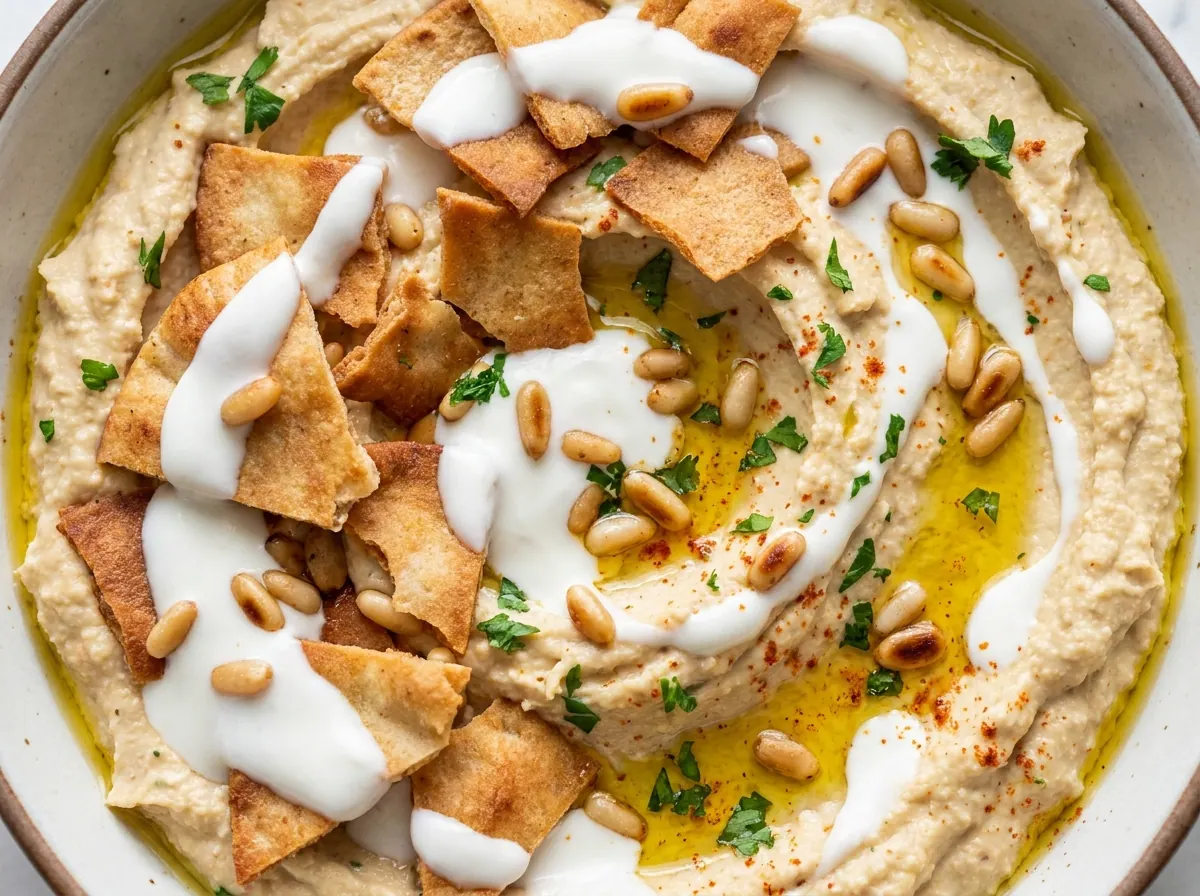
Classic Levantine hummus fatteh with yogurt: crispy toasted Arabic bread, chickpeas boiled in their broth, and a mixture of yogurt with garlic and tahini, garnished with pine nuts toasted in ghee. GI 34.
Hummus fatteh with yogurt is a traditional Levantine dish documented in Syria, Lebanon, Palestine, and Jordan, with an entry in encyclopedias and recipes in reputable cooking sources. It is served traditionally as a warm, filling breakfast or mid-morning meal, and it brings together three layers of contrasting texture: crispy bread on the bottom, soft warm chickpeas in the middle, and a creamy yogurt-tahini mixture on top.
The secret of the dish is the contrast: the toasted bread crunches under the tooth, balanced by the softness of the chickpeas and the flow of the yogurt. The pine nuts toasted in ghee add the final touch of rich flavor and crunch. This is not an invented composition, but an old recipe passed down across Levantine tables generation after generation.
Preparation Steps
Toast the bread
Heat the cubed Arabic bread in the oven or a dry skillet until it crisps and gains a golden color, and set it aside. Toasting dries the white bread and increases the availability of its starch, which raises the glycemic impact of the dish.
Warm the chickpeas
Warm the boiled chickpeas with a little of their broth and a little salt and cumin until they become soft and warm.
Prepare the yogurt mixture
Whisk the yogurt with the tahini, crushed garlic, lemon juice, and a pinch of salt until the mixture becomes creamy and homogeneous.
Toast the pine nuts
Toast the pine nuts in the ghee over low heat until they gain a golden color, watching carefully because they burn quickly.
Spread the bread
In the serving dish, spread the layer of toasted bread on the bottom.
Add the chickpeas
Distribute the warm chickpeas with their broth over the bread.
Pour the yogurt mixture
Pour the yogurt-tahini mixture over the chickpeas until it covers them.
Garnish and serve
Garnish with the toasted pine nuts and the hot ghee, and serve immediately before the bread absorbs the liquid and loses its crunch.
Blood Sugar Impact
The glycemic index (GI) measures how quickly a food raises blood sugar, while the glycemic load (GL) measures how much a full serving raises it. Together they give the complete picture.
Glycemic Index
GI
34Low
Low0–55Medium56–69High70+
A low value (≤55) means a gradual rise in blood sugar — the most suitable range for diabetes and insulin resistance.
Glycemic Load
GL
12Medium
Low0–10Medium11–19High20+
Glycemic load reflects the impact of the full serving. To lower it: take half a serving, or pair the recipe with a source of protein and fiber.
Nutritional Information
Per ServingMakes 4 servings · one serving is about 310 g of raw ingredients
Calories475 kcal24%of Daily Value*
Protein18 g36%of Daily Value*
Carbohydrates45 g16%of Daily Value*
Fat26 g33%of Daily Value*
Fiber9 g32%of Daily Value*
Sodium824 mg36%of Daily Value*
* Percent Daily Values are based on a 2,000-calorie diet per FDA food-label reference values — your daily needs may be higher or lower. Values are derived from the recipe's ingredients via the USDA database.
Troubleshooting
The most common problems when preparing Hummus Fatteh with Yogurt, and how to fix them:
The bread lost its crunch and turned soft
You served the dish late after assembling it, so the bread absorbed the liquids. Hummus fatteh is a last-minute dish that is assembled and served immediately. To fix it: we assemble the layers right before serving, and keep the toasted bread in a separate bowl until the last moment. Every minute the bread stays under the yogurt costs it some of its crunch.
The pine nuts burned and turned bitter
The heat is high or it was left without stirring. Pine nuts are rich in oil and burn in seconds. We toast them over low heat with constant stirring, and lift them off the heat the moment they begin to gain a light golden color, since they finish cooking with their own heat. Burnt pine nuts cannot be rescued; discard them and start a new batch.
The yogurt mixture separated and became grainy
The yogurt was too cold or was heated too strongly. The yogurt mixture in Levantine fatteh is served at room temperature or lukewarm, not boiled. We take the yogurt out of the refrigerator a quarter of an hour before preparing, and whisk it with the tahini well until homogeneous. If we want to warm it, then over very low heat with constant stirring and without boiling.
The garlic taste is overpowering and sharp
The amount of garlic is large or it was crushed raw in excess. Raw garlic intensifies in the yogurt mixture over time. We start with just two cloves for four servings, and mix them well before tasting. If the flavor dominates: we add two extra spoons of yogurt to soften the sharpness, or a small pinch of sugar that balances the acidity and the garlic together.
The chickpeas are dry and hard, not soft
They were warmed without their broth or with little water. Boiled chickpeas need a little of the boiling liquid to stay soft when warmed. We add two to three spoons of their broth or warm water when warming, and stir them gently. Canned chickpeas need rinsing then warming in lightly salted water to soften.
The dish is heavy and richer than necessary
The amount of ghee or full-fat yogurt is large. Fatteh is a rich dish by nature, but it can be lightened: we reduce the ghee to one spoon, and use low-fat yogurt for half the quantity while keeping the other half full-fat for the texture. This way you preserve the creaminess with fewer calories.
Storage and Make-Ahead
Refrigerator (4°)
The assembled dish: unsuitable for storage, since the bread absorbs liquid and loses its crunch within an hour. The components separately: the yogurt mixture and the chickpeas keep for two days in airtight containers, and the toasted bread in a dry container at room temperature.
Freezer (-18°)
Completely unsuitable. The yogurt mixture separates after thawing, and the toasted bread becomes doughy. Only the boiled chickpeas can be frozen before use in the dish.
Make ahead
Boiled chickpeas: a day ahead, kept in their broth in the refrigerator. Yogurt mixture: hours ahead, kept covered in the refrigerator and taken out a quarter of an hour before serving. Toasted bread: two hours ahead at room temperature in a slightly open container. Final assembly: right before serving only.
Serving
A dish served immediately after assembly. The chickpeas warm, the bread crispy, and the yogurt lukewarm. Do not leave it out of the refrigerator after serving for more than two hours because of the yogurt.
Tested Ingredient Substitutions
Original Ingredient
Tested Substitute
Ratio
Flavor Difference
White Arabic bread
Toasted whole-wheat bread
Same amount
Deeper in flavor, lowers the glycemic index [3], higher fiber
White Arabic bread
Toasted gluten-free bread
Same amount
Gluten-free, more delicate texture, neutral flavor
Full-fat yogurt
Low-fat yogurt
Same amount
Fewer calories, lighter and less creamy texture
Pine nuts
Toasted slivered almonds
Same amount
Cheaper, clearer crunch, less buttery flavor
Ghee
Olive oil for toasting the pine nuts
Half the amount
Lighter, unsaturated fats, less rich flavor
How Much Does It Make? Scaling Guide
Number of servings
Boiled chickpeas
Yogurt
Bread
Pine nuts
2 (individual × 2)
1 cup
1 cup
1 flatbread
1.5 tbsp
4 (base)
2 cups
2 cups
2 flatbreads
3 tbsp
8 (large family)
4 cups
4 cups
4 flatbreads
6 tbsp
12 (entertaining)
6 cups
6 cups
6 flatbreads
9 tbsp
EEINA Nutrition Tip
The chickpeas are the base of the dish, not the bread: hummus fatteh combines low-index legumes with high-index white bread, so it should not be marketed as a low-sugar dish despite containing chickpeas. To lower its impact on blood sugar without losing its soul: we reduce the bread a little, replace it with whole-wheat bread, and increase the chickpea layer rich in fiber and protein.
Add This Recipe to Your Plan
The EEINA app saves your favorite recipes, calculates them from their real ingredients, and shows your daily numbers toward your goal. Try it free now.
Is hummus fatteh suitable for people with diabetes?
In moderation and with portion control. The white bread raises the glycemic index to medium (50), so whole-wheat bread is preferable and its amount should be reduced. The chickpea layer rich in fiber and protein helps slow the absorption of the starch.
What is the difference between hummus fatteh and eggplant fatteh?
Both are from the Levantine fatteh family (toasted bread and yogurt), but in hummus fatteh we use boiled whole chickpeas as a middle layer, while eggplant fatteh replaces it with fried or grilled eggplant.
Can it be prepared ahead for hosting?
The components yes, the assembled dish no. We prepare the chickpeas and the yogurt mixture ahead, toast the bread and pine nuts at the last moment, then assemble just minutes before serving to preserve the crunch.
Do canned chickpeas work?
Yes, we rinse them well then warm them in lightly salted water with a pinch of cumin until they soften. Home-boiled chickpeas are softer and richer in flavor, but canned is a quick acceptable option.
Sources: University of Sydney · Gulf GSO · Our methodology · Updated on