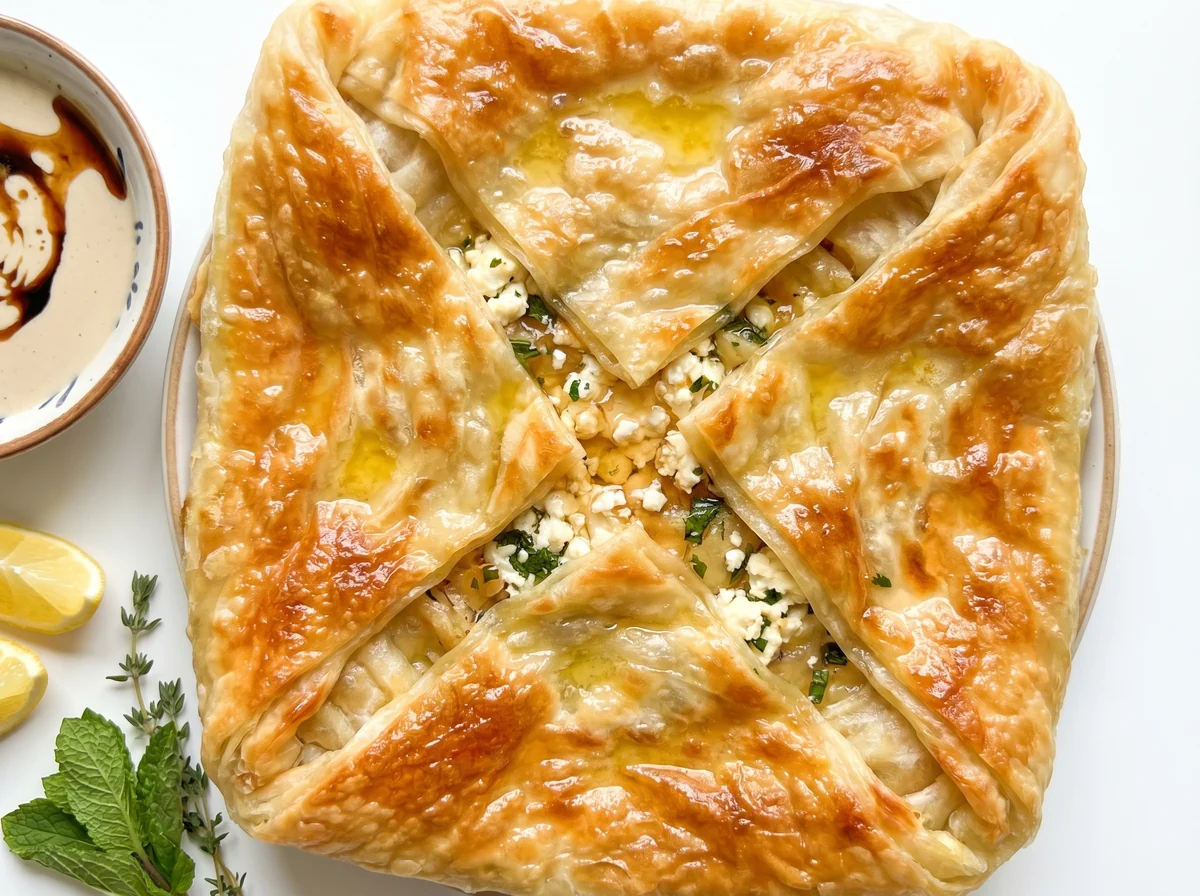
Egypt's royal layered pastry — dough stretched thin as silk, folded with ghee into many layers, and baked until golden and crisp. Eaten sweet with honey or savoury with cheese. Medium glycemic load; contains gluten and dairy.
Feteer Meshaltet is Egypt's royal pastry, known since the Pharaohs who offered it as a temple sacrifice and later associated with royal tables and special occasions (meshaltet comes from the root meaning 'to fold'). It is dough stretched thin as silk, folded with ghee into many layers, and baked until it becomes shatteringly flaky.
Eaten sweet with honey and cream or savoury with cheese, as a breakfast or at celebrations and weddings in rural Egypt. Stretching the dough thin is an art that demands skill and a light hand.
Preparation Steps
Knead the dough
Combine the flour with the salt and sugar, then gradually add the lukewarm water and knead until a soft, smooth, elastic dough forms — about 10 minutes. Divide into small balls, coat with oil, cover, and leave to rest for 30 minutes. Resting makes the dough supple enough to stretch thin without tearing.
Stretch the dough thin
The secret of feteer is in the thinness of the dough: grease a wide surface with oil, then stretch each ball with your hands in a circular motion until it is very thin and nearly transparent — like silk (you should be able to see the surface through it). Extreme thinness is what gives feteer its many layers.
Fold into layers
Brush the stretched dough with melted ghee, then fold it into layers (fold the edges toward the centre like an envelope, or roll it up then coil it into a spiral). Repeat the folding and brushing to build up many layers. The ghee between the layers separates them and gives the pastry its crunch and flakiness.
Shape the rounds
Form each folded piece into a ball, then gently flatten it into a round (or stack several pieces on top of one another in the baking tray for a thicker feteer). Brush the top with ghee. You can stuff it with cheese or cream between the layers for a filled version.
Bake
Preheat the oven to the highest setting (220–240°C). Bake the feteer for about 15–20 minutes until the top is golden and crisp and the layers have puffed up. High heat quickly crisps the layers before they dry out.
Serve
Serve the feteer hot and crisp. For the sweet version: with honey or cane molasses and tahini, or cream. For the savoury version: with cheese or olives. Feteer Meshaltet is a royal Egyptian breakfast dish (historically served to royalty and at special occasions), eaten sweet or savoury — the joy is in its flaky layers.
Blood Sugar Impact
The glycemic index (GI) measures how quickly a food raises blood sugar, while the glycemic load (GL) measures how much a full serving raises it. Together they give the complete picture.
Glycemic Index
GI
75High
Low0–55Medium56–69High70+
A low value (≤55) means a gradual rise in blood sugar — the most suitable range for diabetes and insulin resistance.
Glycemic Load
GL
33High
Low0–10Medium11–19High20+
Glycemic load reflects the impact of the full serving. To lower it: take half a serving, or pair the recipe with a source of protein and fiber.
Nutritional Information
Per ServingMakes 6 servings · one serving is about 120 g of raw ingredients
Calories398 kcal20%of Daily Value*
Protein6 g12%of Daily Value*
Carbohydrates46 g17%of Daily Value*
Fat21 g27%of Daily Value*
Fiber2 g7%of Daily Value*
Sodium1 mg0%of Daily Value*
Potassium65 mg1%of Daily Value*
Phosphorus65 mg5%of Daily Value*
* Percent Daily Values are based on a 2,000-calorie diet per FDA food-label reference values — your daily needs may be higher or lower. Values are derived from the recipe's ingredients via the USDA database.
Troubleshooting
The most common problems when preparing Feteer Meshaltet (Egyptian Layered Pastry), and how to fix them:
Feteer is tough, not flaky
The dough was not stretched thin enough, or too little ghee was used between the layers. Stretch the dough very thin until almost transparent, and brush every fold with ghee — the ghee separates the layers and creates the flakiness and crunch.
Dough tears during stretching
It has not rested, or it is too dry. Let the dough rest for 30 minutes coated in oil to relax, then it will stretch thin without tearing. Sufficient water during kneading makes it pliable.
Top has not browned and layers have not puffed
Oven temperature is too low. Bake feteer at the highest setting (220–240°C) — high heat puffs the layers and crisps the top quickly. A low temperature dries it out without crisping.
Feteer is greasy and heavy
Too much ghee. Balance the ghee: a light brush between the layers is enough — do not flood them. A well-balanced feteer is crisp, not swimming in fat. Use a pastry brush to apply a thin layer.
Layers stuck together and did not separate
Not enough ghee or incorrect folding. Brush with sufficient ghee between each fold, and fold in a way that creates overlapping layers (envelope or spiral roll) — both the folding and the ghee together create the layers.
Storage and Make-Ahead
Room temperature
Best eaten fresh and hot for the best crunch. Keeps for a day in a sealed bag; reheat in the oven for a few minutes to restore some crispness (not the microwave, which softens it).
Freezer (-18°C)
Baked feteer freezes for a month between sheets of parchment paper, and can be reheated from frozen in the oven. You can also freeze the raw folded dough and bake it later.
Advance preparation
Prepare the dough, stretch it, and fold it in layers in advance, then keep it chilled or frozen and bake fresh when needed for crisp feteer.
Reheating
Reheat in an oven at 180°C for a few minutes to restore crunchiness. Avoid the microwave, which makes the layers soft and chewy.
Tested Ingredient Substitutions
Original Ingredient
Tested Substitute
Ratio
Flavor Difference
White flour
Replace a third with whole-wheat flour
Same quantity with a little more water
Higher fibre and lower glycemic load; slightly denser texture and less flaky layers
Ghee
Melted butter or oil
Same quantity
Ghee is closest to the traditional Egyptian flavour; oil has a lighter flavour
Sweet serving with honey
Savoury serving with low-fat cheese
To taste
The savoury version has less sugar, and cheese adds protein that balances the starch of the pastry
How Much Does It Make? Scaling Guide
Servings
Flour
Ghee
Water
3 (half recipe)
1.5 cups
1/4 cup
1/2 cup
6 (base)
3 cups
1/2 cup
1 cup
12 (large family)
6 cups
1 cup
2 cups
EEINA Nutrition Tip
Feteer Meshaltet is calorie-dense from the flour and ghee, making it a festive breakfast rather than an everyday one — especially for those watching their weight (ghee is high in saturated fat). Its glycemic load is medium-high. To lighten it: reduce the ghee between the layers, replace a third of the flour with whole-wheat flour, and serve it savoury with low-fat cheese and vegetables rather than generous amounts of honey. A moderate portion with protein balances it.
Add This Recipe to Your Plan
The EEINA app saves your favorite recipes, calculates them from their real ingredients, and shows your daily numbers toward your goal. Try it free now.
Stretching the dough very thin until nearly transparent, brushing it with ghee, and folding it into layers (envelope fold or spiral roll). The ghee separates the layers and the high heat puffs them, so they come out shatteringly flaky.
Is feteer sweet or savoury?
Both. Plain Feteer Meshaltet is served sweet with honey, cane molasses and cream, or savoury with cheese and olives. Its versatility in serving is part of its popularity.
How do I stretch the dough thin without tearing it?
Leave it to rest for 30 minutes coated in oil to relax, then stretch it on an oiled surface with gentle circular movements using your fingertips until it is nearly transparent. Resting and oil are the secret to suppleness.
Is Feteer Meshaltet healthy?
It is a calorie-dense breakfast rich in energy from the flour and ghee — an occasional dish rather than a daily one. Its glycemic load is medium-high and its fat content is high. Lighten it with less ghee, whole-wheat flour, and serve it savoury with low-fat cheese and vegetables.