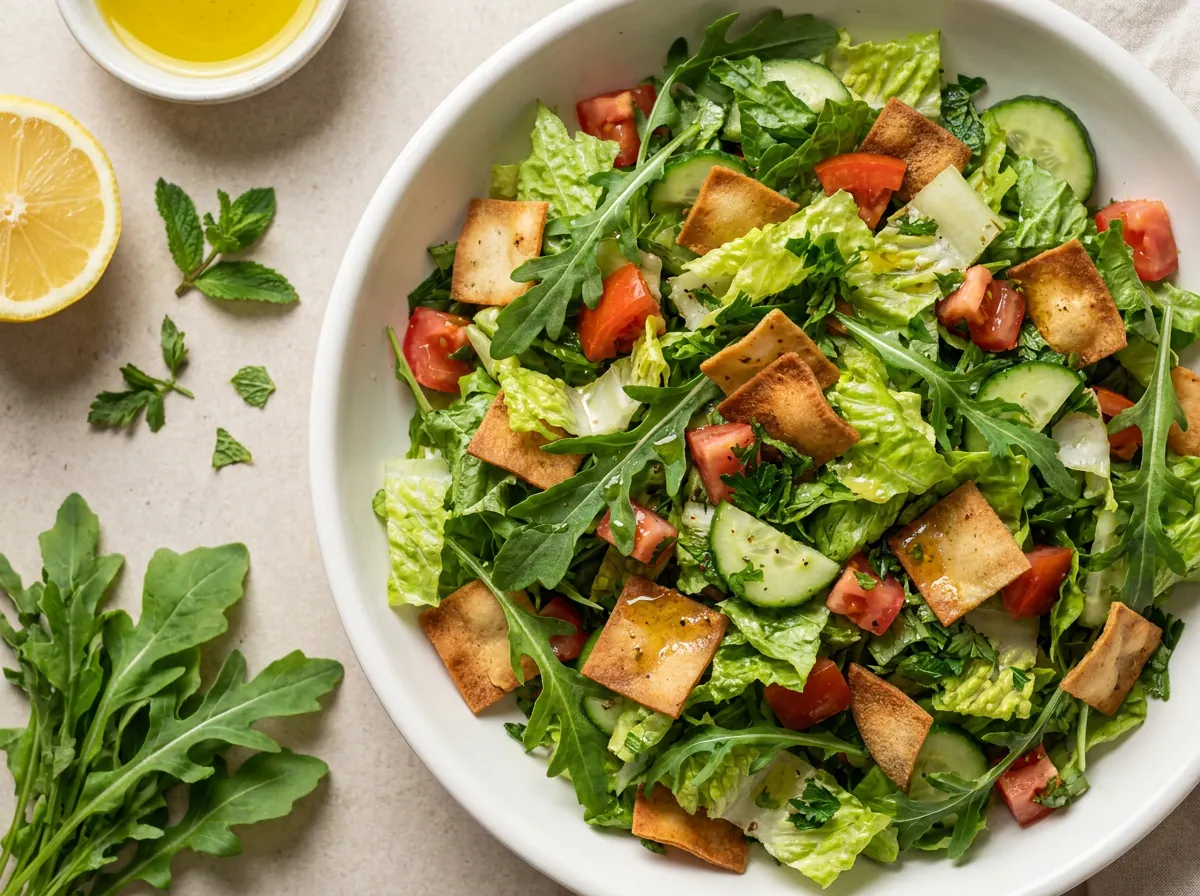
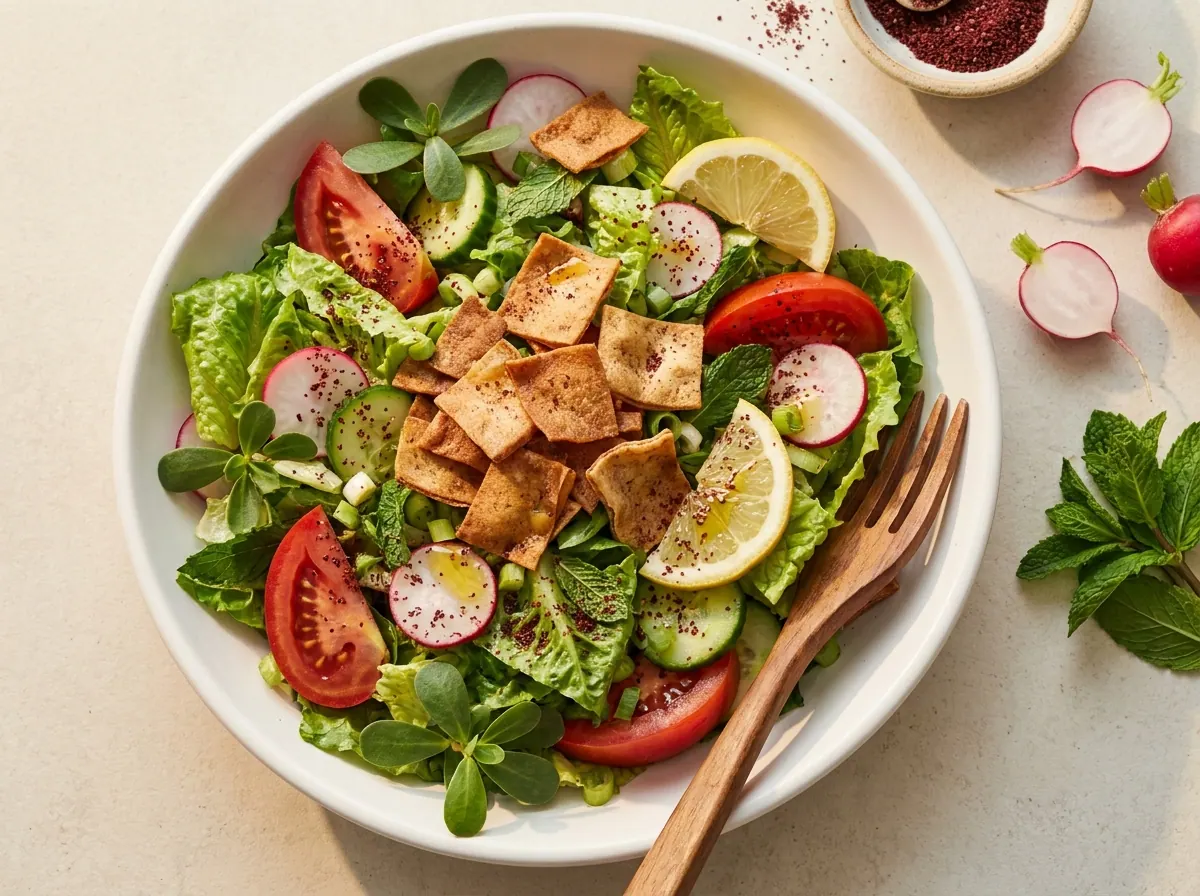
A traditional Saudi salad in an improved version · grilled chicken, toasted barley bread, and fresh vegetables. Low GI (35), high protein, ideal for diabetics and dieters.
Mufattah is a popular Saudi dish based on tannour bread and vegetables. The classic version uses white bread and fatty meat.
Our version uses barley bread and light grilled chicken. The fiber in the barley bread lowers the GI by 40% compared with white. The result: a salad that fills you for 4 hours without raising blood sugar.
Preparation Steps
Toast the bread
Cut the bread into small cubes and toast it in an oven at one hundred eighty degrees for five minutes without oil until it crisps.
Grill the chicken
Season the chicken with salt, pepper, and lemon juice, and grill it for eight minutes then cut it into medium pieces.
Prepare the vegetables
Cut the cucumber and tomatoes into medium pieces, and chop the parsley and mint.
Make the dressing
In a small bowl, whisk the olive oil, lemon juice and zest, and ground dried lime with a pinch of salt and pepper until uniform.
Serve it
Mix all the ingredients except the bread with the dressing, and add the bread just before serving so it stays crisp, and garnish with the pine nuts.
Blood Sugar Impact
The glycemic index (GI) measures how quickly a food raises blood sugar, while the glycemic load (GL) measures how much a full serving raises it. Together they give the complete picture.
Glycemic Index
GI
22Low
Low0–55Medium56–69High70+
A low value (≤55) means a gradual rise in blood sugar — the most suitable range for diabetes and insulin resistance.
Glycemic Load
GL
3Low
Low0–10Medium11–19High20+
Glycemic load reflects the impact of the full serving. To lower it: take half a serving, or pair the recipe with a source of protein and fiber.
Nutritional Information
Per ServingMakes 4 servings · one serving is about 270 g of raw ingredients
Calories259 kcal13%of Daily Value*
Protein16 g32%of Daily Value*
Carbohydrates20 g7%of Daily Value*
Fat14 g18%of Daily Value*
Fiber5 g18%of Daily Value*
Sodium423 mg18%of Daily Value*
* Percent Daily Values are based on a 2,000-calorie diet per FDA food-label reference values — your daily needs may be higher or lower. Values are derived from the recipe's ingredients via the USDA database.
Troubleshooting
The most common problems when preparing Mufattah Salad with Vegetables, and how to fix them:
The bread lost its crispness and turned soft
You added the bread long before serving, so it absorbed the dressing. The toasted bread in mufattah is added only at the moment of serving, after mixing the vegetables with the dressing. For quick meals: keep the toasted bread in a separate dry container, and add it to the plate just before eating.
The vegetables wilted before serving on the table
The vegetables were washed and not dried, or mixed with the salt early. Leafy vegetables are washed then dried with a cotton towel, and the dressing is added only minutes before serving. If advance prep is needed: keep the vegetables dry in a container and the dressing in a cup, and mix them at serving time.
The dressing is flat without an acidic sharpness
The lemon is too little or not fresh. The balanced Saudi dressing: extra virgin olive oil, fresh lemon, salt, and a pinch of ground cumin. Canned lemon loses its aroma within weeks, so the fresh is not replaced when available.
The taste is bland despite the spices
The olive oil used is the refined type (not virgin), so it adds no flavor. Extra virgin olive oil contains polyphenols that give a pungent fruity taste [1]. Always choose it for cold salads, and keep it away from light and heat.
The salad separates and the dressing pools at the bottom
The oil was not mixed well with the acid before pouring. Make the dressing in a small airtight cup: oil, lemon, and spices, shake it well until uniform, then pour it over the vegetables all at once and toss gently.
Storage and Make-Ahead
Refrigerator (4°)
Cut vegetables without dressing: two days in an airtight container on the middle shelf. The salad with dressing: one day only, it loses crispness and the vegetables wilt.
Freezer (-18°)
Not suitable. Leafy vegetables, cucumber, and tomatoes turn into a watery paste after thawing. Mufattah salad is a same-day dish only.
Make ahead
Cutting the vegetables: two hours before serving in the fridge, covered. Toasting the bread: hours or a day ahead, in a dry airtight container. The dressing: an hour ahead in a sealed cup. The final mixing: only five minutes before serving.
Serving
A cold dish that is not heated. Not left out of the fridge more than two hours per the general USDA recommendation for cold foods [2].
Tested Ingredient Substitutions
Original Ingredient
Tested Substitute
Ratio
Flavor Difference
Toasted Levantine bread
Tamees bread or local saj bread
Same amount
A thinner texture, a deeper authentic Saudi wheat flavor
Toasted bread (for gluten-free)
Corn chips toasted with a little oil
Same amount
Similar crunch, neutral flavor
Fresh lemon
White vinegar diluted with water
Each spoon of lemon → a spoon and a half of vinegar with water
A clearer sharpness without the lemon aroma
Ground cumin
Ground coriander and a pinch of black pepper
Same total amount
A less earthy flavor, a different depth
Arugula
Fresh baby spinach
Same amount
Lighter bitterness, a smoother flavor for children
How Much Does It Make? Scaling Guide
Number of servings
Bread
Leafy vegetables
Tomatoes
Lemon
2 (individual × 2)
0.5 flatbread
1 small bunch
1 medium
0.5 lemon
4 (base)
1 flatbread
1 bunch
2
1 lemon
8 (large family)
2 flatbreads
2 bunches
4
2 lemons
12 (entertaining)
3 flatbreads
3 bunches
6
3 lemons
EEINA Nutrition Tip
The smart trick: add the bread just before serving. If you mix it in early, it will absorb the dressing and lose its crispness. This is the difference between a good salad and an excellent one.
Add This Recipe to Your Plan
The EEINA app saves your favorite recipes, calculates them from their real ingredients, and shows your daily numbers toward your goal. Try it free now.